A component-level cost breakdown for junior and beginner rackets — how frame and shaft material, racket weight, grip, stringing, finish and printing each move unit cost, how to compare two racket quotations line by line, and when the rackets inside a set matter more than the net.
Two junior rackets can look identical on a quotation sheet and sit at very different unit costs. The gap is not one line — it is the sum of six decisions made before the racket is boxed: frame and shaft material, finished weight, grip, stringing, surface finish, and printing. This breakdown is written for schools, clubs and retailers sourcing junior or beginner rackets, and it stays at the racket level rather than the whole-set level.
Key takeaways
- A racket quotation is a stack of component decisions, not a single market price.
- Frame and shaft material is usually the largest lever: metal versus composite changes cost, weight and feel together.
- Stringing, grip and finish are comparatively small per unit but sit on the critical path of lead time.
- Compare quotations line by line against one reference specification, or you are comparing two different products.
- In a set, the racket usually carries more of the unit cost than the net — so the rackets are the right place to spend.
Why there is no single racket price
“How much do badminton rackets cost” has no useful single answer, because a racket price is the result of a specification. Change the frame material, the finished weight, whether stringing is included, or how many colours are printed on the shaft, and you have changed the product — not just the number next to it.
For a sourcing team, the practical question is narrower: which decisions in this racket am I paying for, and which of them matter to the players who will use it? A school buying for a PE programme and a retailer buying for a spring promotion will answer that differently, and their quotations should reflect that.
Driver 1: Frame and shaft material — the biggest lever
The single largest cost decision is what the frame and shaft are made from. At the sourcing level this is mostly a choice between metal and composite.
- Metal frames sit at the entry end. Material is widely available and predictable to work with, but finished weight tends to be higher for the same dimensions, and the frame is less tolerant of being flexed hard.
- Composite frames allow a lighter frame and shaft at the same length. The material cost is higher and the forming process is less forgiving, so the unit cost rises — but so does comfort during play, which matters for children and beginners who have not yet developed technique.
As a working example, a junior set racket with a lightweight composite frame and a soft grip at 53 cm length sits in the composite category, not the metal one. That single line, more than any other, will explain most of the difference between two otherwise similar offers.
Driver 2: Finished weight
Weight is not just a number on a spec sheet; it is the outcome of the frame, shaft, grip and stringing choices combined. Rackets built for children are deliberately short — 53 cm in the junior set referenced here, against a full-length adult racket — because a shorter racket at a manageable weight is easier to swing and control.
The commercial point is that weight cannot be negotiated independently. Asking for a lighter racket means changing the frame or shaft material, the grip, or both, and the unit cost moves with those changes.
Driver 3: Grip
Grip is a small line item and usually a small share of unit cost, but it carries two buyer-visible consequences:
- Feel for the player. A soft grip is more comfortable for younger hands and reduces the immediate complaint of “it hurts to hold”. For junior and beginner rackets, that is often the difference between a racket being used and a racket being left in the bag.
- Wear replacement. Schools and clubs should ask whether replacement grips are available separately. Grip failure is the most likely reason a racket is retired early, and an easy replacement path extends the usable life of the whole set.
Driver 4: Stringing — the one driver that hides in the quote
Two quotations can show the same racket and mean different things, because stringing can be handled in three ways:
- Strung at the factory, tension set by the supplier.
- Strung to order, with tension specified by the buyer — usually a different lead-time commitment.
- Unstrung, with the buyer stringing locally — lowest unit cost on the racket line, but the buyer carries the labour.
Factory stringing also changes the packed product: strung rackets are bulkier, so carton dimensions and packing quantities can shift. This is a racket-level decision that quietly becomes a set-level and logistics-level one, so make it explicit in writing rather than assuming it is included.
Driver 5: Finish and printing
Paint finish and printed branding sit at the end of production and are rarely the reason a racket costs more overall — but they are the reason two quotations for the “same” racket differ.
- Number of colours printed is the main variable. Each additional colour is an additional production step.
- Where the print goes matters too: shaft and frame printing is more demanding than a simple butt-cap mark.
- Finish consistency across a run is what school and club buyers notice, because mismatched rackets in one shipment look like a quality problem even when the frames are identical.
If you are sourcing for a school or club, a restrained finish in one or two colours is usually the better trade than a complex print, because budget spent on print is budget not spent on the frame.
Driver 6: Length and sizing
Racket length is a spec decision with a cost consequence. A shorter shaft and frame use less material per unit, which is one reason junior rackets can be priced below full-length adult models at comparable construction. The 53 cm junior racket and its short handle are sized for children, and that sizing should appear in every quotation you compare.
Comparing racket quotations line by line
The fastest way to make two quotations comparable is to demand one reference specification and check each line against it.
| Line to compare | What to ask for | Commercial effect |
|---|---|---|
| Frame and shaft material | Metal or composite, stated explicitly — not “good quality” | Largest single cost lever and the main driver of finished weight |
| Racket length and handle | Overall length in cm; handle type | Sizing fit for the age group; material use per unit |
| Finished weight | Weight of the strung racket, or state whether weight is quoted before stringing | Comfort during play; comparability between offers |
| Grip | Grip material and whether replacements are available separately | Comfort for young players; product lifetime |
| Stringing | Strung or unstrung; if strung, by whom and to what tension | Unit cost, lead time, packing dimensions |
| Finish and printing | Number of printed colours; where print is applied | Small per-unit cost, visible consistency across the run |
| Compliance evidence | Which standard the racket is tested to, and the report reference | Market access for schools and for retail channels that require it |
If one quotation lists strung composite rackets and the other lists unstrung metal rackets, they are not competing on price — they are different products. Fix the specification first, then compare.
When the rackets matter more than the net
Schools and clubs often shop by the set, and it is tempting to compare nets. But in a junior set the racket generally carries more of the unit cost than the net, because the racket involves formed materials, stringing and a grip, while a net is a cut-and-stitched textile item.
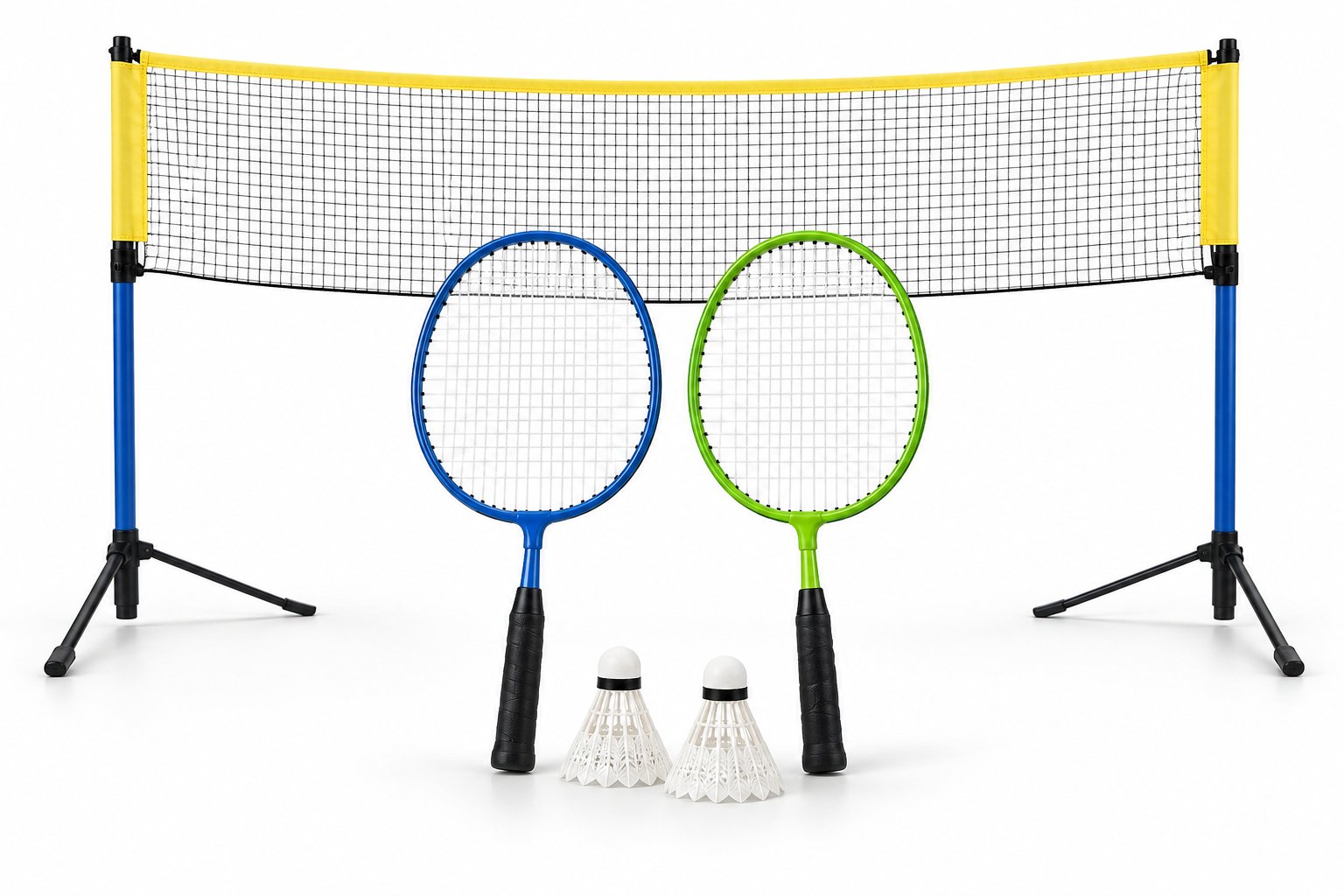
The junior set referenced here illustrates the point: two 53 cm composite rackets with soft grips, 2 shuttlecocks, one 300 x 60 cm nylon net, 4 ground pegs, tool-free assembly, suitable for ages 6+, and compliant with EN71 and ASTM F963, at an MOQ of 500 sets. When you evaluate an offer like this, the rackets are where specification changes will actually be felt by the children using it. A tool-free net is a setup convenience; a better racket is a better session.
Buyer-type priorities
| Buyer | Priority drivers | Usually lower priority |
|---|---|---|
| Schools | Durability of the frame, soft grip, sizing for the age group, compliance documentation | Multi-colour printing, premium finish |
| Clubs | Consistency across the batch, replaceable grips, stringing to a stated tension | Retail packaging detail |
| Retailers | Print and finish quality, packaging consistency, price point per set | Grip replacement programme |
Questions to put to a supplier
- Is the frame metal or composite, and what is the finished weight of the strung racket?
- Is stringing included, and if so, at what tension and under whose specification?
- How many printed colours, and where on the racket?
- Which compliance standard applies to the racket, and can the report reference be provided?
- Are replacement grips available separately?
These five questions will surface most of the difference between two racket quotations without needing a price sheet at all.
Frequently asked
Does a composite frame always cost more than metal?
The material cost is higher and the forming process is less forgiving, so unit cost generally rises. The trade is weight and comfort in play, which is usually the deciding factor for junior and beginner rackets.
Is printing worth paying for on a school racket?
Usually not in large runs. Print is a small per-unit line, but the budget is finite — on a school order, the same spend is better placed in the frame or the grip.
Why do my two quotations differ if both say “junior racket”?
Because the two rackets are almost certainly specified differently — material, length, stringing or print. Fix a reference specification, then request both quotations against it.
For a concrete racket-level reference point, see the Junior Badminton Set with Net, where the racket is a 53 cm composite frame with a soft grip inside a 500-set minimum order. If you are specifying junior or beginner rackets for a school, club or retail programme, send your reference specification and we will quote the racket lines against it.