Buyers, educators, and retailers searching for fidget toys for ADHD or anxiety need clear category guidance, safety checks, and durability factors. This article compares quiet classroom picks, tactile focus tools, and stress-relief options, and outlines what resellers should confirm before stocking wholesale sensory toys.
Wholesale Buyer Guide
Key Takeaways
- Fidget toys for ADHD and anxiety split into three broad groups: quiet classroom tools, tactile focus aids, and stress-relief items.
- Material, size, and build quality decide whether a toy survives daily use in schools, clinics, or retail shelves.
- Safety certification (EN71, ASTM F963) is a baseline requirement for wholesale orders, not a premium add-on.
- Resellers should confirm age grading, small-parts warnings, packaging format, and reorder consistency before committing.
In this article
- What "good for ADHD" means in product terms
- Three fidget categories and who they suit
- Quiet classroom fidgets: low noise, low distraction
- Tactile focus tools: texture and resistance
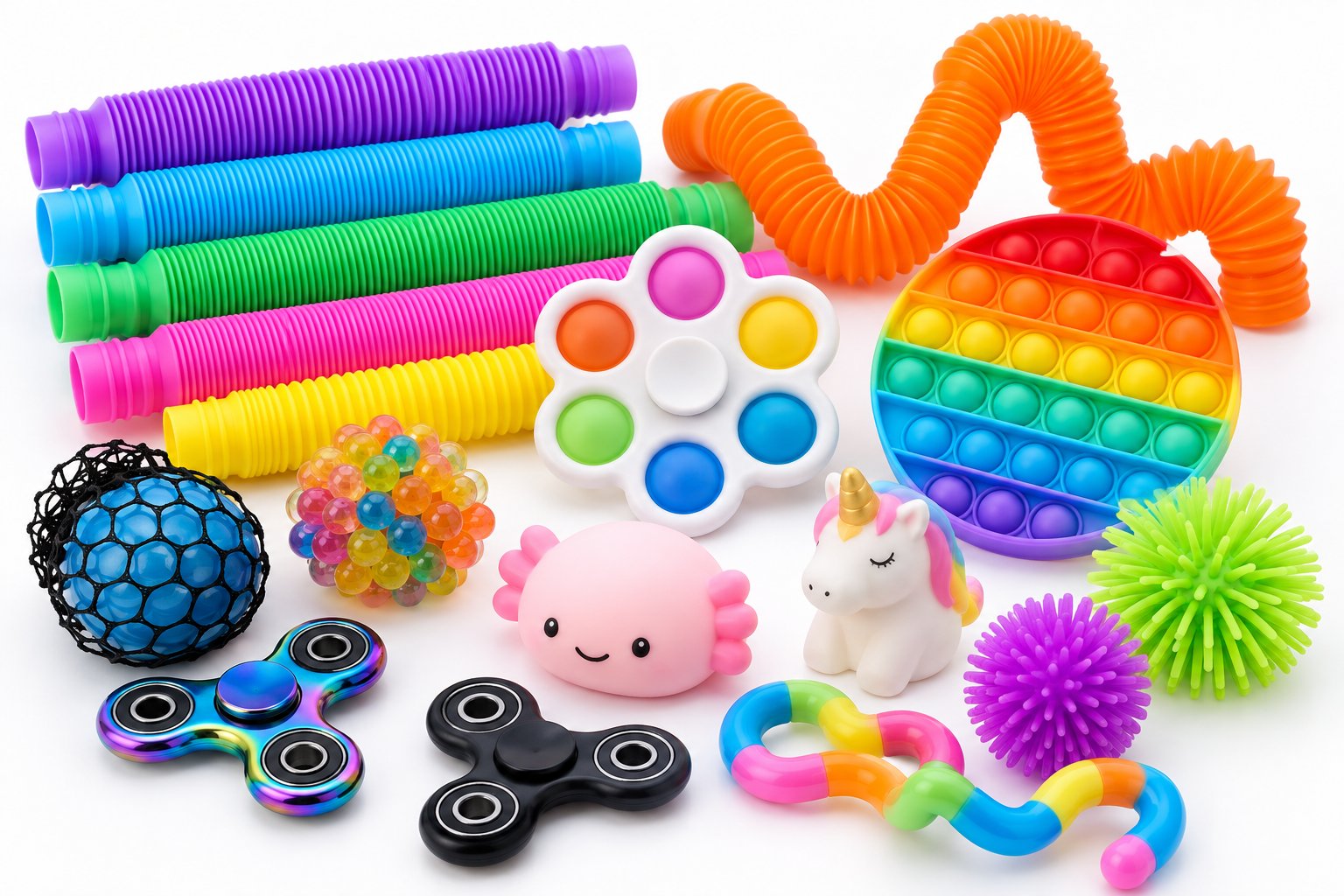
- Stress-relief fidgets: squeeze, stretch, and repeat
- Safety and durability: what to check
- What resellers should confirm before stocking
- FAQ
What "good for ADHD" means in product terms
When a buyer types "what fidget toys are good for ADHD" into a search engine, they are usually not looking for a clinical recommendation. They are choosing stock for a store shelf, a classroom, or a therapy room. The practical question is: which fidget types perform well in the settings where they will actually be used?
"Good" in this context means the toy suits a specific use pattern. A fidget that works on a school desk must be quiet and small. A fidget for a teenager might need a different texture and a less childish look. A fidget for an adult stress-relief buyer might prioritize grip feel and durability. The same product rarely wins on all three fronts, which is why buyers compare categories rather than single items.
No fidget toy should be marketed with medical or therapeutic claims. The categories below describe use patterns and physical characteristics. They do not diagnose, treat, or cure any condition.
Three fidget categories and who they suit
For wholesale planning, fidget toys for ADHD and anxiety broadly fall into three groups. Each has different material, size, and compliance implications.
| Category | Typical form factors | Best suited to | Main buyer concern |
|---|---|---|---|
| Quiet classroom fidgets | Spinner rings, silent cubes, textured pencil grips | Classrooms, libraries, test settings | Noise level, small footprint |
| Tactile focus tools | Textured rollers, beads, marble fidgets | One-to-one focus sessions, sensory rooms | Material safety, surface finish |
| Stress-relief fidgets | Stress balls, stretch toys, squeeze poppers | Retail impulse buys, adult gifting | Elasticity, ink or filler safety |
Quiet classroom fidgets: low noise, low distraction
Classroom fidgets are judged on what they do not do: they should not click, rattle, or roll off the desk. Common options include spinner rings that stay on a finger, silent cubes with soft internal mechanisms, and textured pencil grips that sit on a standard pencil.
For buyers, the useful checks are physical. Measure the assembled product and compare it to a desk surface. Listen to a sample in a quiet room. Check whether the mechanism can be opened by hand, which creates a small-parts risk for younger age groups. A quiet fidget that falls apart after two weeks of classroom use is a returns problem, not a repeat-order product.
Tactile focus tools: texture and resistance
Tactile fidgets rely on texture, weight, and resistance rather than motion. Marble fidgets, textured rollers, and bead-based tools sit in this group. They tend to appeal to older students and adults who prefer a less visually obvious object.
Material choice matters here. Silicone grades differ in softness and tear resistance. ABS and TPR components have different surface feels. If a buyer plans to offer a tactile range, ask the supplier for the material specification per SKU and confirm that the finish does not shed or flake under repeated handling.
Stress-relief fidgets: squeeze, stretch, and repeat
Stress balls, stretch toys, and squeeze poppers are the retail-facing end of the category. They sell on feel and color. They also fail fastest. Gel-filled stress balls can leak; stretch toys can tear at the seam; printed logos can crack.
For this group, durability testing focuses on cycle life. A simple squeeze-and-release check on a sample batch gives a rough indication of seam strength and filler integrity. Buyers should treat these as consumable items with a shorter replacement cycle than classroom fidgets, and plan inventory accordingly.
Safety and durability: what to check
Safety compliance is a hard gate for wholesale sensory toys, especially when the end user may be a child. EN71 (Europe) and ASTM F963 (United States) are the two toy safety standards most often requested by importers and retailers. These cover mechanical and physical properties, flammability, and migration of certain elements.
Certification documents should match the specific product and the specific production batch. A supplier's general capability statement is not a substitute for a test report covering the SKU you are ordering. Ask for the report number, the test date, and the product description on the certificate. Confirm that the age grading on the report matches your intended market and packaging.
Durability checks that buyers can request without a full lab test include:
- Repeated drop tests from desk height for hard plastic parts.
- Abrasion check on painted or printed surfaces to assess flaking.
- Seam and joint inspection on soft or filled items.
- Small-parts cylinder check for products intended for children under three.
- Function cycle count for mechanisms such as spinners and poppers.
These are practical screening steps. They do not replace formal certification, but they help a buyer reject obviously fragile samples before placing an order.
What resellers should confirm before stocking
Before committing to a wholesale order, confirm the following points with the supplier. Each one affects landed cost, returns, or compliance risk.
- Age grading and warnings: Does the product carry the correct age marking and choking hazard warning for your market?
- Certification scope: Which certification applies to this exact SKU, and is the report current?
- Material specification: What material is each component, and can the supplier document it?
- Packaging format: Blister card, poly bag, or retail box, and does the packaging carry required labeling?
- Reorder consistency: Will the color, size, and mechanism be identical across production runs?
- OEM and ODM options: Can the supplier customize color, logo, or packaging, and what is the minimum order for customization?
- Sample lead time and production lead time: Get both in writing before finalizing quantities.
If your catalog includes wholesale sensory toys alongside fidgets, check whether the same compliance documents cover the full sensory range or whether each item needs separate paperwork. Range-wide claims without per-item reports are a common source of customs delays.
FAQ
Are fidget toys safe for children with ADHD?
Safety depends on the specific product, its age grading, and its compliance with toy safety standards such as EN71 or ASTM F963. Buyers should confirm certification for each SKU and check for small parts where young children are the end user. Fidget toys should not be presented as medical devices or treatments.
Which fidget type sells best in schools?
Quiet, low-distraction items such as spinner rings and silent cubes tend to fit classroom rules better than noisy or visually large fidgets. Schools often prioritize noise level, size, and ease of cleaning.
Can I order custom colors and packaging?
OEM and ODM customization is available from many manufacturers, including custom color, logo, and packaging formats. Minimum order quantities and lead times vary by project, so confirm terms with your supplier before planning a launch.
What documents should I request before importing?
Request the toy safety test report covering the exact SKU, the age grading statement, material specifications, and packaging artwork with required warnings. Keep the report number and test date on file for your market's compliance records.
Choosing fidget toys for ADHD or anxiety stock is a category decision, not a single-product decision. Quiet classroom tools, tactile focus aids, and stress-relief items each serve different buyers and carry different durability and compliance profiles.
For wholesale buyers, the reliable path is to compare categories against your end market, request SKU-level safety documentation, and confirm packaging, reorder consistency, and customization terms in writing. If you are sourcing wholesale sensory toys and fidget ranges, discuss your target market and age grading with your supplier before locking in a production run.