A practical guide for retail buyers comparing flying discs, covering material differences, key specifications, safety standards, and supplier evaluation checklists.
A flying disc is a circular, aerodynamic object designed to be thrown and caught in flight. For retail buyers, the term covers a wide range of products — from lightweight foam flying discs sold as impulse items to high-durometer sport discs used in organized play. The specifications and safety considerations differ significantly by category, and choosing the wrong disc for your channel can lead to returns, compliance issues, or poor sell-through.
- Flying disc toys and sport discs are not interchangeable — buyers should match disc type to end-use and age group.
- Material, weight, diameter, rim depth, and flight plate thickness are the core specifications to compare.
- Safety compliance depends on target market; EN 71 and ASTM F963 are common references for toys, but confirm the specific test standard and certificate scope with your supplier.
- Request pre-production samples and test reports before placing bulk orders.
What a Flying Disc Is — and Why the Term Matters for Buyers
A flying disc is any disc-shaped object intended to be thrown through the air and caught. The term "frisbee" is a registered trademark of Wham-O and should not be used generically in product listings or packaging. Using "flying disc" or "flying disc toy" keeps your catalog compliant and avoids trademark issues.
From a sourcing perspective, flying discs fall into two broad categories:
- Flying disc toy: Usually made of soft foam or lightweight plastic, designed for casual play, often marketed to children or for promotional giveaways. These prioritize safety and low cost over flight performance.
- Sport disc: Made from stiffer, higher-density polyethylene or polypropylene, designed for consistent flight characteristics. Used in ultimate, disc golf, and freestyle play. These require tighter manufacturing tolerances.
Confusing the two in your product line can lead to customer dissatisfaction. A buyer looking for a disc golf driver will not accept a soft foam flying disc, and vice versa.
Material Types: Foam, Polyethylene, and Rubber
Material choice drives cost, durability, flight behavior, and safety profile. Most flying disc toys and sport discs fall into three material families.
Foam Flying Disc
A foam flying disc is typically made from expanded polypropylene (EPP) or EVA foam. These are lightweight, soft, and designed for indoor or close-range play. Key advantages include low injury risk, floatability, and low unit cost. However, foam discs are prone to tearing after repeated use, especially at the rim. Buyers should confirm foam density and whether the disc has a solid rim or a hollow core.
Polyethylene (PE) Discs
PE is the most common material for sport discs. It offers a balance of stiffness, grip, and impact resistance. Within PE, you may encounter LDPE (softer, more flexible) and HDPE (stiffer, more durable). Disc golf discs often use blends with different cooling rates to achieve specific flight ratings. For retail buyers, the key specification is the material grade and whether the supplier can provide consistent color and weight across production runs.
Rubber and TPR Discs
Thermoplastic rubber (TPR) discs are flexible and offer good grip, often used for dog toys or discs marketed for outdoor play in wet conditions. Rubber discs tend to be heavier and may not fly as far as PE discs, but they resist cracking in cold weather. Confirm whether the rubber compound is phthalate-free and meets the relevant toy safety standard for your market.
Specifications Buyers Should Compare
When comparing flying disc suppliers, request a specification sheet that covers the following points. These values should be measurable and consistent from sample to bulk order.
| Specification | Why it matters | Typical range to compare |
|---|---|---|
| Diameter | Affects flight distance, hand fit, and age suitability | 18 cm – 28 cm for toys; 21 cm – 24 cm for sport discs |
| Weight | Influences throw stability and wind resistance | 60 g – 180 g depending on type |
| Rim depth and shape | Determines grip and flight curve | Flat, dome, or beveled rim |
| Flight plate thickness | Affects durability and flex | 1.5 mm – 3 mm |
| Material grade | Controls stiffness, UV resistance, and feel | EPP, EVA, LDPE, HDPE, TPR |
| Hardness (Shore A) | Indicates softness for safety and grip | 30A – 70A for foam/rubber |
| Colorfastness | Prevents fading and color transfer | Confirm with supplier test data |
| Tolerance | Ensures consistency across production | ±1 mm diameter; ±5 g weight |
Beyond the table, ask for the following:
- Flight testing data: If the supplier claims specific flight characteristics (e.g., stable, understable), request test conditions such as throw speed, release angle, and distance measured. Without this, flight claims are marketing language.
- UV stability: Discs left outdoors can degrade. Ask whether the material includes UV inhibitors and whether the supplier has accelerated aging data.
- Temperature range: PE discs can become brittle in cold weather. Confirm the recommended operating temperature range.
- Printing and branding: For promotional discs, confirm the print method (pad print, screen print, in-mold) and whether the ink meets toy safety requirements if the disc is marketed to children.
Safety Points and Compliance Considerations
Safety requirements for flying discs depend on the target market, the age group, and whether the product is classified as a toy. The following points are common areas buyers should verify.
Age Grading and Small Parts
Flying discs for children under 3 years old must not present small-part hazards. If the disc includes a detachable component (e.g., a light-up module or a tail), confirm that it passes the small parts cylinder test required by the applicable standard. For discs marketed to ages 3+, labeling should clearly state the age recommendation.
Material Safety
Toy safety standards in major markets restrict heavy metals, phthalates, and certain flame retardants. Ask your supplier for test reports covering the specific materials used in the disc, not just a general company certificate. The report should reference the actual material and the standard tested (e.g., EN 71-3 for migration of certain elements, ASTM F963-17 for toy safety).
Physical Safety
Hard plastic discs can cause injury if thrown at close range. For toys intended for young children, softer materials (foam, TPR) are preferable. If you are sourcing sport discs, include a warning about proper use and supervision in your product listing. Check whether the supplier provides a template warning label or safety sheet.
Packaging and Labeling
Retail-ready packaging should include the product name (use "flying disc" or "flying disc toy," not "frisbee"), age grading, country of origin, and any required warnings. For the EU, the CE mark and the name and address of the manufacturer or importer are mandatory. For the US, CPSIA tracking labels may be required for children's products. Confirm with your supplier who is responsible for labeling compliance.
Supplier Evaluation Checklist
Use this checklist when comparing flying disc suppliers. Each item is designed to surface information that affects your risk and total cost.
- Sample evaluation: Request pre-production samples in the exact material and color you plan to order. Check weight consistency, rim finish, and print quality.
- Material documentation: Ask for the material datasheet, including grade, density, and any additives (UV stabilizers, colorants).
- Test reports: Request test reports from an accredited laboratory for the specific product and target market. Verify the report date and the model number referenced.
- Production capacity and lead time: Confirm monthly output and standard lead time. Ask how the supplier handles peak season demand.
- Quality control process: Ask about in-line inspection and final inspection procedures. What is the AQL level? Are flight tests performed on samples from each batch?
- Packaging options: Confirm whether the supplier offers retail packaging, custom printing, and barcoding. Ask for dieline files and packaging samples.
- Compliance responsibility: Clarify who prepares and pays for test reports, labeling, and any market-specific documentation.
- References: Ask for contact information of other buyers in your region or channel. If the supplier cannot provide references, factor that into your risk assessment.
FAQ for Retail Buyers
- What is the difference between a flying disc and a frisbee?
- "Frisbee" is a trademarked brand name. "Flying disc" is the generic term for any disc designed to be thrown. Using the generic term in your product listings avoids trademark infringement.
- Which material is best for a flying disc toy?
- Foam (EPP or EVA) is common for toys aimed at young children because it is soft and lightweight. For outdoor play and better flight, PE or TPR discs are more durable. The best choice depends on your target age group and use case.
- What safety standard should a flying disc toy meet?
- For the EU, EN 71 is the relevant toy safety standard. For the US, ASTM F963 and CPSIA requirements apply. Confirm the exact standard and test the specific product, not just a similar model.
- How do I verify flight performance claims?
- Ask for flight test data that includes throw speed, release angle, and measured distance. If the supplier cannot provide this, treat flight claims as unverified and test samples yourself.
- Can I order custom colors and branding?
- Many suppliers offer custom colors and printing. Confirm the minimum order quantity, print method, and whether the ink meets toy safety requirements for your target market.
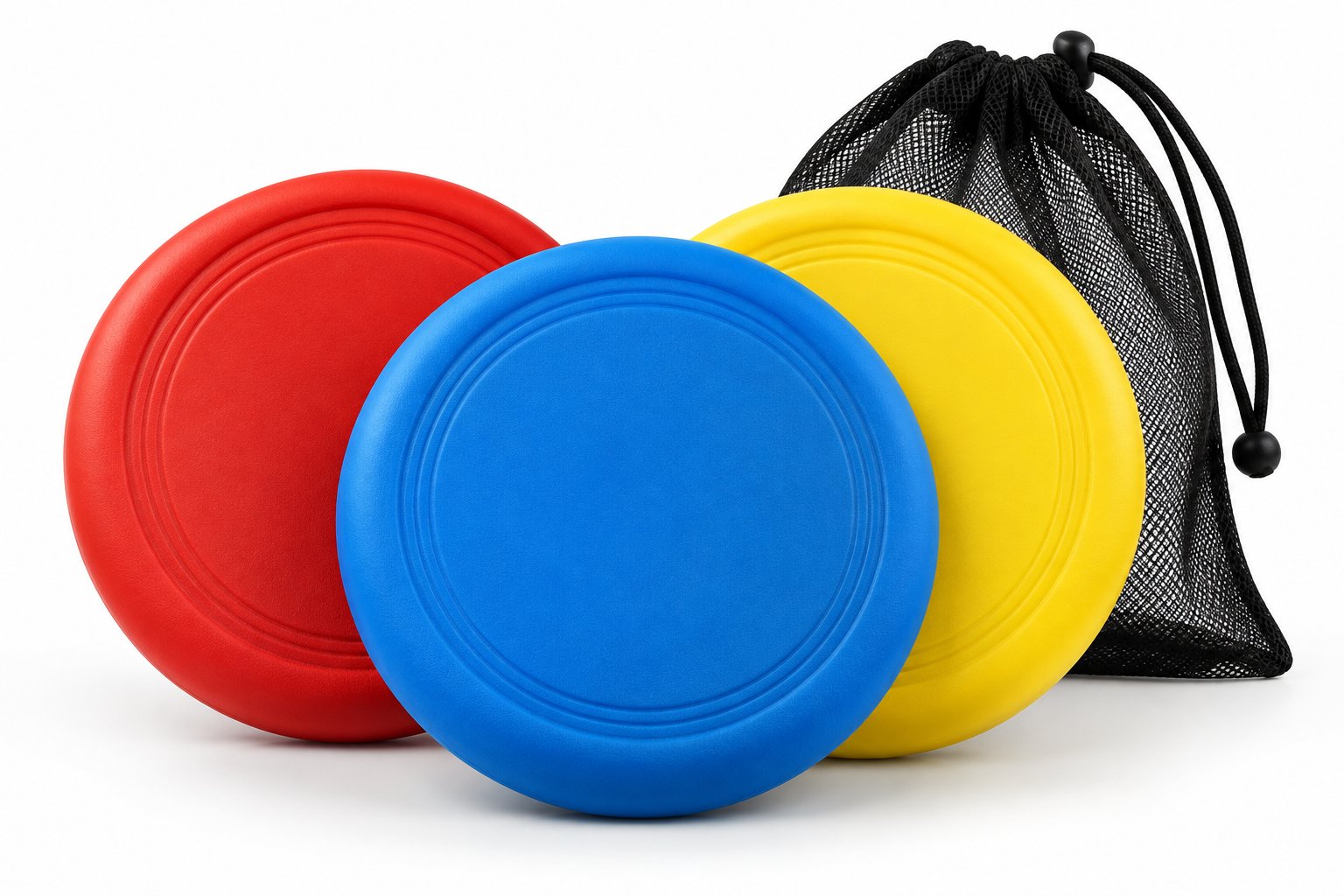
A ready reference for toy-grade configuration: Lequ Toys' soft foam flying disc set with mesh bag ships three discs in soft flexible material with rounded rims and a mesh carry bag for park and beach play.