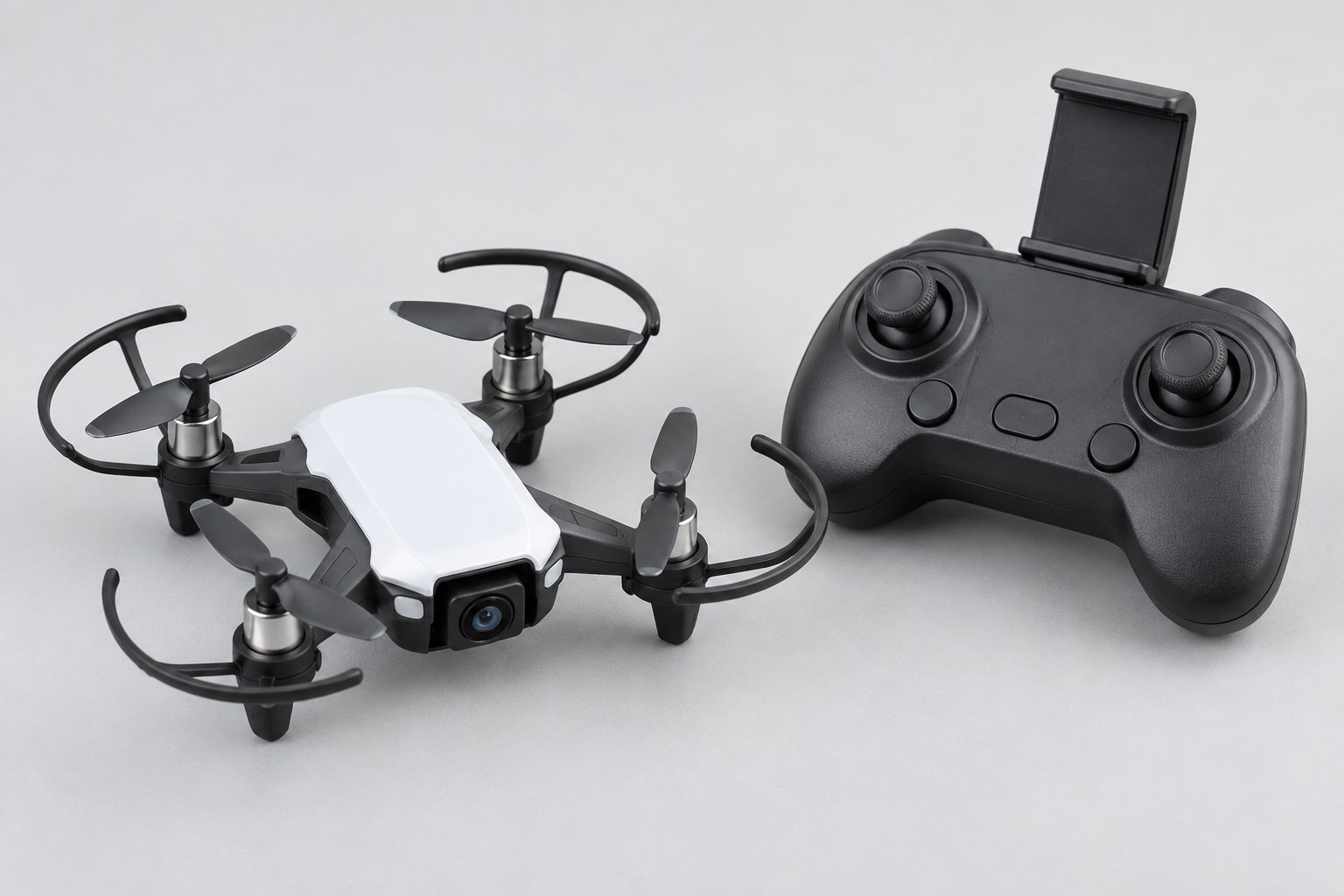
A mini drone is a palm-sized quadcopter typically flown indoors or in tight outdoor spaces. This buyer's guide explains the spec framework that actually matters when comparing toy-grade mini RC drones with cameras: size class, camera resolution, altitude hold, control band, charging method, and age suitability. Includes a spec comparison table and a link to our Mini RC Drone with 720p Camera and Altitude Hold.
A mini drone is a small quadcopter that fits in the palm of your hand, typically flown indoors or in tight outdoor spaces. Most toy-grade mini drones weigh little enough to be flown without registration in many countries, which is a major reason beginners choose them over larger camera drones. If you are comparing models for a first-time flyer — or sourcing toy-grade mini drones for retail — the useful question is not "which one is best" but "which specs actually change the flying experience and the reorder value." This guide gives you a spec comparison framework: size class, camera resolution, altitude hold, control band, charging method, and age suitability.
What this guide covers
- What counts as a mini drone
- Size class and what it determines
- Camera: resolution and what it really means
- Altitude hold and beginner control
- Control band and interference
- Charging method and cycle time
- Age suitability and safety
- Spec comparison table
- FAQ
What Counts as a Mini Drone
There is no single official definition, but the practical one used in retail and wholesale listings covers three things:
- Size: small enough to hold in one palm, with propellers under roughly 3 inches (diagonal motor-to-motor). This is what separates a mini from a standard camera drone.
- Weight: light enough to be treated as a toy in most regulatory frameworks. Many countries exempt drones under 250g from registration, but rules vary — always check the destination market's rules rather than assuming.
- Use case: designed for short-range flight, indoor play, and casual outdoor use rather than long-range aerial photography.
If a listing calls something a mini drone but shows a gimbal, obstacle sensors, or a range measured in kilometers, it is a larger consumer drone, not a mini. That distinction matters when you are buying for a specific age group or a specific retail price band.
Size Class and What It Determines
Size is not just a marketing label. It determines three things buyers care about:
- Where you can fly. Palm-sized minis can be flown in a living room without hitting furniture. Larger ones need a yard or park.
- Wind tolerance. Lighter drones get pushed around outdoors. If the buyer's main use is indoor, this is not a problem; if it is outdoor, it is.
- Shipping cost. Smaller packaging and lower weight reduce freight per unit — relevant if you are importing in volume.
When comparing models, look for the diagonal motor distance or the propeller size. If neither is listed, ask the supplier. A photo next to a hand is not a reliable size reference.
Camera: Resolution and What It Really Means
Mini drones with cameras usually list a resolution figure such as 720p or 1080p. Two things to understand before comparing:
- Sensor vs. interpolation. A true 720p sensor captures 720p natively. Some cheap listings claim 1080p but use software upscaling. Ask the supplier whether the resolution is native or interpolated.
- Frame rate matters as much as resolution. A 720p camera at a higher frame rate often looks smoother than a 1080p camera at a low frame rate, especially for fast movement.
For a toy-grade mini drone aimed at beginners or children, 720p is a practical baseline — it is enough to capture recognizable photos and video without the cost and weight of a higher-resolution module. Our Mini RC Drone with 720p Camera and Altitude Hold uses a 720p camera, which is a reasonable specification for a first drone or a gift item.
Altitude Hold and Beginner Control
Altitude hold is a feature that keeps the drone at a consistent height when you release the throttle. For a beginner, this is the single most useful control feature because it removes the hardest part of learning to fly: constantly adjusting throttle to maintain height.
- Without altitude hold: the flyer must continuously manage throttle. More crashes, steeper learning curve.
- With altitude hold: the flyer focuses on direction and turning. Photos and video are steadier because height is stable.
If you are sourcing for the beginner or gift market, altitude hold is a strong differentiator. It is also a feature that shows up in buyer questions, so listing it clearly in the product title and description helps conversion.
Control Band and Interference
Mini drones use either 2.4 GHz radio or Wi-Fi control (usually via a phone app). Each has trade-offs:
- 2.4 GHz radio with a dedicated transmitter: more reliable, lower latency, no phone needed. Better for younger users who do not have a smartphone.
- Wi-Fi / app control: allows phone-based flight and video preview, but can suffer latency and interference in crowded Wi-Fi environments.
For toy-grade retail, 2.4 GHz radio is the more robust choice. Confirm the control band with the supplier if the listing does not state it.
Charging Method and Cycle Time
Charging is an underrated spec. Two common methods:
- USB charging cable — simple, low cost, works with any USB port.
- Charging dock or spare battery bundle — faster cycle time, lets the user keep flying.
Ask the supplier for the nominal charge time and whether spare batteries are available. A drone with a long charge time and no spare battery is frustrating for a child; that feedback comes back as returns. Do not assume a charge time from the battery size — confirm it.
Age Suitability and Safety
Toy-grade mini drones usually carry an age recommendation, commonly 8+ or 14+, depending on the market's toy safety rules. When comparing:
- Check the age label against the destination market's requirements.
- Look for propeller guards. Open propellers are a safety concern for younger children.
- Confirm battery handling. Lithium batteries require proper shipping documentation; ask the supplier what documentation they provide.
Age suitability is a compliance question as much as a marketing one. If a supplier cannot state the age grade or battery documentation, treat that as a gap.
Spec Comparison Table
| Spec | What to compare | Why it matters |
|---|---|---|
| Size class | Diagonal motor distance, propeller size | Determines indoor vs. outdoor use and shipping cost |
| Camera | Native resolution, frame rate, interpolation | 720p native is a practical toy-grade baseline |
| Altitude hold | Yes / no | Removes the hardest beginner control task |
| Control band | 2.4 GHz radio or Wi-Fi/app | Radio is more reliable; app adds phone dependency |
| Charging | Charge time, spare battery availability | Affects usability and return rate |
| Age suitability | Age grade, propeller guards, battery docs | Compliance and safety |
How the Specs Fit Together
No single spec makes a good mini drone. A 720p camera is only useful if altitude hold keeps the shot steady. A small size is only an advantage if the control band is reliable enough for indoor flight. When you compare models, score them against the buyer's actual use case — a gift for a child indoors weights altitude hold and propeller guards highly; a retail impulse item weights packaging and price band.
If you also source other RC and electronic toys, the same comparison discipline applies. Our 4-Channel RC Stunt Car with 360-Degree Spin and RC Walking Robot with LED Lights are examples of related categories where control band and charging method are equally relevant to the buying decision.
FAQ
- Do mini drones need to be registered?
- It depends on the country and the drone's weight. Many markets exempt drones under 250g, but rules change. Check the destination market's current regulations rather than assuming an exemption applies.
- Is 720p good enough for a mini drone camera?
- For toy-grade use, yes. 720p captures recognizable photos and video without the cost and weight of a higher-resolution module. Confirm whether the resolution is native or interpolated.
- What does altitude hold actually do?
- It keeps the drone at a steady height when the throttle is released, so the beginner can focus on direction and turning instead of constantly adjusting height.
- Should I choose 2.4 GHz radio or Wi-Fi control?
- 2.4 GHz radio with a dedicated transmitter is generally more reliable and does not require a phone. Wi-Fi app control allows phone-based video preview but can suffer latency.
- What should I ask a supplier before ordering mini drones?
- Ask for: native camera resolution, altitude hold confirmation, control band, nominal charge time, spare battery availability, age grade, and battery shipping documentation.
Comparing mini drones for your next order?
Our Mini RC Drone with 720p Camera and Altitude Hold is built for the beginner and gift market. See the full specification on the product page, or send us your target market and age grade and we will help you narrow the options.
Specifications referenced in this guide are limited to what is stated on the linked product page. For dimensions, flight time, control range, battery details, and market-specific compliance, confirm with the supplier before ordering.