A number puzzle is a hands-on learning toy that pairs numerals with countable objects. This article defines the category, compares the main types buyers see in RFQs — including wooden number puzzle boards and counting peg puzzles — and lists the checks an importer should run before placing an order: age grading, slot fit, peg count, coating, edge finishing, compliance, and packaging math. It is written for buyers sourcing preschool educational toys.
A number puzzle is a learning toy that pairs a printed numeral with an equal, countable set of physical pieces. The buyer's real question is not what it looks like, but which construction type suits the target age, how the pieces are held and counted, and what to verify on a pre-production sample before committing to an order.
Key takeaways
- A number puzzle combines numeral recognition with one-to-one counting; both halves must work together.
- Main types differ by how pieces are held: flat inset boards, peg-and-hole boards, chunky jigsaw numbers, and magnetic or felt variants.
- Age grading, slot fit, peg count, coating, edge finishing, compliance documents, and carton math are the checks that decide a reorder.
- Ask for a physical pre-production sample and inspect it against the approved drawing, not against a photo.
What a number puzzle actually is
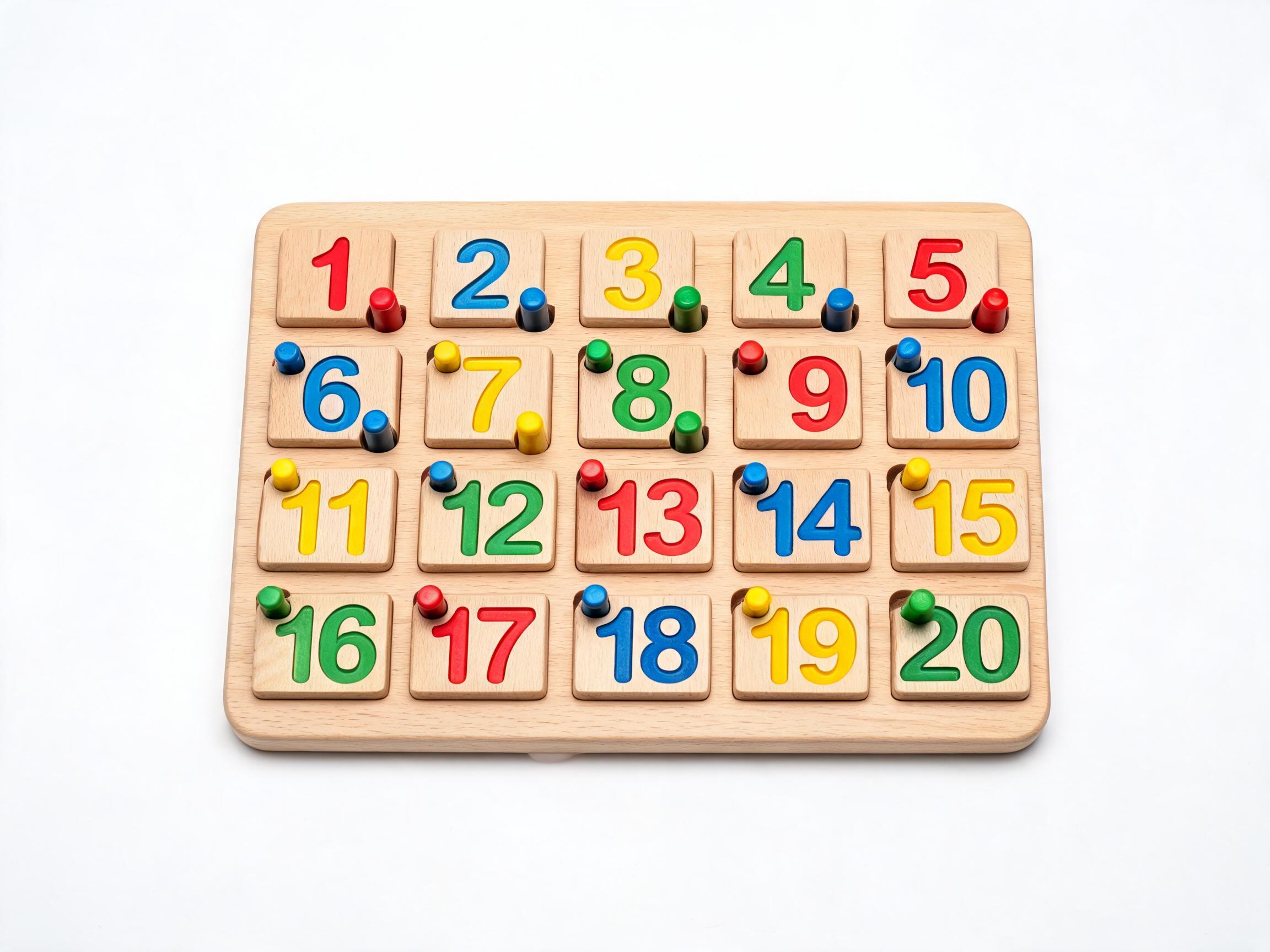
A number puzzle is a manipulative toy in which a child matches a numeral to a quantity. The numeral may be printed on a removable piece or on the base board; the quantity is represented by removable pegs, discs, rings, or printed dots. The learning sequence is recognition, then counting, then matching the two.
This dual structure separates a number puzzle from a plain shape sorter or alphabet puzzle. A shape sorter teaches form matching; a number puzzle adds cardinality — the idea that the symbol "3" and three separate objects refer to the same amount. For a buyer, that distinction matters because it determines the piece count, the printing accuracy, and the inspection points.
Types of number puzzles and how they compare
Most preschool number puzzles on the market fall into four construction types. They are not ranked here; each suits different age bands and price points.
| Type | How pieces are held | Typical strength | Buyer watch-out |
|---|---|---|---|
| Flat inset board (chunky numbers) | Number pieces drop into recessed slots; no separate counters | Simple tooling, low piece count, easy to wipe clean | Slot tolerance — too loose and pieces fall out in transit; too tight and a child cannot lift them |
| Peg-and-slot counting board | Number blocks sit in slots; each slot has holes for a matching number of pegs | Teaches numeral and quantity together; strong repeat play | Peg count per row must match the printed numeral; small pegs need a documented choke-test position |
| Interlocking number puzzle | Numbers join edge-to-edge or into a frame | Encourages sequencing 1–10 and fine motor control | Interlocking joints wear differently across wood species; check repeated assembly |
| Magnetic or felt number set | Numbers adhere to a board or mat | Light, packable, good for travel SKUs | Magnet retention and felt fibre shedding under repeated handling |
Wood remains the dominant material for the inset and peg types because it holds a routed slot cleanly and gives the piece enough weight for small hands to grip. The peg-and-slot format is the one that most directly ties a digit to a countable object, which is why it appears frequently in preschool catalogues.
A worked example: peg-and-slot board
To make the checks concrete, here is the specification of our wooden number puzzle board, which is the peg-and-slot type:
- Solid wood base with a water-based, non-toxic coating
- 20 number blocks set into routed slots
- Each slot has holes for a corresponding number of counting pegs, so the numeral and the quantity are paired in the same row
- Rounded and sanded edges
- Suitable for ages 3 and up
- Board size 30 × 22 × 1.8 cm
- MOQ 500 sets, packed 40 sets per carton
- Shrink-wrapped pieces in an export carton
- EN71 and ASTM F963 compliant
- OEM/ODM available
For a buyer, the important part is the relationship between the 20 blocks, the slots, and the peg holes. Twenty blocks across a 30 × 22 cm board means the slot pitch is tight; a variation in block thickness of even a fraction of a millimetre shows up as a loose or stuck piece. That is why the pre-production sample, not the catalogue photo, is the document that matters.
What to check before ordering
Run the following checks on the first physical sample, and record the result so the same points can be re-checked on the production inspection.
- Slot fit and lift-out. Each block should sit flush without rattling, and lift out with a child-sized fingertip without tools. Test the tightest and loosest slot, not the average one.
- Numeral and quantity match. Count the peg holes in every row against the printed numeral. A mis-drilled row is a functional defect, not a cosmetic one.
- Peg diameter and length. Confirm the peg fits the hole with light friction and cannot be swallowed by the target age group. Ask for the choke-test position to be documented in the inspection report.
- Coating and finish. The specification here is a water-based, non-toxic coating. Confirm on the sample that the coating is even, does not bridge the routed slots, and has no odour after unpacking.
- Edge and corner finishing. Rounded and sanded edges should be verified by touch across every exposed edge, including the underside and the slot rims.
- Printing durability. Rub the printed numeral with a damp cloth and check for ink transfer or fading; the print must survive normal cleaning.
- Compliance documents. Request the EN71 and ASTM F963 test reports for the exact product and finish. Confirm the report covers the model you are ordering, not a sister SKU.
- Packaging and carton math. With 40 sets per carton, confirm the carton dimensions, gross weight, and whether shrink-wrap is per set or per piece. This drives your landed-cost calculation.
- MOQ and customisation. The MOQ here is 500 sets. If you need printed numerals, a custom board size, or your own retail box, raise it at quotation stage — OEM/ODM is available, but the artwork and tooling lead time should be agreed in writing.
Age grading and safety framing
The specification for this board states ages 3 and up. That grading is not a marketing label; it drives how the peg size, piece count, and warning text are engineered. If your target market is younger, the peg dimensions and the required test protocol change, and the product would need to be re-specified — not simply re-labelled.
For the same reason, keep the compliance question specific. A supplier's factory system certificate does not certify a product; ask for the product-level EN71 and ASTM F963 reports that name the item and its coating. Our own facility operates under ISO 9001 with 6 production lines, a monthly capacity of 1.2 million pieces, and 180 staff serving North American and European buyers — useful context when you assess capacity, but the product report is a separate document.
Frequently asked questions
- Is a number puzzle the same as a counting peg puzzle?
- They overlap. A counting peg puzzle is a number puzzle in which the count is represented by pegs rather than printed dots. Both teach numeral-to-quantity matching; the peg version adds a physical counting action.
- What age is a wooden number puzzle board suitable for?
- This board is specified for ages 3 and up. Any change to that grading should trigger a review of peg size, warning text, and the applicable test protocol.
- What is the MOQ and how is it packed?
- MOQ is 500 sets, packed 40 sets per carton. Shrink-wrap is used for protection, and OEM/ODM options are available if you need custom printing or packaging.
- Which compliance reports should I request?
- Ask for the EN71 and ASTM F963 reports that specifically cover the ordered model and its coating, and confirm the report references match the SKU on your purchase order.
- Can the board be customised?
- OEM/ODM is available. Custom numerals, board size, or retail packaging should be defined at quotation stage so that artwork and tooling lead times are agreed before the order is placed.
Sourcing a number puzzle for your 2026 range?
Send us your target age, piece count, compliance market, and packaging format. We will confirm the specification, sample lead time, and carton details against your requirement.
Request product details