A plush backpack combines a soft toy and a functional bag. This guide defines the category, explains which ages it suits, and lists the four points buyers evaluate most: closure, strap attachment, detachable small parts, and cleaning. A published Plush Animal Backpack is used as a concrete reference.
Category explainer
A plush backpack is a soft toy and a small bag made as one object. The body is sewn from plush fabric, usually shaped as an animal or character, and it carries a real compartment with a closure plus straps a child wears over the shoulders. That double role is why the category sits between the toy aisle and the bag aisle, and why buyers judge it on both toy safety and bag construction.
This article defines the category, explains which ages it fits, and walks through the four points buyers examine in a sample: how the bag closes, how the straps attach, whether small parts could detach, and how it cleans. A published Plush Animal Backpack is used throughout as a concrete reference. The search term "what is a plush backpack" and the related "what is plush bag" are real Google question queries found through autocomplete suggestions; no verifiable search-volume data is available for either, so none is quoted here.
What Counts as a Plush Backpack
The category has three defining traits. Remove any one and you have a toy or a bag, but not a plush backpack.
- A plush outer body. The visible surface is short-pile or longer-pile plush, not woven fabric, mesh, or coated material. On the reference product the shell is short-pile plush with a polyester lining.
- A working compartment. There is a main pocket that opens and closes, sized for a child's small items. The reference item uses a zip main compartment and measures 28 x 24 x 10 cm.
- Wearable straps. Shoulder straps let a child carry it hands-free. On the reference item the shoulder straps are adjustable.
The related term "plush bag" is broader. It can describe a plush pouch, a drawstring toy bag, or a handbag-style plush tote. A plush backpack is the subset with two shoulder straps and a back panel a child wears against the body.
Who a Plush Backpack Suits
Two user groups drive most of the demand, and they pull the design in slightly different directions.
Nursery and preschool age
For younger children the object functions first as a comfort toy and second as a bag. It hangs on a hook, sits on a bed, or travels to nursery holding a spare set of clothes or a snack. Buyers in this segment care most about soft edges, no loose small parts, and easy surface cleaning. The reference product is marked age 3+ and keeps its features embroidered with no detachable small parts.
Day-trip age
For children around early school age the bag side matters more. It needs to hold a water bottle, a notebook, or a few collected stones on a day out, which puts weight on the straps and the zip. Buyers here look at strap anchoring, stitching reinforcement, and whether the compartment is deep enough for the intended contents. The reference bag's 10 cm depth and adjustable straps are the relevant figures to compare against a real packing list.
The Four Features Buyers Evaluate
These four checks separate a plush backpack that survives a season of use from one that fails at the seam or the zip.
How the bag closes
The closure determines how quickly a child can open the bag and how well contents stay inside. Zips, hook-and-loop strips, drawstrings, and snap flaps all appear in the category, and each sets a different expectation for small hands. A zip keeps contents contained and is the closure used on the reference product's main compartment. When comparing samples, open and close the fastener several times and check whether the pull is large enough for the target age to grip.
How the straps attach
Straps take the load, so their attachment is the highest-stress point on the whole bag. Look at where each strap meets the body and whether that joint is bar-tacked or reinforced with extra stitching. The reference product uses reinforced stitching at the strap anchors, which is the detail to ask about in any sample. Also confirm the straps adjust, since a fixed length limits the age range that can wear the bag comfortably.
Whether small parts could detach
Loose eyes, noses, buttons, or glued-on decorations can come off in a child's hands and become a choking risk. This is the check that most often decides whether the item can be sold in a given market. Embroidered features remove the problem at the source; the reference product uses embroidered features with no detachable small parts. For any sample that does use attached parts, buyers should confirm what testing was performed and on which version of the item.
How it cleans
Plush collects crumbs, spills, and outdoor grime, and the cleaning method should match how the bag will be used. Surface washing, spot cleaning, and full machine washing each require different construction, so the care instruction and the build need to agree. Buyers should take the stated cleaning method and check it against the materials in the sample, then pass the same instruction on to retail customers.
Reference Specs at a Glance
The table below summarises the published Plush Animal Backpack for Kids, so buyers can compare a candidate specification against a known example.
| Item | Detail |
|---|---|
| Shell | Short-pile plush, polyester lining |
| Main compartment | Zip closure |
| Straps | Adjustable shoulder straps, reinforced stitching at strap anchors |
| Features | Embroidered, no detachable small parts |
| Size | 28 x 24 x 10 cm |
| Age marking | 3+ |
| Compliance | EN71 / ASTM F963 |
| Packing | 40 pieces per carton |
| MOQ | 1,000 pcs |
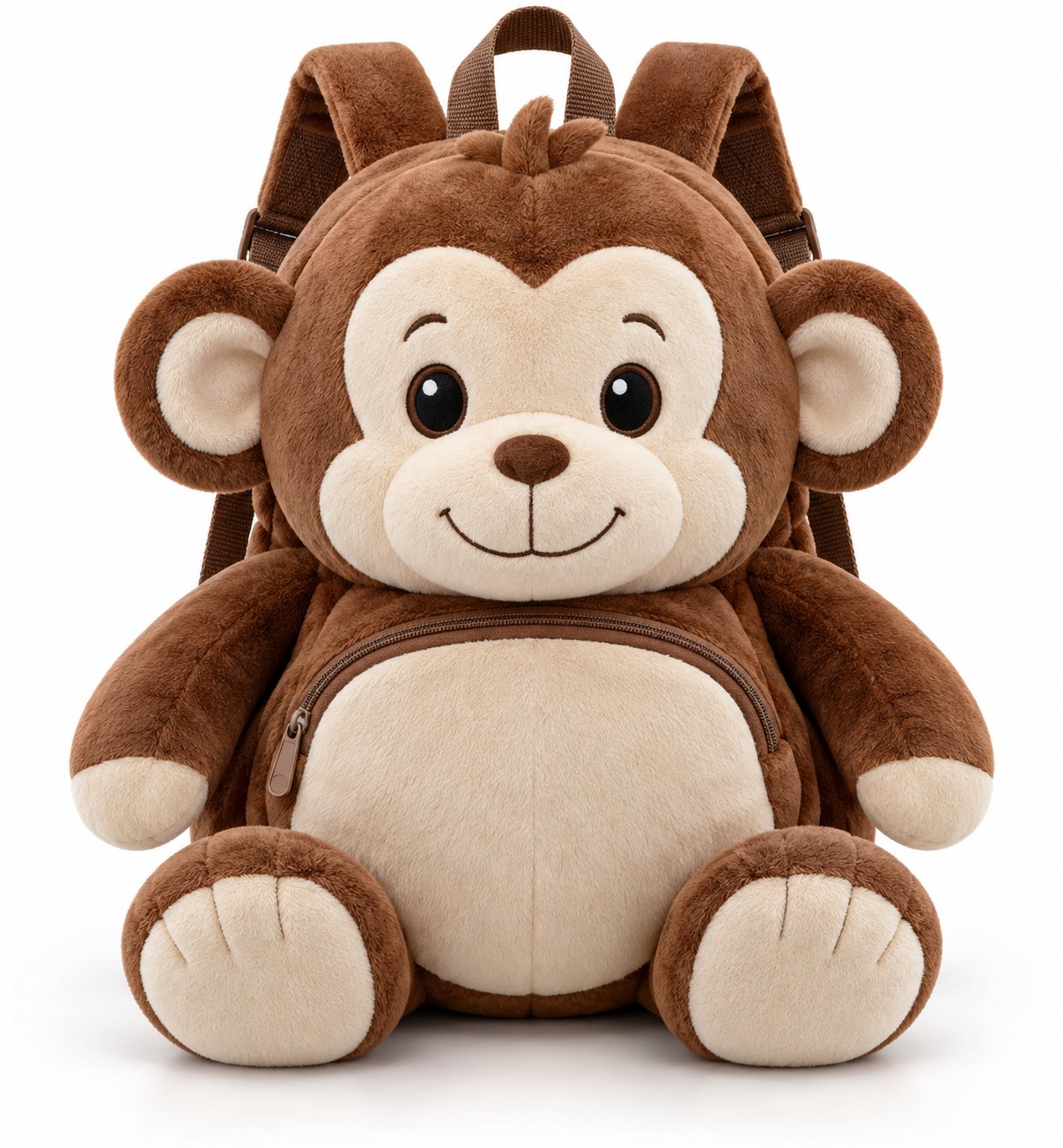
The published photo shows a brown-cream plush monkey backpack against a white background. The shoulder straps are visible at the back, and the zip pocket sits on the front of the body, which is how the main compartment opens. Buyers comparing suppliers can use the same view to check strap anchoring and zip placement at a glance.
How to Use These Checks in a Sample Review
The four checks are most useful when applied in a fixed order, because a failure early in the list makes later checks less relevant.
- Open and close the closure ten times and note whether the pull suits the target age.
- Pull gently on each strap at the anchor and inspect the stitching there for reinforcement.
- Inspect every attached decoration and confirm whether it is embroidered, sewn, or glued.
- Read the care instruction and check it against the lining and shell in front of you.
Two questions usually remain open until the supplier confirms them: the exact cleaning instruction shipped with the goods, and the test report that applies to the specific production version. Both are worth putting in writing before a purchase order, because they travel with the item into retail.
Key Takeaways
- A plush backpack is a soft toy and a functional bag in one object: plush body, working compartment, wearable straps.
- It suits nursery and preschool children as a comfort toy, and day-trip-age children as a light carry bag.
- Buyers evaluate four things: closure type, strap attachment, detachable small parts, and cleaning method.
- The reference Plush Animal Backpack gives a fixed point to compare against: short-pile plush with polyester lining, zip main compartment, adjustable straps, reinforced stitching at strap anchors, embroidered features, 28 x 24 x 10 cm, 40 pcs per carton, MOQ 1,000 pcs, EN71 / ASTM F963, age 3+.
FAQ
Is a plush backpack a toy or a bag?
It is both. The plush body makes it a soft toy, while the compartment and straps make it a usable bag. Buyers should evaluate it against toy safety requirements and bag construction at the same time.
What age is a plush backpack for?
The reference product is marked age 3+. Younger children use it mainly as a comfort toy, and older children use it as a light day bag. The strap adjustment range is the practical limit on which ages can wear it.
What should I check first in a sample?
Start with the closure and the strap anchors, since those are the two points that take the most handling. Then check for detachable small parts and confirm the cleaning method.
What compliance information is available for the reference product?
The published Plush Animal Backpack is listed as EN71 / ASTM F963 compliant. Buyers should request the test report that applies to the specific production version before ordering.
Request the Plush Animal Backpack Details
Share your target age group, order quantity, and market so we can confirm the matching specification.
View the Plush Animal Backpack