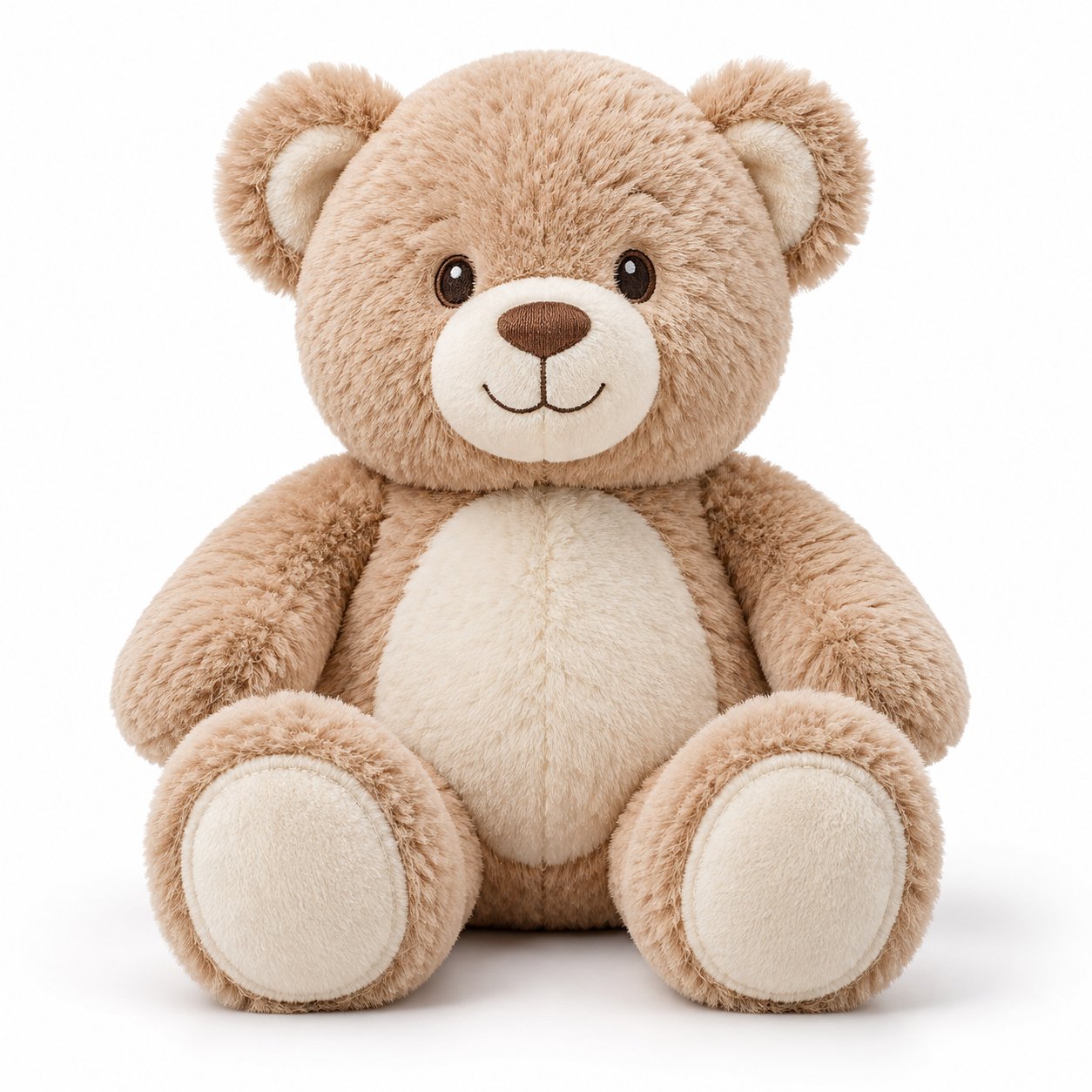
A procurement-focused guide to plush teddy bears for infant and toddler product lines. Covers comfort toy design, hypoallergenic teddy bear materials, safety standards, and the questions to ask suppliers before you place an order.
Plush Sourcing Guide
If you are sourcing a plush teddy bear for a nursery, gift, or baby-line catalog, the phrase hides a lot of variation. Two bears that look identical on a sample table can differ in fiber content, filler, stitching, and the tests they pass. For an infant-safe product, those differences decide whether a shipment clears customs and safety review or gets pulled. This guide breaks down what a plush teddy bear actually is, which features matter for infants, and what to confirm with a supplier before you commit to a purchase order.
What a plush teddy bear is
A plush teddy bear is a soft-bodied stuffed toy modeled on a bear, with an outer shell of pile fabric and an inner fill. "Plush" describes the fabric surface, not a brand or a single material. The category covers everything from a 20 cm crib toy to a 90 cm display bear, and the construction choice drives both cost and safety profile.
The main components are consistent across suppliers:
- Outer shell: knitted plush, woven velboa, short-pile fleece, or recycled-polyester pile. Pile height affects feel and swallowing risk during fiber-shedding tests.
- Fill: polyester fiberfill (most common), sometimes with a foam or pellet insert for shape. Fill density determines whether the bear stands or slumps.
- Facial features and trims: embroidered eyes and nose, or plastic eyes and a sewn nose. Thread, ribbon, and any attached accessories.
- Internal joints: none for infant-oriented bears; plastic or metal joints belong to collectible/adult lines and are a hazard for children under three.
The comfort toy role for infants
A plush teddy bear comfort toy is bought for a different purpose than a decorative bear. Parents use it for sleep association, stroller attachment, and tactile exploration. That changes the design brief: the toy has to survive washing, hold no small parts, and feel soft against skin.
For a buyer, the practical implications are:
- Washability. Surface-wash only limits repeat use. Machine-washable construction needs colorfast fabric, secure embroidery, and fill that does not clump.
- Size discipline. Very small bears can present a choking or suffocation concern in a crib; very large ones are hard for an infant to hold. Buyers should define a target size range and confirm it against the market's safety rules.
- No detachable parts. Bows, ribbon loops, and plastic accessories are the usual cause of a failed pull test.
- Colorfastness. Infant contact plus saliva and washing means dye transfer matters. Ask for the test method and result rather than an assurance.
Infant-safe design features to specify
"Infant-safe" is not a self-declared label. It is the result of construction choices plus testing against the rules of the destination market. The features below are the ones buyers usually need to lock down in the spec.
| Feature | Infant-oriented construction | Why it matters |
|---|---|---|
| Eyes | Embroidered, no plastic button eyes | Removes a small-part pull-off risk |
| Nose | Stitched or embroidered | Same as above; no glued parts |
| Joints | None, or soft sewn-only limbs | Avoids hard points and pinch risk |
| Trims | No ribbon, no detachable bow | Passes torque/tension expectations more reliably |
| Seams | Reinforced, double-stitched at stress points | Reduces fill leakage and seam burst |
| Fill | Clean polyester fiberfill, no loose beads | Bead fill is a choking hazard if the seam fails |
| Surface | Short-pile, low-shed fabric | Limits fiber ingestion and lint |
Age grading is a separate decision. A bear marketed for "0+" carries stricter expectations than one sold as a collectible for adults. If the same factory makes both, ask how the lines are separated on the floor.
Hypoallergenic teddy bear materials
"Hypoallergenic" is used loosely in retail. For procurement purposes, treat it as a claim that must be supported by material choice and, where the market requires it, test documentation. A hypoallergenic teddy bear in practice means the shell and fill minimize the common irritants: dust mite accumulation, residual dyes, and chemical finishes.
What buyers can actually specify:
- Fiber. Virgin or recycled polyester pile, or cotton blends. The fiber type matters less than whether the fabric is finished with restricted substances.
- Dyes and finishes. Ask about azo dyes, formaldehyde, and heavy metals; these are the typical restricted-substance categories in toy chemical tests.
- Filler purity. Ask for the fill's recycled-content or contaminant statement if the fill is reprocessed material. Reprocessed fill is common and acceptable when documented.
- Storage and packing. A bear that sits in a humid warehouse before shipping can develop a musty odor. Poly-bagging and desiccant choices affect arrival condition.
Do not accept "hypoallergenic" as a printed marketing word. Ask which test, which lab, which report number, and whether the report covers the specific production batch. Certification scope is one of the most frequent places a shipment fails review.
Shell and fill comparison for infant lines
| Option | Feel and durability | Best suited to | Watch point |
|---|---|---|---|
| Short-pile knitted plush | Soft, low shed | 0+ comfort toys | Piling after many washes |
| Velboa | Denser, holds shape | Larger bears, mid-price | Can feel warm and less cuddly |
| Recycled polyester pile | Comparable to virgin pile | Buyers with sustainability briefs | Needs documentation for the claim |
| Polyester fiberfill | Light, resilient | Most plush lines | Clumping if fill is low grade |
| Bead or pellet fill | Weighted, sits upright | Adult or display bears | Not for infant products |
Sample procurement spec sheet
Buyers get faster, more comparable quotes when the RFQ states the items below instead of sending a photo. Values here are placeholders to show structure; set your own.
- Size
- Finished height and sitting height, with tolerance. State whether height includes ears.
- Shell
- Fabric type, pile height, color reference (e.g., Pantone TCX), and colorfastness requirement.
- Fill
- Fill material, weight per bear, and whether fill is virgin or recycled.
- Features
- Embroidered eyes and nose, no detachable trims, reinforced seams, optional hanging loop only if tested.
- Packaging
- Individual poly bag with suffocation warning where required, carton dimensions and quantity per carton.
- Testing
- Which standard, which lab, report provided before shipment or after, and who carries the cost.
- Compliance
- Destination market and age grading. Ask the supplier to state which clauses they can support in writing.
Questions to ask a supplier before ordering
- Can you show the current test report for this exact construction, and does it name this material and size?
- Which components are embroidered versus glued, and what pull-test values apply?
- Is the bear machine-washable, and what wash cycle did you test it under?
- What is the fill composition, and is it virgin or reprocessed?
- How do you separate infant-grade and adult/collectible production on the same line?
- What is the MOQ per size and color, and how does color affect lead time?
- Can you provide pre-production samples with the final trims, not stock samples?
- Who handles retesting if a batch fails, and what is the replacement policy?
Keep in mind
A low unit price rarely survives a failed safety review. Cost the bear against the test, packaging, and documentation you actually need, then compare quotes on that basis. A supplier that answers the test and material questions clearly is usually the safer partner, even at a slightly higher unit price.
FAQ
Is a plush teddy bear safe for a newborn?
That depends on the bear's construction and how it is age-graded. For sleep environments, many markets advise keeping soft toys out of the crib. Buyers should confirm the target market's guidance and specify the age grading accordingly.
How do I verify a hypoallergenic claim?
Ask for the restricted-substance test report, confirm the report covers the same materials and batch, and check the report date. A general factory certificate does not prove a specific bear is compliant.
Can the same bear be sold as a comfort toy and a collectible?
Construction requirements differ, especially joints and small parts. If you want one SKU for both, the stricter infant construction is the one that must be met.
What drives plush teddy bear cost the most?
Size, pile quality, embroidery coverage, fill weight, and testing scope. A larger bear with more embroidery and a full test package will cost more than a small, plain one, regardless of supplier.
If you are building an infant line, start with the spec sheet and test scope, then price the bear. Send your size, age grading, and destination market to a supplier and ask which clauses they can document before you place a sample order.