A robot dog toy is a four-legged, pet-style electronic toy; an RC walking robot is a two-legged machine built to move and steer on indoor floors. This article defines the common forms of robot dog toys, then compares them with the RC Walking Robot with LED Lights for Indoor Play by age, play pattern, durability, and factory-side sourcing factors such as MOQ and certification.
Buyer briefing · Robot toys
Searches for what is a robot dog and rc walking robot usually come from the same desk: someone sourcing robot toys for a retail or e-commerce program, trying to decide which category fits the age band, price point, and shelf space they have in mind. This article defines each form, then compares them on the criteria that decide a purchase order.
Key takeaways
- A robot dog toy is a four-legged electronic toy, usually presented as a pet-style companion. A walking robot is a two-legged machine built to walk, turn, and glide.
- Four-leg toys are typically sold on companionship and reaction; two-leg RC robots are sold on visible movement and control.
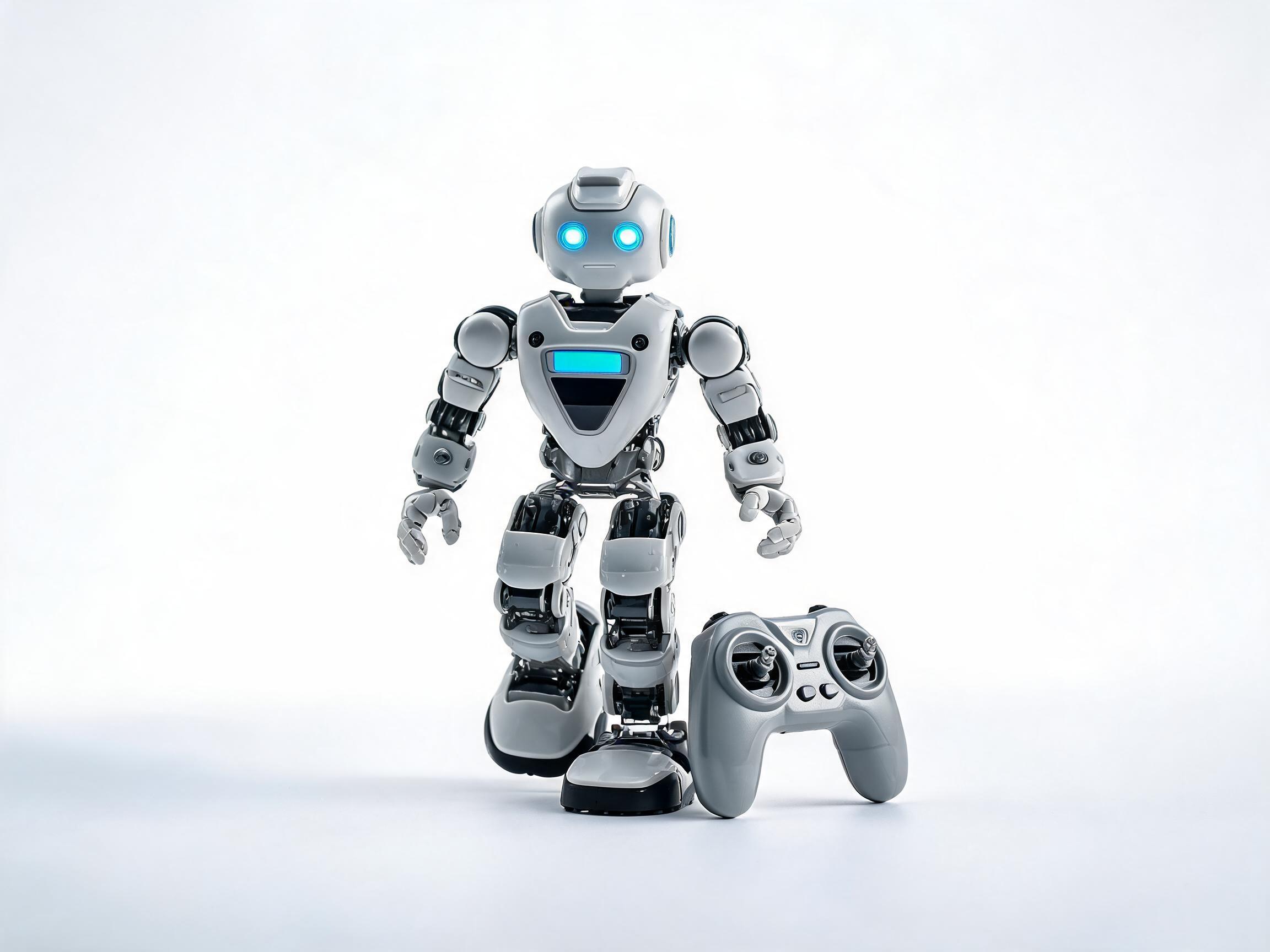
- The RC Walking Robot with LED Lights for Indoor Play is a two-channel handheld RC unit for indoor smooth floors, rated for ages 6 and up.
- Common procurement figures for this unit: 28 cm tall, 15 m control distance, 3 x AA batteries (not included), MOQ 500 pieces, 24 pcs per carton, EN71 / ASTM F963 compliant.
What a robot dog toy actually is
"Robot dog toy" is a product-category label, not a single design. Buyers use it for any four-legged battery-powered toy whose body shape imitates a dog and whose main function is interaction: walking or trotting on flat surfaces, reacting to touch or sound, lighting up, barking, or following simple commands. It sits at the intersection of the plush/companion toy aisle and the RC toy aisle.
That overlap is what makes the term confusing in a purchase order. Two suppliers can both quote a "robot dog" and deliver very different products: one a low-cost sound-and-light companion on wheels, another a servo-driven quadruped with leg articulation and a remote control. Neither is wrong; they target different age bands, price tiers, and retail buyers. When a search returns both robot dog toys and walking robots, the practical question is not which name is correct but which movement mechanism and play pattern your program needs.
Common forms on the market
Most four-legged robot dog toys fall into one of three broadly recognizable shapes. These are category-level descriptions, not specifications of any particular model.
- Companion-style — a dog-shaped body with sound, LED eyes, and simple reactions to clapping or touch. Movement is often limited to stepping in place, sitting, or walking on a fixed path. Low unit cost, aimed at younger children.
- Remote-controlled quadruped — a handheld transmitter sends walk, turn, and gesture commands to four articulated legs. More mechanics, higher unit cost, and a wider ability gap between the toy and a real pet.
- Programmable or app-linked quadruped — adds coding or app interaction, sold more on STEM value than on pet imitation. Usually the highest price tier and the most complex to support after sale.
The two-legged alternative covered in this article is a different mechanism entirely. A walking robot uses two legs plus feet to walk, turn, and glide on smooth indoor flooring. It is controlled by a handheld transmitter rather than reacting to its environment, so the buyer's promise to the end customer is "control and visible movement" instead of "companionship."
Robot dog vs. walking robot: side by side
The table below sets the two categories against each other on the points that normally decide which one goes into a program. The walking robot column reflects the verified configuration of the RC Walking Robot with LED Lights for Indoor Play; the robot dog column describes the category generally, because four-leg specifications vary widely between suppliers.
| Comparison point | Robot dog toy (four legs) | RC walking robot (two legs) |
|---|---|---|
| Body form | Dog-shaped, pet imitation | Humanoid, two legs plus feet |
| Leg count and gait | Four legs; gait varies from stepping in place to articulated walking | Two legs; walks, turns, and glides |
| Control | Often touch, sound, or fixed pattern; some units add a remote | Two-channel handheld control for direction and movement |
| Primary play value | Companionship and reaction | Operating the machine and directing its path |
| Surface | Usually flat indoor floors; small wheels or feet | Smooth indoor floors, with rubber foot pads for grip |
| Lights | Common on eyes and collar | LEDs at the chest and eyes |
| Typical height | Category varies; often palm-sized to small | 28 cm |
| Control distance | Model-dependent; short range common | 15 m |
| Power | Usually rechargeable internal battery | 3 x AA batteries, not included |
| Age guidance | Often 3+ for companion styles | 6 years and up |
| Durability focus | Soft parts, fur, moving joints | Impact-resistant ABS housing and rubber foot pads |
| Certification focus | Age-dependent; small parts are the usual concern | EN71 and ASTM F963 compliant |
One practical consequence of this split: a walking robot has fewer interacting parts on the outer surface, so damage from drops tends to concentrate on the housing rather than on fur or joint covers. That is a durability claim about construction, not a guarantee of drop performance in any specific test.
Choosing by age, play pattern, and durability
Age band
- 3–5 years: the dominant need is safety and simplicity. Companion-style four-leg toys made of soft, rounded parts are the usual fit. Avoid items with small detachable components.
- 6–9 years: children can hold a transmitter and understand directional commands. Both a simple RC quadruped and a two-leg walking robot can work; the two-channel indoor RC unit described here is rated for 6 and up.
- 10 years and above: the purchase rationale often shifts toward building or coding, which favors programmable quadrupeds or more advanced robots rather than pet-style toys.
Play pattern
Ask what the child will do in the first ten minutes. If the answer is "carry it around, talk to it, watch it react," a companion robot dog is the better product. If the answer is "drive it, steer it, make it move," a remote-controlled walking robot delivers a more direct cause-and-effect loop: press, change direction, see the result. The two-channel handheld control and LED lights on the chest and eyes support exactly that loop.
Durability and indoor use
Both categories assume a flat indoor floor. Carpet, thresholds, and outdoor pavement are outside normal use for either type. Rubber foot pads on a two-leg robot reduce slipping on smooth flooring. Impact-resistant ABS on the housing addresses the wall bumps that come with any indoor RC toy. For four-leg toys, check what the fur and joint covers are made of before assuming the same resilience.
Two more sourcing notes that affect perception in retail: a 28 cm height puts the walking robot in a size class that reads clearly on a shelf and in e-commerce photography, and a 15 m control distance covers a typical living room without the child needing to follow the unit closely.
What a factory-side buyer should verify
The verified configuration of this walking robot, from an export manufacturer's data, is summarized below. Treat it as the negotiation baseline rather than a complete specification for every variant.
| Item | Verified detail |
|---|---|
| Housing material | Impact-resistant ABS |
| Control | Two-channel handheld transmitter |
| Movement | Walks, turns, and glides on smooth indoor floors |
| Lights | LEDs at chest and eyes |
| Footing | Rubber foot pads for slip resistance |
| Height | 28 cm |
| Control distance | 15 m |
| Power | 3 x AA batteries, not included |
| Recommended age | 6 years and up |
| Compliance | EN71 / ASTM F963 |
| MOQ | 500 pieces |
| Carton | 24 pcs per carton, colour box for export |
| Customization | OEM / ODM available |
Before you commit to a robot dog program at the same time, collect comparable data on the four-leg candidate — leg mechanism, battery type, age grading, and surface requirements — because the category label alone will not tell you whether the two products can share a compliance file or a shipping plan.
On the manufacturer side, the relevant capacity for planning a seasonal buy is 6 production lines at a monthly capacity of 1.2 million pieces, with 180 staff and ISO9001 in place. Those figures describe the factory, not this specific item; confirm the allocation and lead time for your order quantity when you request a quote.
FAQ
Is a robot dog toy the same as an RC walking robot?
No. A robot dog toy is defined by its dog-shaped, four-legged body and pet-style interaction. An RC walking robot is a two-legged machine controlled by a handheld transmitter. Some four-leg toys include remotes, but the body form and play pattern still differ.
Which one suits a first-time robot purchase for a child?
For ages 3 to 5, a companion-style four-leg toy is usually easier to use. From about 6 years old, a two-channel RC walking robot is manageable and gives clearer feedback when the child changes direction. The unit described here is rated for 6 and up.
Does the RC walking robot run on batteries included in the box?
It requires 3 x AA batteries, which are not included. Plan that into your retail copy so the end buyer is not surprised at unboxing.
Can the walking robot handle carpet or outdoor surfaces?
Its verified movement is walking, turning, and gliding on smooth indoor floors, with rubber foot pads for grip. Carpet, uneven ground, and outdoor use fall outside that description.
What are the ordering terms?
MOQ is 500 pieces, packed 24 pieces per carton in a colour box for export. OEM and ODM are available, and the product is EN71 and ASTM F963 compliant. Confirm your target market's documentation needs and any customization scope when you request a quotation.
Request product details
Send your target market, age band, order quantity, and any OEM or ODM requirements. We will confirm customization scope, packing, and lead time against your program.
View the RC Walking Robot with LED Lights