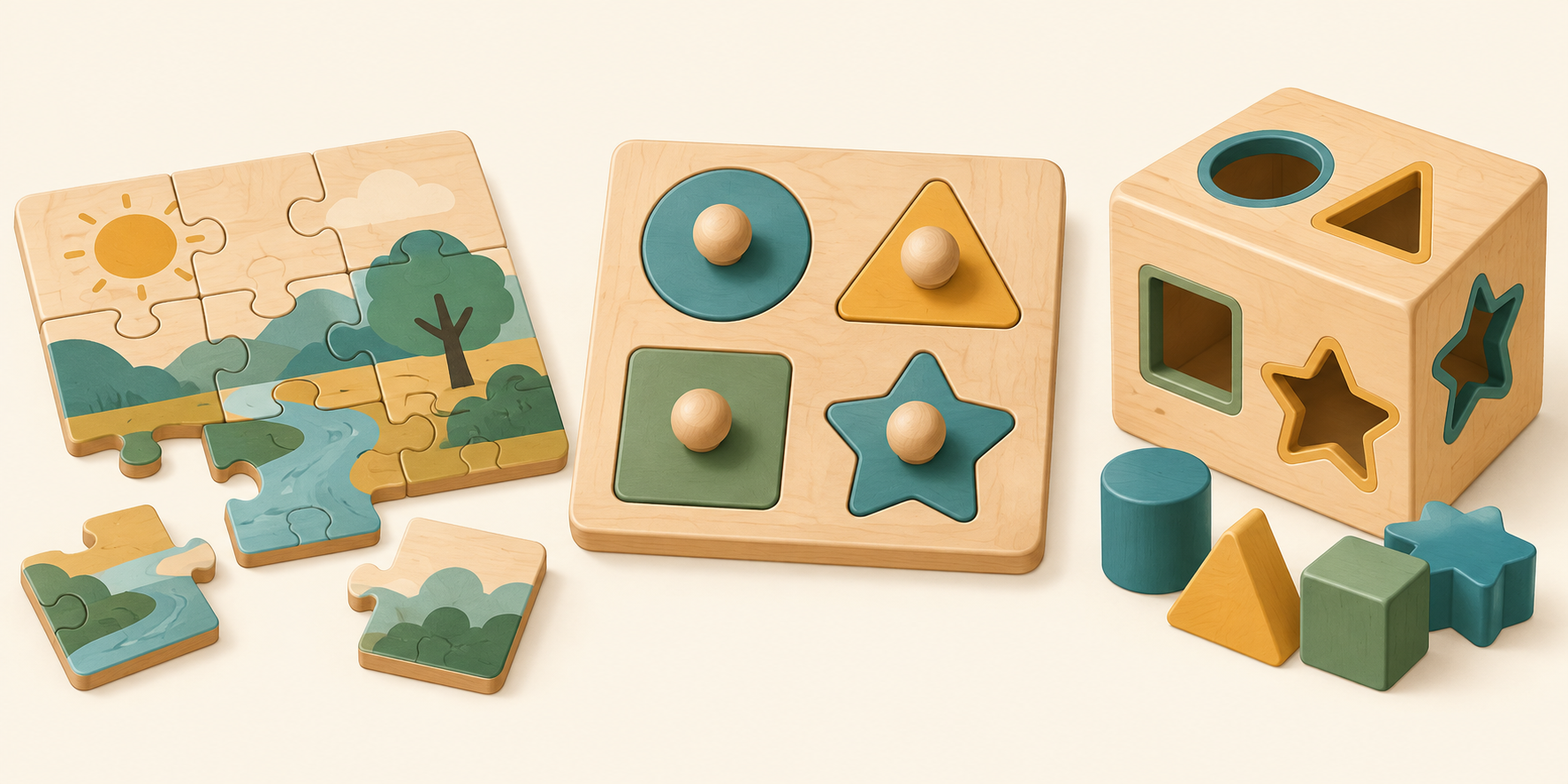
A wooden jigsaw puzzle is a picture cut into interlocking pieces that fit together to form the image. This guide explains how jigsaw puzzles differ from peg puzzles, shape sorters, and board puzzles, and outlines the specifications buyers should confirm when sourcing.
Category Explainer
A wooden jigsaw puzzle is a picture bonded to wood and cut into interlocking pieces. The pieces fit together — usually only one way — to rebuild the image. That interlocking cut is the defining feature, and it is what separates a jigsaw puzzle from other wooden puzzle types that also involve fitting pieces into a frame or sorting shapes.
For buyers and parents comparing wooden puzzles, the confusion is common: many products are called “wooden puzzles,” but they solve different problems. A peg puzzle teaches shape recognition; a jigsaw puzzle builds the picture itself. Knowing which category a product belongs to is the first step in specifying it correctly.
- A jigsaw puzzle is defined by interlocking cuts that form a single picture — not by the material alone.
- Peg puzzles, shape sorters, and board puzzles use recessed or outlined shapes, not interlocking pieces.
- Buyers sourcing wooden jigsaw puzzles should confirm wood type, piece count, printing method and finish, and safety testing against the target market.
- Category-level specifications vary by supplier and project; confirm exact values rather than assuming standards.
What makes a puzzle a jigsaw puzzle
The term comes from the jigsaw blade once used to cut wooden pictures into pieces. Today the word describes the cut pattern: pieces with tabs and blanks that lock into their neighbors. When assembled, the pieces form a continuous picture with no frame required.
Three features distinguish a jigsaw puzzle from other wooden puzzles:
- Interlocking pieces. Each piece connects to adjacent pieces through cut tabs and blanks. The fit is designed so the picture can be assembled and, in many products, disassembled and rebuilt.
- A single image across the pieces. The picture is printed or mounted across the whole board before cutting, so each piece carries a fragment of the image.
- Assembly as the play goal. The child or user completes the puzzle by reconstructing the image. There is no separate frame or sorting tray that defines the answer.
Wooden jigsaw puzzles for young children often use thicker pieces and larger cuts than adult puzzles. The category remains the same; the piece size and thickness change with the age group and intended handling.
How wooden jigsaw puzzles differ from other wooden puzzle types
The table below compares the four categories most often grouped under “wooden puzzles.” The differences are structural, not just stylistic.
| Type | Structure | How it is solved | Typical use |
|---|---|---|---|
| Jigsaw puzzle | Picture cut into interlocking pieces; no fixed frame | Pieces lock together to rebuild the image | Picture completion, visual-spatial reasoning, persistence |
| Peg puzzle | Board with recessed shapes and raised pegs on each piece | Lift each piece by the peg and place it in its matching recess | Shape and animal recognition, grasping, hand-eye coordination |
| Shape sorter | Container or board with cut-out holes and separate shaped blocks | Match each block to the correct hole and push it through | Shape and size discrimination, fine motor control |
| Board puzzle (chunky) | Flat board with outlined or recessed spaces for thick pieces; pieces do not interlock | Place each piece in its outlined space | Early matching, vocabulary, independent play |
The practical difference for buyers is the play mechanic. A peg puzzle has a correct slot for each piece, and the board itself shows the answer. A jigsaw puzzle gives no such guide — the image emerges only when the interlocking cuts are matched. Shape sorters and chunky board puzzles sit closer to peg puzzles: the frame or hole defines where each piece belongs.
This matters when selecting for an age group or a learning objective. If the goal is shape recognition and grasping, a peg puzzle or shape sorter fits. If the goal is picture assembly and spatial reasoning, a jigsaw puzzle is the right category.
What buyers should specify when sourcing wooden jigsaw puzzles
Category-level specifications are not standardized across the industry. Suppliers may use different wood species, cutting methods, and printing processes. The points below are the areas where a clear specification prevents mismatched expectations.
Wood type and board construction
Wooden jigsaw puzzles are commonly made from plywood, MDF, or solid wood. Each has trade-offs in weight, durability, and how cleanly it cuts. Buyers should confirm:
- The exact wood or board material, not just “wood.”
- Board thickness, since it affects piece durability and how easily young children can handle pieces.
- Whether the board is a single layer or laminated, and how the edges are finished.
These details affect the feel of the finished puzzle and the cutting quality. They should be stated in the specification rather than left to the supplier’s default.
Piece count and cut design
Piece count is usually tied to the age group and the size of the finished picture. A puzzle for toddlers will have fewer, larger pieces; a puzzle for older children will have more, smaller pieces. Buyers should confirm the intended piece count, the finished dimensions, and whether the cut pattern is a standard grid or a shaped cut.
Cut design also affects assembly difficulty. A puzzle with distinct, varied tabs is generally easier to assemble than one with uniform cuts. The cut pattern should be specified if it matters to the product’s positioning.
Printing method and surface finish
The image on a wooden jigsaw puzzle is typically printed directly onto the board or printed on paper and mounted. Buyers should confirm the printing method, the ink type, and the surface finish — matte, glossy, or coated. The finish affects appearance and how the pieces feel in hand. It also affects resistance to wear during repeated assembly.
Color accuracy should be checked against a physical sample or proof, since screen colors and printed colors differ. The approved sample is the reference for production.
Safety testing and compliance
Wooden puzzles for children are subject to toy safety regulations in the destination market. Requirements vary by country and by the age group the product is intended for. Buyers should confirm which tests the supplier can support and whether test reports apply to the specific product, material, and finish being sourced.
Common areas of testing include small parts, sharp edges, and surface coatings. The exact standards and test methods depend on the market. Buyers should request the applicable test reports and verify that they cover the product being purchased, rather than assuming a general certificate applies.
Where wooden educational puzzles fit in a product range
Wooden jigsaw puzzles are one category within the broader wooden puzzle and educational toy market. Suppliers that produce number puzzle boards, shape sorters, and Montessori-style sets may also produce jigsaw puzzles, or they may specialize in other puzzle types. Buyers should confirm the supplier’s actual production scope rather than assuming that a wooden puzzle supplier covers every category.
For a product range that includes multiple puzzle types, the specifications for each category should be handled separately. A shape sorter and a jigsaw puzzle have different structural requirements, different age grading, and often different testing considerations. Treating them as one category can lead to mismatched specifications.
Frequently asked questions
Is a wooden jigsaw puzzle the same as a wooden peg puzzle?
No. A jigsaw puzzle uses interlocking pieces to form a picture. A peg puzzle uses a board with recessed shapes and raised pegs; each piece fits into a specific recess. The play mechanic and the structural design are different.
What age group are wooden jigsaw puzzles for?
Wooden jigsaw puzzles are made for a range of ages, from toddlers to older children and adults. The age group is determined by piece size, piece count, and the complexity of the image. Buyers should match these factors to the intended age grade and confirm the age labeling with the supplier.
What should I check on a supplier’s sample?
Check the cut quality and piece fit, the print color against the approved proof, the surface finish, and the edges. For children’s products, also check that the sample matches the tested specification and that the test reports cover the materials and finishes used.
Do all wooden puzzle suppliers make jigsaw puzzles?
No. Many suppliers specialize in peg puzzles, shape sorters, or board puzzles. Buyers should confirm the supplier’s production categories and request samples of the specific puzzle type before placing an order.
For buyers comparing wooden puzzle types, the key is to match the category to the intended play experience and age group, then specify the material, cut, print, and testing requirements in writing. Category-level understanding makes that specification conversation more precise.