
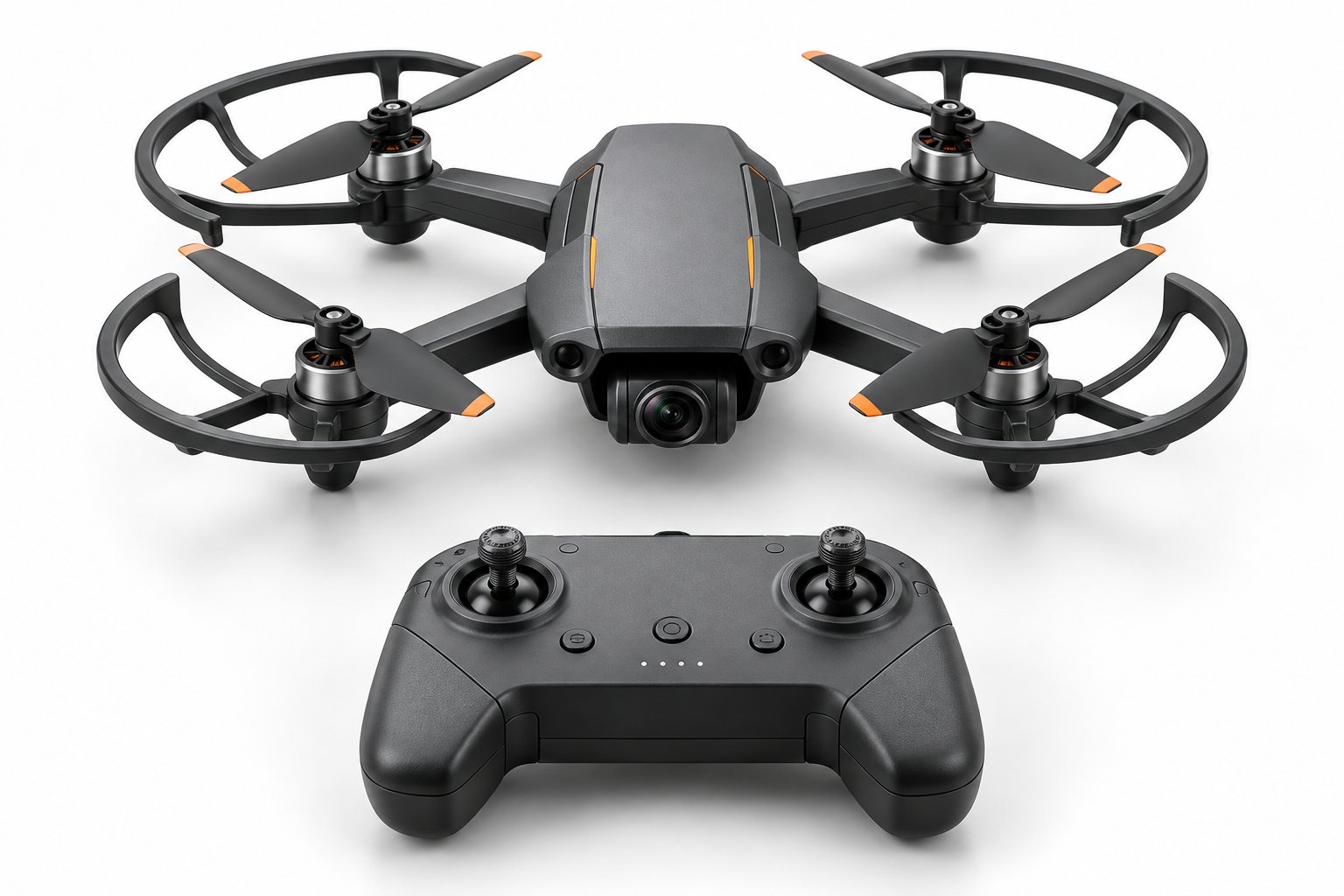
Altitude hold keeps a drone at a roughly steady height so the pilot can focus on direction and camera framing. This guide explains how the function works, why it matters for beginners and children's use, how it combines with headless mode and one-key take-off, and what to request from a supplier — plus what to watch in a sample flight — before you place a pre-order.
Altitude hold is a flight assistance function that keeps a quadcopter at approximately the height it is already flying at, without the pilot continuing to work the throttle. On a toy or mini camera drone, it is the feature that separates “the drone keeps climbing or sinking while I try to steer” from “the drone stays at eye level while I move it left, right, forward and back.”
For a buyer comparing models for a kids' line, an entry-level gift set or a first-drone program, the practical question is narrower than the definition: how do you confirm that the altitude hold on the unit you are about to order actually works, and works in a way a beginner can use? This article covers the mechanism, what it changes for new pilots, and a pre-order check you can run with a supplier's sample.
Key takeaways
- Altitude hold stabilises height; it does not steer the drone or keep it in one spot horizontally.
- Its value for beginners is divided attention: the pilot manages direction and framing instead of continuously correcting climb and sink.
- It works as part of a beginner set together with headless mode and one-key take-off and landing.
- Before a pre-order, ask for a recorded demonstration and check five points on a sample flight: hover stability, take-off and landing, prop guards, recorded footage, and behaviour at the stated control distance.
How altitude hold works in practice
On a drone without altitude hold, the throttle stick controls motor speed directly. Release it and the aircraft keeps whatever climb or descent it had, so the pilot is constantly trimming height. Altitude hold changes that relationship: once the drone is at the height you want, you release the throttle and the flight controller holds that height by adjusting motor output, while the other stick handles direction.
The function is about height only. If you push the drone forward, it moves forward and stays at roughly the same altitude; it will still drift with air movement and it will not hold a fixed position over the ground. This is worth stating plainly to end users, because buyers sometimes expect altitude hold to mean the drone parks itself in the air. It does not. A stable hover in still indoor air is the observable result; a hands-off fixed position is not.
For a factory specification discussion, the practical points to confirm are what triggers the hold (typically releasing the throttle), how the drone behaves at the top and bottom of its range, and whether height is maintained well enough for the camera to keep a consistent framing. You do not need to know the sensor arrangement to make a purchasing decision; you need to see the behaviour.
What it changes for beginners and younger pilots
A first flight asks a new pilot to do several things at once: keep the drone off the ceiling and floor, work out which way it is facing, and aim a camera. Altitude hold removes one of those tasks. With height handled, the pilot's attention goes to direction, which is the part that actually needs practice.
This matters more when the operator is a child. A drone that holds height is easier to keep in a room without constant up-and-down corrections, and easier to keep in frame while recording. For a retailer or distributor, that translates into a product that is easier to demonstrate on a shelf-side trial and easier to explain on the box.
Two boundaries are worth keeping in mind. First, altitude hold makes flying easier; it does not make a drone safe to use unsupervised, and the product's stated age suitability still governs who should operate it. Second, indoor flight is still affected by airflow from air conditioners, fans and open windows, which can push a small quadcopter off its line even when height is held. Neither point undermines the feature — they simply define what it does.
How altitude hold combines with headless mode and one-key take-off
Altitude hold is most useful when it is part of a coherent beginner set. On the Mini RC Drone with 720p Camera and Altitude Hold, three functions work together to shorten the learning curve:
- One-key take-off and landing removes the trickiest manual steps at the start and end of a flight, when a beginner is most likely to over-correct.
- Altitude hold keeps height steady during the flight itself, so the pilot concentrates on steering.
- Headless mode keeps the controls fixed relative to the operator rather than to the drone's nose, so “forward” stays forward even after the aircraft has rotated. This is the function that most often causes a first-flight crash when it is missing.
Taken together, they cover the three things a new pilot struggles with: getting airborne, staying at a usable height, and knowing which way is which. That is why these functions are usually specified together on beginner models rather than offered individually.
The pre-order verification checklist
A specification sheet can list altitude hold without telling you how well it performs. The check below is designed to test the claim rather than the listing. It applies to any supplier, including ours, and can be completed in a single sample session.
What to request from the supplier before ordering
- A recorded demonstration of one continuous flight — take-off, a hands-off hover, a short forward and sideways move, then landing — filmed in one take without cuts. A continuous clip is harder to assemble from favourable moments than an edited montage.
- The full specification list for the exact model, including flight time, control distance, battery type and charging method, so the sample can be tested against the numbers you will print on the packaging.
- Certification documentation for the model and the destination market. Ask for the documents themselves, not a statement that they exist.
- Packaging and carton data — pieces per carton, product dimensions, and whether the outer carton is designed for retail or transit — so you can plan landed cost and shelf fit.
- OEM/ODM terms if you intend to change colour, packaging or configuration, including MOQ for the customized version rather than only the standard one.
What to watch on the sample flight
| Check point | What to observe | Why it matters to the buyer |
|---|---|---|
| Hover stability | Take off, release the throttle, and watch for a few seconds. The drone should stay at roughly the same height without the pilot correcting. | This is the altitude hold function itself. A drone that drifts steadily up or down when the stick is released is not holding height. |
| Take-off and landing | Use the one-key function from a level surface and confirm the drone lifts cleanly and settles without tipping. | Beginners rely on these two moments; a bad landing is the most common first-flight complaint. |
| Prop guards | Check that all four arms carry guards and that they are firmly seated, with no gaps at the mounting points. | Guards are a physical safety feature for indoor and children's use, and a loose guard is a quality-control signal. |
| Recorded footage | Record to a microSD card during the hover and play it back on a computer, not just on the phone. | Confirms the 720p camera, the recording path and the stability of the image while height is held. |
| Control distance | Fly at increasing distance up to the stated range and note where response becomes intermittent. | Gives you a realistic figure for your own packaging copy and for customer expectations. |
Run the sample flight in a space large enough for the stated control distance and follow the product's operating instructions. A sample result describes that unit under those conditions; it is not a guarantee of every production unit, which is why the incoming inspection terms belong in the purchase order.
Specifications to state alongside the feature
Buyers who ask what altitude hold is usually need to place it in a full specification list before they can compare quotes. For reference, the Mini RC Drone with 720p Camera and Altitude Hold is listed with the following:
| Configuration | Quadcopter with altitude hold, headless mode, and one-key take-off and landing |
|---|---|
| Camera | 720p, recording to microSD |
| Flight time | Approximately 8 minutes |
| Control distance | Up to 50 m |
| Battery | 3.7 V rechargeable, USB charging |
| Materials | ABS body, PP propeller guards on all four arms |
| Age suitability | 8+ |
| Compliance | EN71 / ASTM F963 |
| Order terms | MOQ 500 pieces; 20 pieces per carton; OEM/ODM available |
Two of these interact with altitude hold in ways worth explaining to end users. The roughly 8-minute flight time is the window in which the function is used, so a spare battery or a charging routine belongs in the product story. The up-to-50 m control range sets the working area: indoors, altitude hold is mostly about keeping the drone at a comfortable height in a room; outdoors, it is about holding height while the pilot moves the drone across a garden or a small field.
Where OEM/ODM fits
Fujian Lequ Wanwan Co., Ltd. is a B2B toy manufacturer and exporter producing this model for wholesale and private-label programs, with OEM/ODM customization available. If your line needs a different body colour, retail packaging or a bundled spare battery, that is a specification conversation rather than a catalogue selection, and the MOQ for the customized version should be confirmed at the same time as the sample. The prop guards, headless mode and altitude hold are the features most often demonstrated at retail, so it is worth agreeing early on how they are shown in packaging artwork and in any in-store or online demo material.
Conclusion
Altitude hold keeps a drone at a roughly constant height so the pilot can concentrate on steering and framing. For a beginner or a younger operator, it is one of three functions — with headless mode and one-key take-off and landing — that make a first flight predictable. The definition is easy to write on a specification sheet; the useful question is whether the behaviour can be seen. Ask for a continuous demonstration clip and a sample, and run the five checks above before you commit to a pre-order.
Next step: If you are evaluating this model for a wholesale or private-label program, review the Mini RC Drone with 720p Camera and Altitude Hold product page, then send your target market, packaging requirements and estimated quantity so the quotation and sample arrangement can be prepared against your actual configuration.
FAQ
Does altitude hold stop the drone from drifting sideways?
No. It maintains height. Lateral movement from air currents or from the pilot's stick input still occurs, and the drone will not hold a fixed position over the ground.
Can a child use a drone with altitude hold without help?
Altitude hold reduces the workload of flying, but it does not remove the need for supervision. The stated age suitability for this model is 8+, and adult supervision during first flights is the practical approach for any small camera drone.
Is altitude hold the same as GPS position hold?
They are different functions. Altitude hold maintains height only. Position hold uses satellite positioning to keep the drone over a fixed point on the ground, which is a separate capability not listed for this model.


