Beech is a dense, close-grained hardwood that has become a default specification in wooden toys because it machines cleanly, holds fine detail, and takes a water-based finish without hiding the grain. This explainer covers what beech actually is, why toy factories choose it over softer species, and which finish and species details buyers should verify before confirming a purchase order.
Beech wood toys are a default specification in the wooden toy category for a practical reason: the timber machines cleanly, holds sharp edges and small profiles, and takes a water-based finish without the grain disappearing under colour. For buyers, the more useful question is not only "what is beech wood" but which beech, dried how, finished with what, and evidenced by which test documents.
What Beech Wood Is
Beech is a hardwood from the genus Fagus. In European trade, the species most commonly used for toys and furniture components is European beech (Fagus sylvatica); North American beech (Fagus grandifolia) is also sold, and the two are not interchangeable in every respect. Beech is deciduous and grows across temperate regions, which is why it appears in the supply chains of European and North American factories alike.
Two structural features matter for toys:
- Close, uniform grain. Beech has fine, evenly distributed pores and little pronounced figure, so a cut block looks the same from most angles and does not split into obvious grain lines the way oak can.
- Diffuse-porous structure. Growth rings are not sharply banded. This is part of why beech sands and routes to a smooth, consistent surface across a batch.
Beech is a hardwood by botanical classification, not a marketing claim. Hardness varies with species, growth conditions and moisture content, so a general figure quoted online should not be treated as a specification for a specific shipment. If hardness or density is a purchasing requirement, ask the supplier for the actual measured value for the batch in question.
Why Wooden Toy Makers Specify Beech
Several properties line up with how wooden toys are actually made. The list below describes what beech is known for; it is not a guarantee about any single factory's output.
- Machining behaviour. Beech turns, saws and routes predictably, which suits the repeated cutting of blocks, rods and shaped panels.
- Clean edges and detail. Small chamfers, rounded corners and engraved or printed surfaces come out well defined on a fine-grained stock.
- Surface consistency. Because the grain is not strongly figured, colour variation between adjacent faces of the same piece is smaller than with species that have dramatic grain patterns.
- Finish behaviour. Beech accepts water-based coatings and stains evenly, so a non-toxic finish can be applied thin and still look finished.
- Availability in standard thicknesses. Beech is widely produced as kiln-dried boards and squares, which helps factories hold consistent dimensions across production runs.
None of these points mean beech is the only sensible choice. Rubberwood, pine, maple and birch are all used in the category. Beech tends to be specified when dimensional accuracy, edge quality and a smooth painted or natural finish matter more than the lowest possible material cost.
Beech Compared With Other Toy Woods
The table below compares general characteristics that buyers usually weigh. Values are qualitative because species and grade differ by supplier; treat it as a starting point for questions, not as a datasheet.
| Consideration | Beech | Pine | Rubberwood |
|---|---|---|---|
| Grain appearance | Fine, uniform, low figure | Pronounced grain, knots common | Straight, even grain |
| Edge detail after cutting | Holds small profiles well | Softer; can crush at thin edges | Good, with careful tooling |
| Surface after sanding | Smooth, consistent | Can fuzz and dent | Smooth when dried correctly |
| Typical role in toys | Blocks, shapes, educational play | Economy items, larger bodies | Mid-range painted toys |
| Buyer check | Species, grade, moisture content | Knot and resin content | Drying quality, colour sorting |
Key takeaways for buyers
- "Beech" is a genus-level name; ask which species and grade is quoted.
- Machining and finish behaviour, not hardness alone, explain why beech is specified.
- The finish is a separate specification from the wood, and carries its own documentation.
- If a supplier cannot name the species or the finish chemistry, that is the gap to close before ordering.
The Finish Matters as Much as the Wood
A wooden toy is a wood specification plus a finish specification, and buyers should evaluate the two separately. A well-chosen hardwood with an unsuitable coating is a compliance problem, while a modest wood with a well-documented finish may pass far more easily.
Water-based finishes are common in toy production because they can be formulated without the solvent load of older lacquer systems. That said, "water-based" describes the carrier, not the whole formulation. Additives, pigments and crosslinkers still determine what is actually in the film. Two useful questions:
- What is the finish chemistry — acrylic, polyurethane dispersion, nitrocellulose, wax-oil, or unfinished?
- Which test report covers the finished article, and does it name the colour or finish variant tested?
Compliance claims follow the tested object. If a report covers a natural-finish version, it does not automatically transfer to a painted variant with a different coating or colourant. Buyers importing into the EU or US should expect the supplier to identify the applicable standard for the market — commonly EN 71 for the EU and ASTM F963 for the US — and to confirm the scope of any test document they provide.
Finish details worth writing into the specification
- Coating type and number of coats, including whether any primer or sealer is used.
- Colourants used for painted parts, with the colour reference for each component.
- Which components are finished, and which are left natural — for example, whether internal surfaces or the inside of a lid are coated.
- Surface preparation, such as sanding grit before coating, since this affects how evenly a finish sits.
- Drying and curing conditions at the factory, which influence whether a coating is fully set before packing.
How Beech Wood Is Usually Specified in a Toy
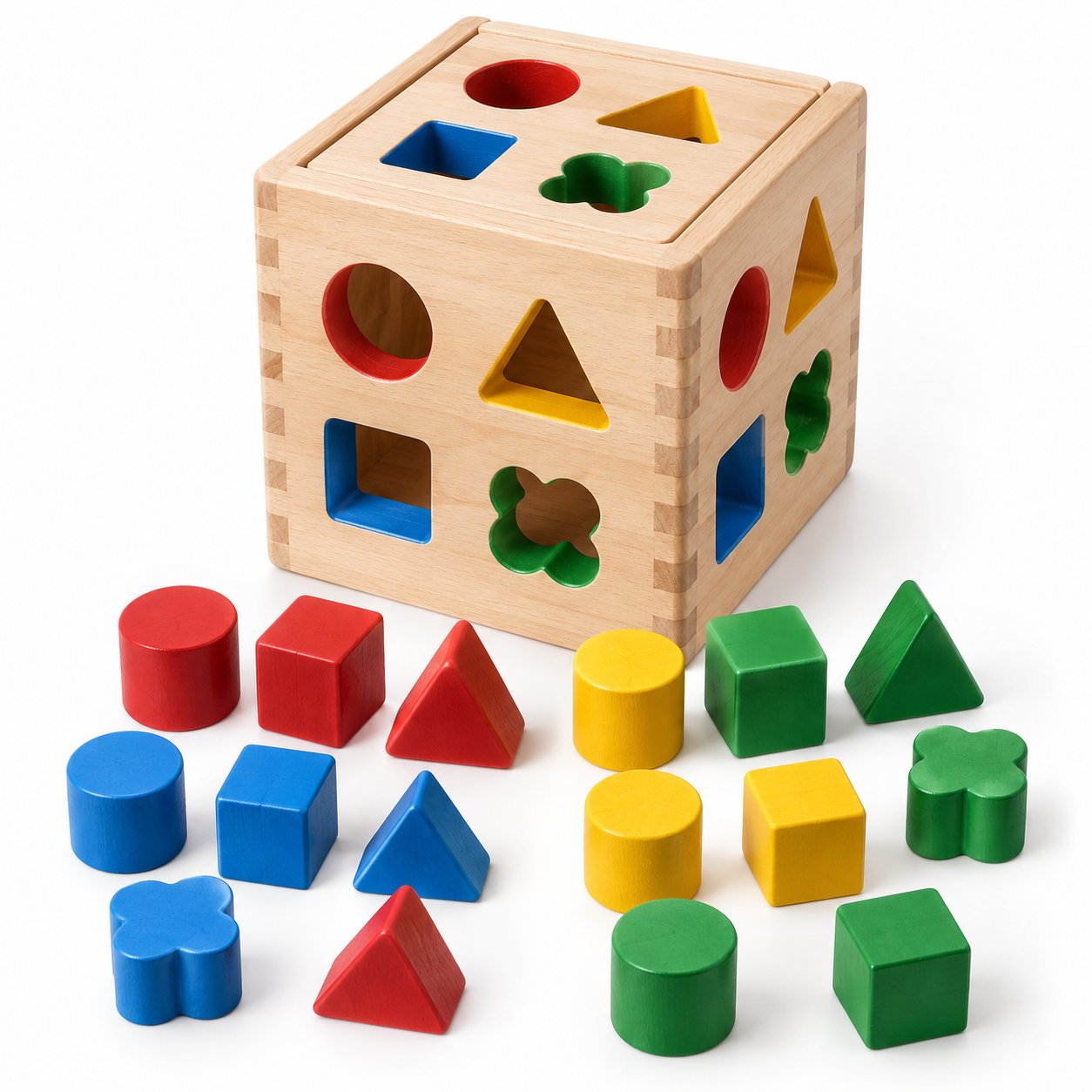
A typical beech toy specification covers the wood, the finish and the physical dimensions together. Using a wooden shape sorting cube as a category example — the format sold as a wooden shape sorter cube — the kind of detail buyers see on a well-documented product includes:
| Specification item | Typical description |
|---|---|
| Material | Solid wood with a non-toxic water-based finish |
| Cube dimensions | 15 x 15 x 15 cm |
| Block count | 12 chunky blocks in 4 shapes and 4 colours |
| Block thickness | 2.5 cm |
| Construction detail | Removable lid |
| MOQ | 500 sets |
| Standards referenced | EN 71 / ASTM F963 |
Note the species gap. Many product listings say "solid wood" without naming the species, and that is not the same as confirming beech. If beech is what you need — for edge quality, for a natural finish, or to match an existing line — ask the supplier to confirm the species in writing on the quotation or specification sheet, and to state whether the blocks are beech or a mix.
What to Verify Before You Order
Beech is a good default, but the specification only holds if it is documented. The checks below are the ones that most often decide whether a shipment matches the sample.
- Species and grade. Ask for the botanical and trade name, and the grade or sorting rule applied to the timber.
- Moisture content and drying method. Kiln-dried stock with a stated moisture range stays dimensionally stable; unstated drying is a risk for cracking and shrinkage.
- Finish chemistry and its test scope. Confirm which standard applies to the market, which article was tested, and whether the colour variant is covered.
- Tolerance on cut parts. A stated thickness such as 2.5 cm should come with an acceptable tolerance range, since wood moves with humidity.
- Sample vs. production. A sample that passes inspection does not by itself prove a full production run will. Agree on the inspection criteria before the run starts.
- Packing and humidity protection. Wooden toys are sensitive to moisture changes in transit; ask how the cartons and any inner wrapping are specified.
Frequently Asked Questions
Is beech a softwood or hardwood?
Beech is a hardwood — a botanical classification based on how the tree reproduces, not a synonym for "dense." Some softwoods are harder than some hardwoods. For purchasing decisions, rely on measured values for the batch rather than the hardwood/softwood label alone.
Are beech wood toys safer than toys made from other woods?
Safety depends on the finished article — wood condition, finish chemistry, small parts, and the testing performed — rather than on the species name. Beech is popular because it machines and finishes predictably, which supports consistent compliance, but a beech toy without documented testing is not automatically safer than a well-tested toy in another wood.
Does "solid wood" on a product listing mean beech?
No. "Solid wood" describes construction, not species. If the species matters for your programme, ask for written confirmation from the supplier and note it on the specification sheet.
What should I ask about the finish?
Ask for the coating chemistry, the number of coats, the colour references, and the test report that covers the finished article in that variant. Then confirm the report's scope matches the version you are ordering.
Can beech be left unfinished?
It can be machined and sanded without a coating, and some products are supplied that way. Whether an unfinished version suits your market depends on your own compliance and labelling requirements, so confirm the finish decision with your supplier before sampling.
Next Step
If beech is the material your line requires, the productive conversation with a supplier covers four things: the species in writing, the moisture and drying specification, the finish chemistry with its test documentation, and the tolerance on cut parts. Bring those four points to your next quotation request and the comparison between suppliers becomes much faster.
Species, finish chemistry and test scope should be confirmed with the supplier for each quotation, since both timber supply and coating formulations can change between orders.