A buyer-facing teardown of the main RC car assemblies — body/shell, drivetrain and wheels, controller link, and power — followed by an inspection checklist for evaluating samples. Includes concrete specs from two published models and a practical sample-evaluation routine.
Technical Explanation & Buyer Check
"What is inside a remote control car?" is a question buyers ask before they place a purchase order. The answer maps directly onto the assemblies you can inspect in a sample. This article breaks the product into four groups — body/shell, drivetrain and wheels, controller link, and power — then gives a sample-evaluation checklist for procurement.
On this page
The four main assemblies
A remote control car is not one component; it is four assemblies that buyers evaluate separately because each one carries a different risk (tooling cost, durability, compliance, and repeat purchase).
- Body/shell — the visible outer part. Determines perceived quality, branding surface, and packaging size.
- Drivetrain and wheels — chassis, motor, gears, axles, wheel material. Determines how the car behaves on the intended surface and how quickly returns appear.
- Controller link — handheld transmitter, receiver board, and channel count. Determines whether multiple cars can run side by side and how far the car responds.
- Power — battery pack and charging method. Determines the charging accessories you must ship and declare, plus child-safety requirements.
When you request a sample, ask which of these four is standardized across the order and which can be customized (color, shell graphics, packaging, channel layout). The customization boundary directly affects MOQ and tooling cost.
What RC car bodies are made of
Body material is the most common buyer question because it sits between two constraints: impact resistance and unit cost. Two published examples show the range.
| Product | Body material | Wheels | Notes |
|---|---|---|---|
| 2.4GHz Remote Control Off-Road Car | Not specified in the published listing | Not specified in the published listing | EN71 and ASTM F963 compliant; age 6+ |
| 4-Channel RC Stunt Car | ABS | Soft rubber | 4 channels; up to 30 m control range; 3.7V rechargeable with USB charging |
ABS is a common rigid shell material for stunt and on-road models. A soft rubber wheel changes the grip and the sound profile compared with hard plastic wheels, and it is usually selected for indoor or smooth-surface play. The off-road listing above does not state a shell material, so treat that as a question for the supplier rather than an assumption.
For a B2B order, the shell also decides packaging: a rigid ABS shell holds shape in a color box, while a thin shell may need internal support to survive shipping. Ask for the boxed weight and dimensions for the exact model — those numbers, not the shell name, drive your freight calculation.
Drivetrain and wheels
The drivetrain converts the motor output into movement. In small RC cars, the parts you can verify on a sample are the gear train, the axle holders, and the wheel mounts.
Ask the supplier to confirm the wheel fixing method and whether wheels are replaceable at the buyer level. Removable wheels matter for two reasons: they affect the spare-parts you may want to stock, and they change how the product is packaged. The 4-channel stunt car uses soft rubber wheels, which can be swapped for a different surface if the supplier offers alternatives.
On an off-road model, check the clearance between the shell and the wheels at full suspension travel. If the shell is a hard ABS type and the clearance is tight, contact during play becomes a warranty issue. This is a physical inspection point, not a spec-sheet point.
Controller link: 2.4GHz and channel count
The controller link has two buyer-relevant properties: frequency band and channel count.
2.4GHz refers to the radio band. A 2.4GHz handheld controller is described in the off-road car listing. For buyers, the practical relevance is that 2.4GHz is the common band for this class of toy, and it is the band the compliance testing covers. The listing does not state a control range for the off-road car, so do not infer one.
Channel count determines how many independent functions the controller drives. The 4-channel stunt car uses four channels, and the published listing gives a control range of up to 30 m. Channel count is not a quality ranking; it tells you how many actions the toy performs, which in turn sets the age grading and the play pattern.
When you evaluate a sample, test the controller link with two units powered on at the same time. On 2.4GHz, both should respond independently. If the supplier cannot demonstrate paired operation on the bench, ask for the factory's test method before you approve the sample.
Power and charging
Both published models use rechargeable batteries with USB charging. This is a packaging and compliance decision as much as a performance one.
- USB charging means you do not ship a wall adapter in most configurations, which reduces box volume and removes a plug-type decision per market.
- Rechargeable battery means the battery is a regulated item for shipping; confirm the battery type and the documentation the supplier provides.
- The off-road car is listed as age 6+ and compliant with EN71 and ASTM F963. Only these two certifications are named in the listing; do not assume others.
The published listings do not state battery capacity or run time. If those figures matter for your channel (they usually appear on retail packaging), request them from the supplier for the exact model and battery as a written specification.
Sample inspection checklist
Use this list on one physical sample, then repeat it on production units at pre-shipment.
- Shell material and thickness. Identify the material (e.g., ABS) and press the shell at the mounting points to check for flex or cracking.
- Wheel material and fixing. Confirm soft rubber vs. hard plastic and whether wheels are replaceable.
- Shell-to-wheel clearance. Cycle the suspension by hand; check for contact at full travel.
- Channel function. Operate every channel and confirm each produces a distinct action.
- Controller link, paired test. Power two units together and confirm independent control.
- Control range. Measure the distance at which control is lost; for the stunt car the published figure is up to 30 m, so that is the reference point.
- Battery and charging. Confirm charging method (USB), connector type, and the battery documentation supplied with the shipment.
- Certification scope. Match the certificate or test report to the exact model. EN71 and ASTM F963 are the certifications named for the off-road car; verify the report covers the model and age grade you are ordering.
- Packaging. Check color box condition, internal support, and the boxed weight and dimensions.
- Age grading. Confirm the age marking (6+ for the off-road car) matches the retail channel and the warning text required in your market.
Two published models as reference
The two models below show how the same four assemblies appear in different form factors.
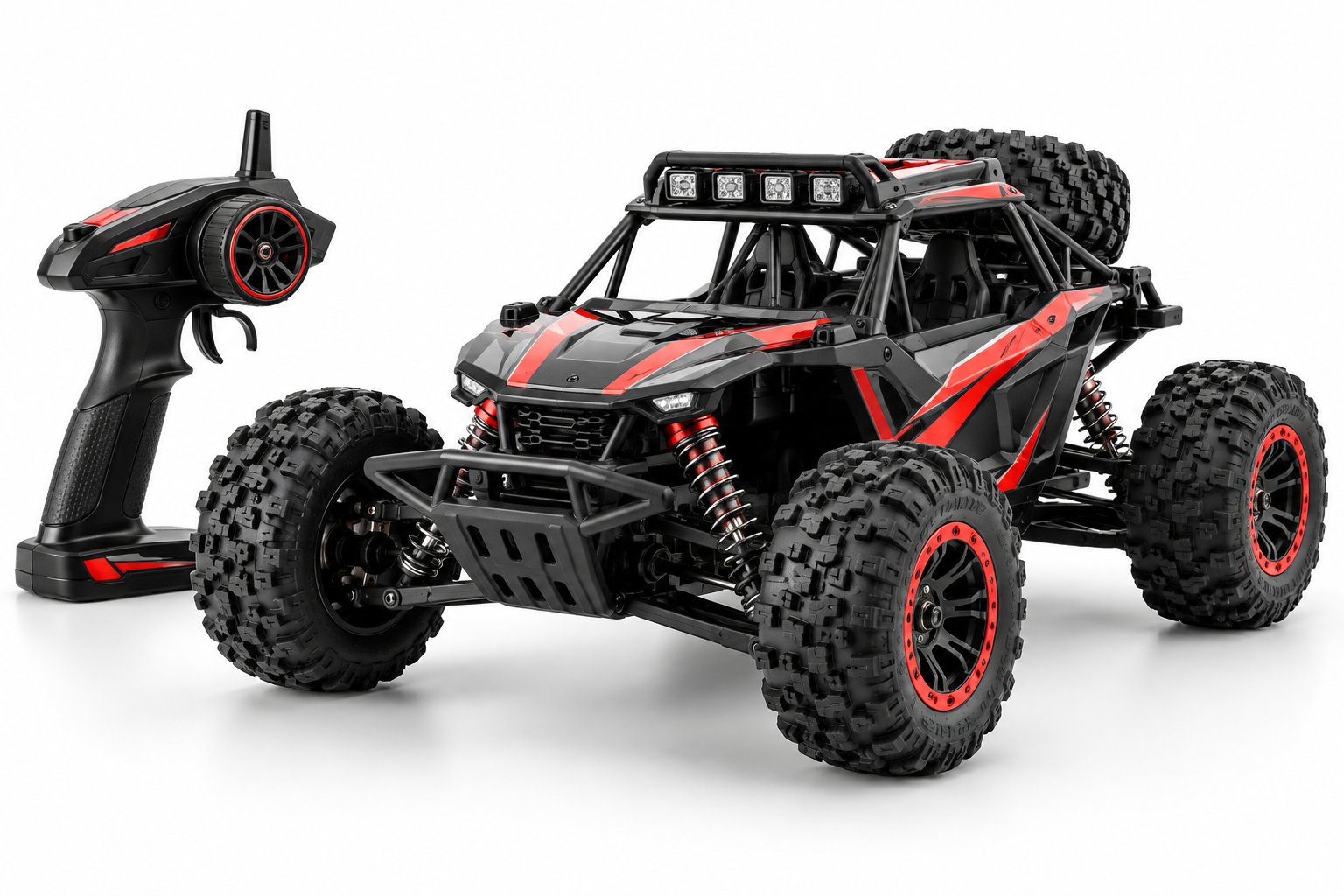
2.4GHz Remote Control Off-Road Car
- Handheld 2.4GHz controller
- Rechargeable battery with USB charging
- EN71 and ASTM F963 compliant
- Age 6+
- MOQ 500 pcs
- Color box packaging
- OEM/ODM available
This model is the better fit if you need a licensed or branded shell program, because OEM/ODM is offered and the MOQ is stated at 500 pcs. See the 2.4GHz Remote Control Off-Road Car page for the full listing.
4-Channel RC Stunt Car
- ABS body
- Soft rubber wheels
- 4 channels
- Up to 30 m control range
- 3.7V rechargeable with USB charging
This model is the better fit if you want a stunt-play feature set with a defined control range. See the 4-Channel RC Stunt Car page for the full listing.
- Four assemblies — body, drivetrain, controller link, power — each carry a separate risk.
- Shell material and wheel material are the two questions most likely to change unit cost.
- 2.4GHz and channel count are different specifications; neither one alone tells you quality.
- Verify that any certificate names the exact model and age grade you are ordering.
FAQ
- What is inside a remote control car?
- A body/shell, a drivetrain with wheels, a handheld controller and receiver, and a battery with a charging method. The four assemblies are mechanically and commercially separate.
- What are RC car bodies made of?
- ABS is used in the published 4-channel stunt car. The published off-road model does not state a shell material, so confirm it with the supplier for that model.
- Does 2.4GHz mean a longer control range?
- Not automatically. 2.4GHz describes the radio band. The published control range figure belongs to the 4-channel stunt car, listed as up to 30 m.
- Which certifications should I expect?
- For the off-road car, EN71 and ASTM F963 are the certifications named in the listing. Confirm the report covers your exact model and age grade.
- What is the MOQ for a private-label order?
- The off-road car listing states MOQ 500 pcs with OEM/ODM available. MOQ for a different model or customization should be confirmed per project.
Evaluating a sample? Request the specification sheet, battery documentation, and the test report for the exact model you are considering.
Request product details