Retail packaging is the individual sellable pack a toy carries onto a store shelf or an e-commerce listing page. This guide explains how it differs from bulk and export packing, what to specify in a quotation (color box, window, insert, barcode area, master carton), and what to confirm with a toy manufacturer before placing an order.
What Is Retail Packaging? A Guide for Toy Buyers
Retail packaging is the individual, sale-ready pack a toy is sold in — the printed box a shopper picks up from a shelf or a marketplace listing uses as its main product image. Bulk and export packing protect the goods in transit; retail packaging has to do that and still sell the unit to an end customer. When you request a toy quotation, the packaging line in that quote decides what arrives at your warehouse and how the product appears in your store.
On this page
- Retail packaging vs. bulk packing vs. export packing
- Why retail-ready packaging affects shelf, e-commerce and margin
- The main retail packaging formats for toys
- What to specify in your packaging request
- Master carton: the export layer buyers often forget
- What to confirm with a toy supplier before ordering
- FAQ for toy buyers
Key takeaways
- Retail packaging is the sellable unit pack; export packing is the transport pack that contains it. Buying a toy normally involves both.
- For shelf retail, the printed box, window and insert have to hold the product in a presentable position and carry your barcode.
- For e-commerce, the same unit pack also has to survive individual shipping and photograph clearly.
- Specify box style, print, window, insert, barcode area and master carton as separate line items so the quotation is comparable.
- Ask the supplier for a packaging sample or print proof before mass production — corrections after printing are expensive.
Retail packaging vs. bulk packing vs. export packing
Buyers use these terms interchangeably in conversation, then discover the quotation means something different. The three levels are separate decisions:
| Packaging level | What it is | Who sees it | Typical use in toys |
|---|---|---|---|
| Retail packaging (retail pack) | The individual sellable unit: printed color box, bag with header card, blister card, window box or display-ready pack | The end consumer, on a shelf or an e-commerce listing | Default for toys sold in stores and online marketplaces |
| Bulk packaging | Plain or minimally printed packing of multiple units, often without retail print or consumer information | Nobody at retail — it is opened for repacking or repurposing | Promotional giveaways, repackers, premium insert programs |
| Export (transport) packaging | Master cartons that protect retail units during container shipping, with shipping marks and carton labeling | Freight handlers, customs, your warehouse team | Used together with retail packaging on OEM/ODM toy orders |
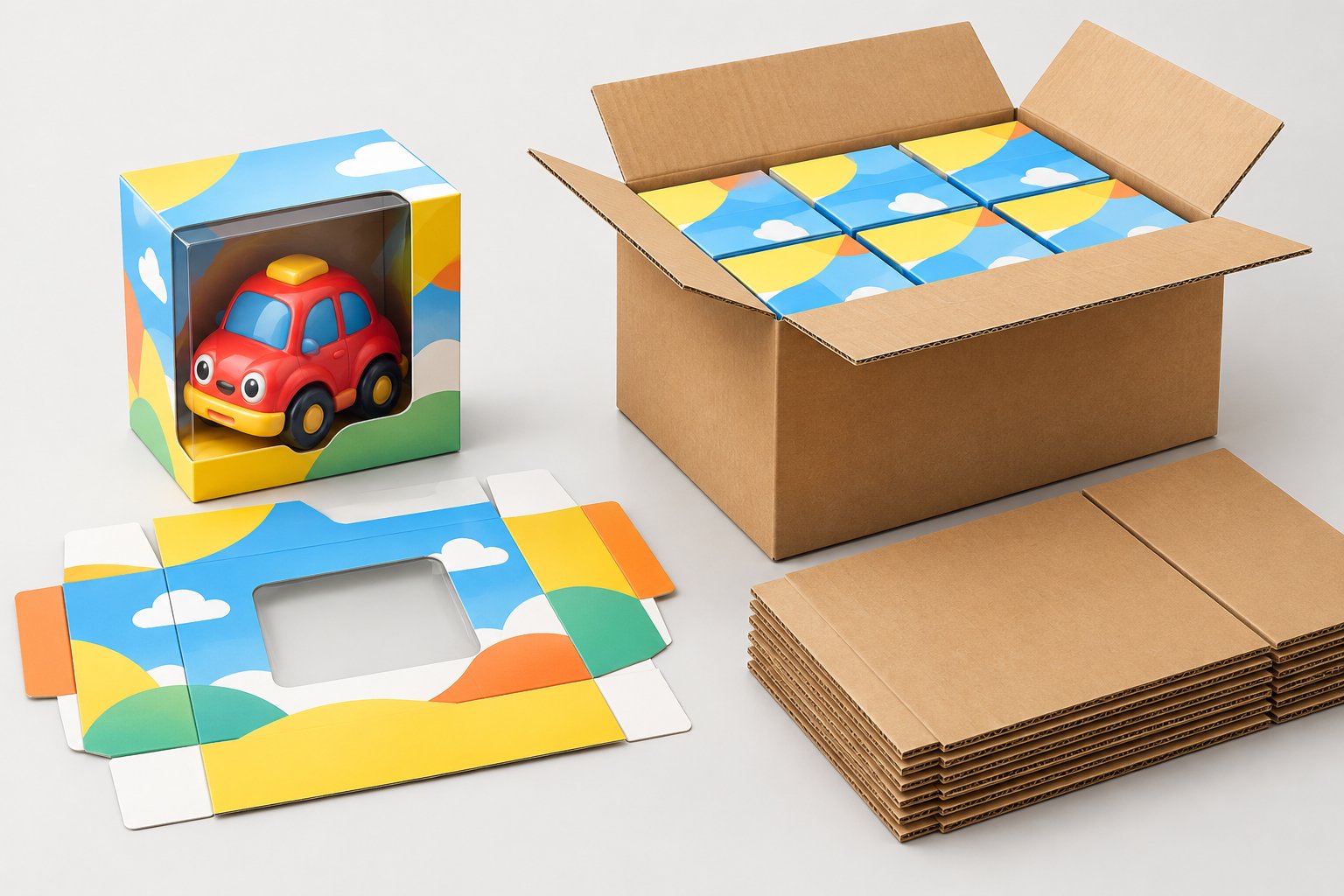
So when someone asks “what is retail pack,” the short answer is: it is the pack the customer carries home, as opposed to the carton that carries it across an ocean. Toy manufacturers offering OEM/ODM customization normally quote both: the retail pack for your listing and the export carton for freight. That combination — retail color box plus export carton — is standard for educational and outdoor toy lines in our own product specifications.
Why retail-ready packaging affects shelf, e-commerce and margin
Shelf presentation
A toy box competes in a fixed rectangle of shelf space. What matters there is front-face clarity: product visible, age marking and key claim readable at a glance, brand consistent with the rest of your range. A window or a well-positioned blister lets the shopper see the actual toy rather than a drawing of it. If the packaging hides the product entirely, you are asking parents to buy on trust, which is a harder sell in a crowded aisle.
E-commerce
Online, the retail pack becomes your product photo. The same artwork must photograph without glare through a window, keep key text legible at thumbnail size, and survive being shipped as a single parcel rather than pulled from a shelf. Some sellers order a sturdier retail pack for direct-to-consumer fulfilment while keeping retail packaging for wholesale channels.
Margin and handling
Retail-ready packaging reduces warehouse labor: a properly packed master carton can go from container to shelf with fewer handling steps, and the unit does not need repacking. It also shifts some protective burden from the master carton onto the retail pack, which is why box board stiffness and insert fit deserve attention on heavier or awkwardly shaped toys. The packaging line in the quotation is therefore not a cosmetic detail — it defines handling cost, damage risk and how the product is presented.
The main retail packaging formats for toys
- Printed color box (folding carton): the most common OEM option for boxed toys, plush sets, puzzles and construction kits. Full-panel print, optional window, and an insert to hold contents.
- Window box: a color box with a die-cut opening covered by film, showing the toy while keeping it enclosed. Useful when the product appearance is the main selling point.
- Blister card or blister pack: a clear plastic shell on a printed card. Often chosen for small accessories and figures where the item should be fully visible.
- Header card with poly bag: a printed card stapled or sealed to a bag. Usually the lowest-cost retail presentation; needs careful closure and adequate material thickness for the product weight.
- Display-ready or shelf-ready pack: a retail pack designed so the master carton can be opened and placed directly on the shop floor as a display unit.
The right format depends on the toy: whether shoppers must see it, how heavy it is, whether it will be shipped individually online, and what retail fixtures your accounts use. If you sell through multiple channels, you may need more than one retail pack for the same toy.
What to specify in your packaging request
A packaging description like “color box, good quality” is not a specification. A supplier cannot quote or sample from it. Provide the following, or ask the supplier to propose options for each point:
- Box style and structure: folding carton, tuck-top, window box, blister card, bag with header. Include whether a window is required and where it sits.
- Print and artwork: how many panels are printed, whether you supply print-ready artwork or need design support, and the brand and language requirements on pack (product name, age marking placement, warning text areas, importer/dealer information blocks).
- Insert: the internal tray, sleeve or tie-down that holds the toy in place. Inserts determine whether the product stays oriented during shipping and how it looks when the box is opened.
- Barcode area: where your EAN/UPC or GTIN barcode goes, on which panel, at what size, and whether a separate carton barcode is needed for the master carton. Reserve a clear, unprinted white area — barcodes printed over artwork or folds cause scan failures at retail.
- Retail pack quantity: how many sellable units per retail pack, when a pack is a multi-pack rather than a single item.
- Export carton master pack: how many retail units go into each master carton, carton construction, shipping marks and carton labeling.
- Sample and proof requirement: state that you need a packaging sample, a structural white sample, or a print proof before mass production.
Quote comparison tip
Ask every supplier to break the quotation into product, retail packaging, insert, and master carton. Quotes that hide all four in one unit price cannot be compared, and packaging changes later become a price negotiation instead of a line item.
Master carton: the export layer buyers often forget
The retail pack protects the product from the shelf to the checkout; the master carton protects the retail packs from the factory to your warehouse. On export orders, confirm:
- Units per carton and carton configuration: how many retail packs fit, and whether the arrangement avoids crushing corners or windows.
- Carton strength rating: boards are rated by a bursting or edge-crush grade. Ask the supplier to match the grade to the product weight and stacking in the container, rather than accepting a default grade.
- Shipping marks and labeling: carton number, item number, quantity, weight and any importer-specific label your account requires.
- Container loading: carton dimensions affect how many units fit per pallet and per container. A few millimeters on the carton can change the load plan, so ask for the carton dimensions early rather than after the print is approved.
- Inspections: agree whether cartons are opened for inspection and how they are re-sealed so retail packs arrive undamaged.
What to confirm with a toy supplier before ordering
Packaging errors are discovered late — when the container is already loaded or when the first carton is opened at the retailer. These are the confirmations worth completing before you issue a purchase order:
- One packaging specification document. A written spec covering retail pack structure, print, insert, barcode placement and master carton, signed off by both sides. On OEM/ODM projects this document drives the sample and the production order.
- A physical sample or proof. Ask for a packaging sample or print proof, and confirm what exactly will be sent: a structural sample with blank board, a printed proof, or a finished sample containing your product. Each validates a different thing — structure, print, or fit.
- Who supplies the artwork and who approves it. Clarify whether you provide print-ready files or the supplier designs from your brief, and require that no print starts without your written approval.
- Barcode readiness. Confirm the exact barcode data you will supply, the panel position, and that a quiet zone is reserved. Test-scannable print is a reasonable request before mass production.
- Product-to-pack fit. Confirm the retail pack is sized for the finished toy, including accessories, with enough clearance for the insert and any bagged parts.
- Sample-to-production consistency. Agree that the production retail pack matches the approved sample, and state what you will do if it does not — reject, rework or accept with a note. This belongs in the PO terms, not in email discussion afterward.
- Documentation. Ask which packaging or product documents the supplier can provide for your market, and confirm them per order. Different destination markets have different labeling and language requirements; do not assume a generic export label covers your account.
If you are still selecting suppliers while you work through packaging details, the checklist in wholesale toys: where to buy and what to verify first covers the verification steps that run alongside packaging confirmation.
FAQ for toy buyers
- Is retail packaging the same as the product box?
- In most toy quotes, yes — the retail pack is the printed box or card the consumer buys. The distinction matters when a supplier uses “packaging” to mean the export carton; always confirm which layer a quoted price covers.
- Can I order a toy in bulk packaging and add retail packaging later?
- That is possible for some products and some supply chains, but it moves labor and risk to your side. If you plan to repack, confirm with the manufacturer what the bulk pack contains and how the product is protected in transit.
- Who is responsible for the barcode on the retail box?
- Normally the buyer supplies the barcode data and the manufacturer prints it in the agreed position. Confirm panel, size and quiet zone before print approval, and request a scannable proof if your retail account requires one.
- Do I need a window on the box?
- Only if seeing the toy helps the sale and the product survives the opening. Windows add a die-cut step and can reduce board stiffness; a printed image or an insert can present the product just as clearly for some categories.
- What if the retail box arrives damaged?
- Damage usually traces back to carton configuration, stacking or handling rather than to the print. Inspect a full master carton, not just the top layer, and raise discrepancies with the supplier against the approved packaging specification.
Retail packaging is a specification, not a description. When you can hand a supplier one document covering the sellable unit, the insert, the barcode and the master carton, you get comparable quotes and fewer surprises at the warehouse door.