
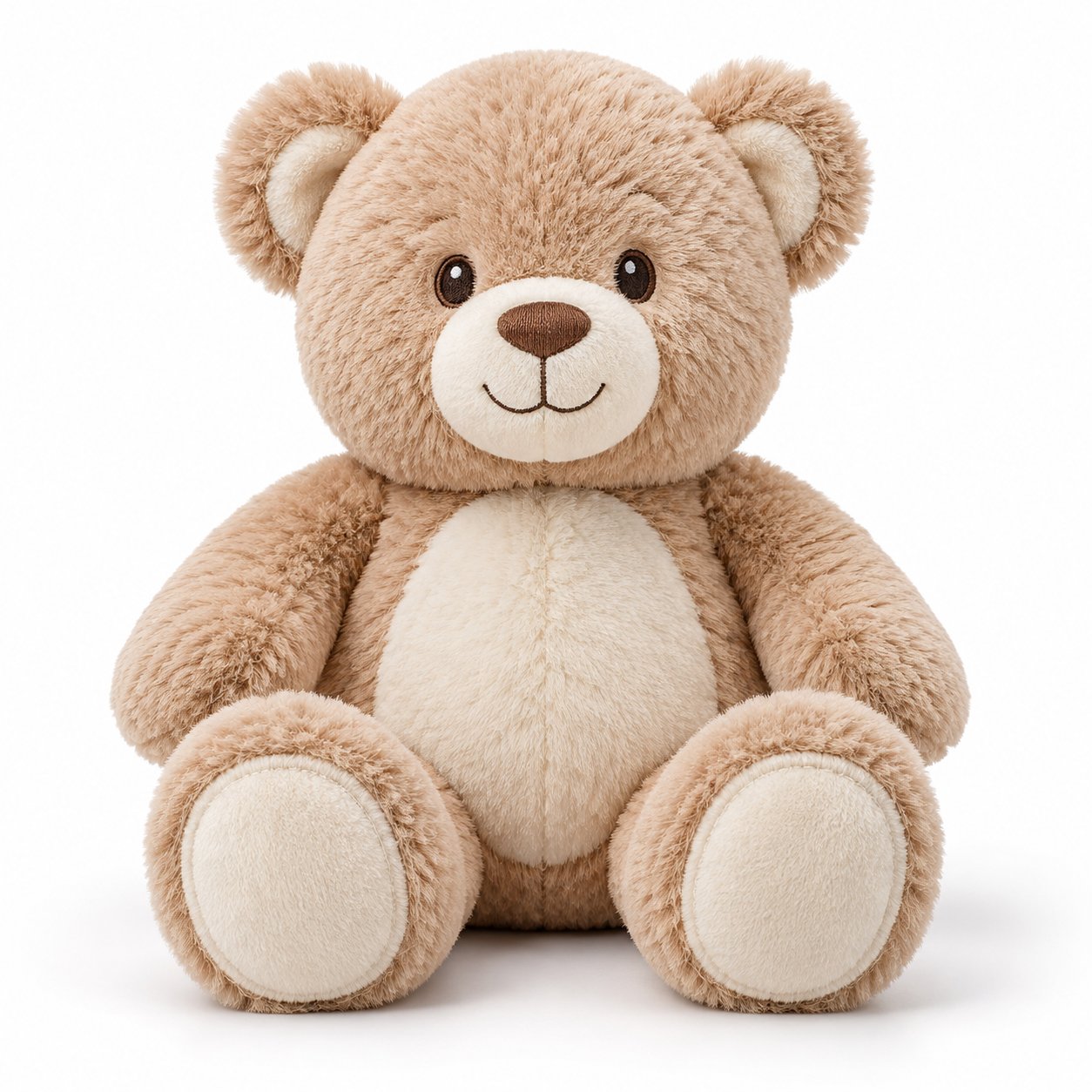
Soft toy making follows the same craft sequence whether you order a thousand units or a hundred thousand: pattern, cutting, sewing, filling, features, finishing, inspection. This guide explains each stage as a craft principle, then shows what Fujian Lequ Wanwan does at that stage and what a buyer can verify on a sample before placing an order.
Production guide for buyers
Soft toy making is a sequence of six craft stages: pattern making, fabric cutting, sewing and seam construction, filling, feature attachment, and finishing with inspection. Each stage produces a decision you can inspect on a physical sample, which is why experienced importers walk through the stages in order rather than judging a plush toy by its surface alone. Below, each stage is described as general industry practice, followed by what Fujian Lequ Wanwan actually does at that stage and what you can check for yourself.
- Soft toy making is a sewing-led process. Pattern and seam decisions made early determine how the finished toy holds its shape and filling.
- Feature attachment is where safety and repair questions concentrate. Embroidered eyes and nose remove the small-parts detachment risk that plastic eyes create.
- Fujian Lequ Wanwan, founded in 2013, runs 12,000 sqm of production space with 180 staff and six production lines, plus an in-house QC laboratory for material inspection, small-parts testing and finished-product checks.
- The plush teddy bear comfort toy is 30 cm seated, uses hypoallergenic polyester fibre filling, is rated 0+ years, is EN71 / ASTM F963 compliant, and has an MOQ of 1,000 pieces.
- Bring a sample checklist to your first round: seams, filling density, feature attachment, surface wipe-clean test, and the compliance report for the specific item.
Stage 1: Pattern making
A soft toy starts as a set of flat pattern pieces that are sewn into a three-dimensional shape. The pattern controls proportion, where the seams fall, how much seam allowance each piece carries, and how the finished toy will sit once it is stuffed. A pattern that looks correct on paper can still produce a toy that leans, bulges at the gusset, or loses its shape after filling, so pattern making is normally refined through a physical prototype rather than approved from a drawing alone.
At Fujian Lequ Wanwan, patterns are developed in-house for the plush range. The plush teddy bear comfort toy is built on a pattern designed for a 30 cm seated height, so the body proportions are set to hold that seated posture rather than standing upright. For custom work, the custom plush stuffed animal line is size-customizable from 20 cm to 60 cm, which means the pattern is rescaled per project and should be re-prototyped rather than simply enlarged.
What a buyer can check
- Ask for a pre-production prototype in the final fabric, not a paper pattern or digital render.
- Set the toy on a flat surface and confirm it holds the intended seated or standing position without support.
- Look at seam placement on the face and belly. Seams running across the front of the face usually indicate a pattern compromise.
Stage 2: Fabric cutting
Cut pieces must match the pattern exactly, including seam allowance and grain direction. On plush fabric, pile direction matters: pieces cut against the pile can look different in tone from adjacent pieces once sewn together, and a toy can appear to have mismatched panels under some lighting. Cutting accuracy also affects how cleanly seams close later.
Fujian Lequ Wanwan uses a short-pile plush surface on the teddy bear comfort toy, chosen partly because it wipes clean with a damp cloth. That same short pile makes cut-edge alignment easier to see on a sample, which is useful during your approval round.
What a buyer can check
- Hold the sample under daylight and rotate it. Panel-to-panel colour and pile direction should read consistently.
- Check the wipe-clean surface on a hidden area with a damp cloth and let it dry; the pile should return without matting.
Stage 3: Sewing and seam construction
Seam construction decides whether a soft toy survives handling, washing instructions and transit compression. Common industry practice is to double-stitch load-bearing seams — the seams that carry filling pressure or take repeated pulling — and to close the final opening with a seam that will not unravel under tension. Stitch density, thread type and seam allowance are set per pattern.
The teddy bear comfort toy uses double-stitched seams. On a sample, the practical question is not whether double stitching exists in principle but whether it is applied where it matters: the arm and leg joins, the neck, and the closing seam.
What a buyer can check
- Turn the sample inside out at an inconspicuous opening and look at the stitch line. A double row should be visible and even.
- Grip an arm and a leg and pull firmly but not destructively. The seam should not open or pucker.
- Inspect the closing seam for loose thread ends that could be pulled by a child.
Stage 4: Filling
Filling gives the toy its weight, softness and ability to recover shape. Plush toys are typically filled with polyester fibre, and the fill density is a deliberate choice: too little and the toy collapses and looks flat; too much and seams take unnecessary stress. Filling is normally added in stages and worked into limbs and corners so the toy fills evenly.
The teddy bear comfort toy uses hypoallergenic polyester fibre filling. For a 0+ years product, filling choice and how securely the filling is enclosed are the points a buyer should focus on rather than softness alone.
What a buyer can check
- Press the sample firmly in the belly, limbs and head. Filling should feel even, with no hard lumps or empty pockets.
- Squeeze and release. The toy should return most of its shape.
- Confirm the filling is fully enclosed with no accessible opening in the finished toy.
Stage 5: Feature attachment
Eyes, noses and other features are the highest-risk part of a soft toy for young children, because attached plastic components can detach if the fixing fails. There are two common approaches: plastic safety eyes fixed with a washer, or embroidered features worked directly into the fabric. Embroidered features remove the detachment risk by eliminating the separate component.
The teddy bear comfort toy uses embroidered eyes and nose instead of plastic parts, so there are no small components to detach. This is a design decision made at pattern stage, not a finishing step added later.
What a buyer can check
- Confirm on the sample and on the specification sheet which features are embroidered and which, if any, are attached components.
- If any attached components remain, ask which small-parts test was applied and request the report for that item.
- Inspect embroidery stitching for loose threads or exposed knots on the face.
Stage 6: Finishing and inspection
Finishing covers trimming threads, brushing pile out of seams, checking surface cleanliness, and a final visual inspection before packing. Inspection is where the earlier stages are confirmed on the finished item rather than on components.
Fujian Lequ Wanwan operates an in-house QC laboratory covering material inspection, small-parts testing and finished-product checks. The teddy bear comfort toy is EN71 / ASTM F963 compliant. Because compliance applies to a specific item and construction, ask for the report matching the product and version you are ordering rather than accepting a general certificate reference.
What a buyer can check
- Review the inspection points listed on the finished-product check and confirm they cover seams, features, filling and surface.
- Match the compliance report to the exact item, size and construction you are buying.
What to check on a sample: a stage-by-stage list
| Stage | What it controls | Sample check |
|---|---|---|
| Pattern making | Proportion, posture, seam placement | Toy holds intended seated/standing position unaided |
| Fabric cutting | Panel match, pile direction, clean edges | Consistent colour and pile under daylight; wipe-clean test |
| Sewing | Seam strength and durability | Double row visible at load-bearing seams; firm pull test |
| Filling | Shape, weight, recovery, enclosure | Even density; springs back; no accessible opening |
| Feature attachment | Small-parts safety | Embroidered vs attached confirmed; matching test report |
| Finishing and inspection | Surface, threads, final conformity | Inspection points reviewed; report matched to item |
Commercial points to confirm before ordering. The plush teddy bear comfort toy has an MOQ of 1,000 pieces and a 30 cm seated height. The custom plush stuffed animal line is size-customizable from 20 cm to 60 cm; confirm the pattern, prototype and compliance route for the exact size you need. Size, feature method and compliance scope should all be written into the specification before production begins.
Buyer questions
Is soft toy making the same as plush toy manufacturing?
The terms overlap. Soft toy making refers to the craft sequence of pattern, cut, sew, fill, attach features and finish; plush refers to the surface fabric. A plush toy is a soft toy made with a pile fabric.
Why do some plush toys use embroidered eyes instead of plastic?
Embroidered features are worked into the fabric, so there is no separate component to detach. That removes a small-parts risk at the design stage. The teddy bear comfort toy uses embroidered eyes and nose for this reason and is rated 0+ years.
What does EN71 / ASTM F963 compliance cover?
These are toy safety standards, and compliance is tied to a specific item and construction. Ask the supplier for the report that matches the product, size and version you are ordering.
How do I check filling quality on a sample?
Press the belly, limbs and head; filling should be even with no hard lumps. Squeeze and release — the toy should recover most of its shape. Confirm the filling is fully enclosed.
What is the minimum order for the teddy bear comfort toy?
1,000 pieces for the plush teddy bear comfort toy. For the custom plush stuffed animal line, sizes are customizable from 20 cm to 60 cm; confirm project terms with the supplier.
Where to start
If you are evaluating a first plush order, ask for a physical sample of the plush teddy bear comfort toy and run the six-stage checklist above against it. For a custom shape or size, start from the custom plush stuffed animal line and confirm pattern, prototype and compliance route before you commit to a production quantity.
Fujian Lequ Wanwan Co., Ltd. was founded in 2013 and operates a 12,000 sqm facility with 180 staff and six production lines.


