There is no single best robot toy for every retail shelf. Buyers should compare movement type and floor suitability, control channels and range, power supply, build quality, age fit and certification, and match those criteria to their specific audience. This guide breaks down each criterion and shows how one indoor RC walking robot fits into that decision.
Buyers searching for the best robot toy usually get answers written for parents, not for people choosing what to put on a shelf. A single model rarely fits every store. The useful question is which criteria decide whether a robot toy sells in your specific channel — and how those criteria interact.
This article covers movement type and floor suitability, control channels and range, power supply, build quality, age fit and certification. It also shows how these criteria apply to one indoor RC walking robot and which retail audiences it suits.
Key Takeaways
- Movement type must match the floor surface most of your customers actually have.
- Control range and channel type determine how the toy performs in real rooms, not just in demos.
- Power supply affects repeat play, battery cost, and whether the toy needs add-on purchases.
- Build quality and age certification are non-negotiable for retail channels with compliance checks.
- Different retail audiences value different criteria — no single ranking works across all channels.
What this guide covers
Movement Type and Floor Suitability
The first criterion is how the robot moves, because movement type dictates where it works. A walking robot, a wheeled robot, and a sliding robot each behave differently on carpet, tile, and wood.
Walking and sliding mechanisms generally perform best on smooth, hard indoor floors. Rubber foot pads can reduce slipping on tiles, which matters if your customers play in kitchens or hallways. On thick carpet, walking legs may catch or stall; on smooth laminate, the same legs glide. Buyers should check the floor surfaces dominant in their market before choosing a movement type.
The RC Walking Robot with LED Lights for Indoor Play is a concrete example. It walks, turns, and slides on smooth indoor floors, and its rubber foot pads reduce slipping on tiles. That makes it a fit for hard-floor homes and a poor fit for deep-pile carpet — not a defect, just a boundary buyers should know before ordering.
Control Channels and Range
Control design affects how children actually play and how the toy performs in a normal room. Two aspects matter: the number of channels and the effective range.
- Channels: A two-channel handheld controller typically handles forward/back and left/right movement. More channels can add arm or head functions, but they also add complexity for younger children.
- Range: A longer control range gives more freedom in larger rooms. A range up to 15 m suits indoor play across a living room or playroom without the child needing to follow the toy.
Buyers should compare channel count against the target age group. A two-channel controller is easier for a six-year-old to master than a multi-function pad, and easier play usually means more repeat use.
Power Supply
Power supply is where retail economics often decide the sale. Rechargeable robots carry a higher unit cost but avoid ongoing battery purchases. Battery-operated models cost less upfront but require the buyer's customer to supply batteries.
The RC walking robot uses 3 x AA batteries, not included. That is a common retail format, but it has two implications: your shelf price looks lower, and the customer needs batteries on hand before first play. If your channel sells batteries nearby, this works well. If not, consider whether the packaging should make the battery requirement obvious.
| Power option | Buyer advantage | Buyer risk |
|---|---|---|
| 3 x AA (not included) | Lower unit cost; familiar battery type | Customer must buy batteries separately |
| Rechargeable built-in | Ready to play out of the box | Higher cost; charging time before use |
There is no universally better option. Match the power supply to your price band and customer expectations.
Build Quality and Materials
Build quality determines returns and complaints. Buyers should look at the housing material, the joint construction, and how the toy handles normal drops.
The RC walking robot uses impact-resistant ABS. ABS is a common choice for toys because it resists cracking under impact and holds molded detail well. It stands 28 cm tall — large enough to feel substantial in hand, small enough for indoor play.
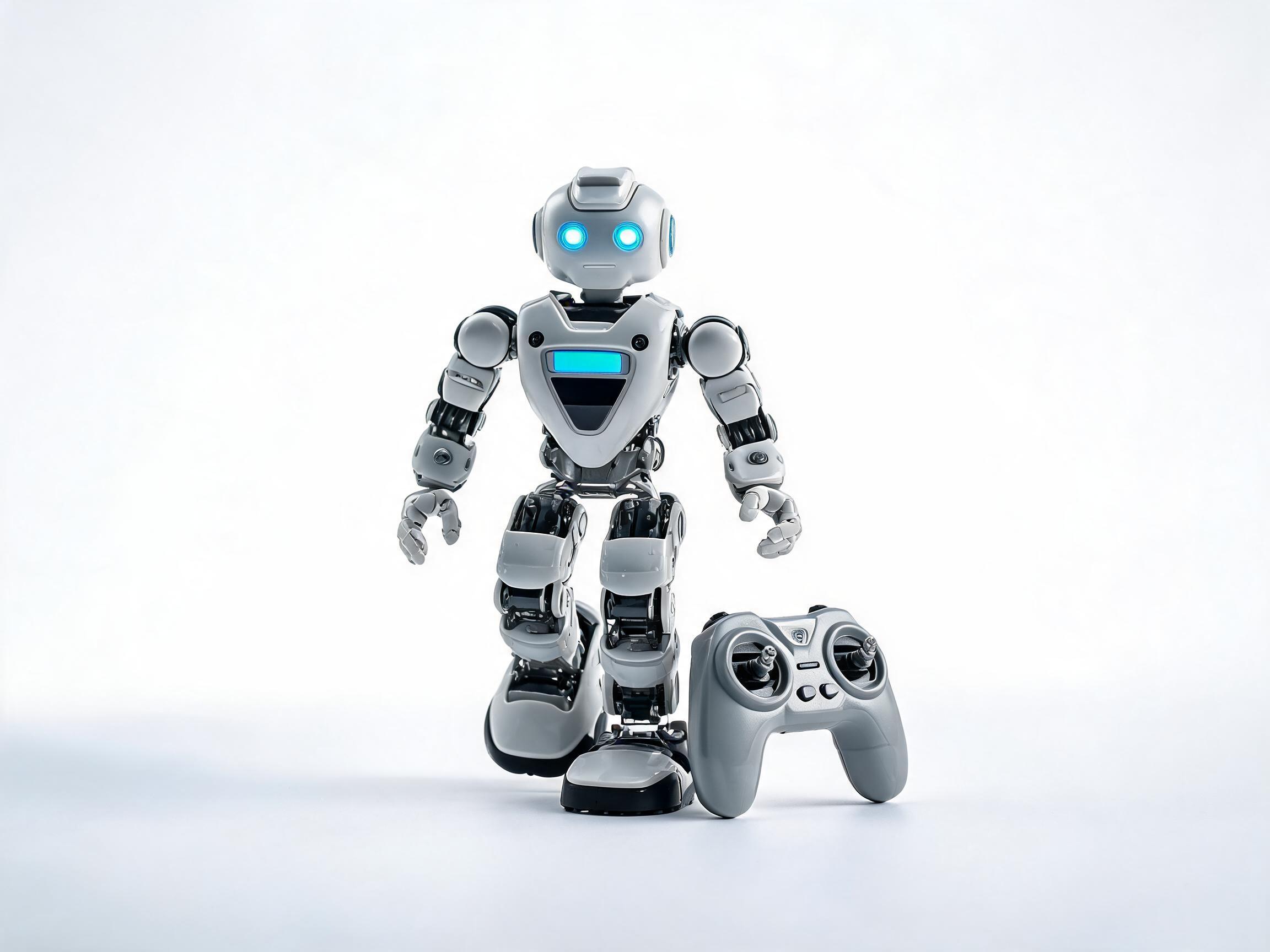
LED lights in the chest and eyes are a visual feature that helps the toy stand out on a shelf or in a product photo, but buyers should treat lighting as a presentation feature, not a durability guarantee. The structural questions — material, joints, foot pads — are what predict how the toy survives a season of play.
Age Fit and Certification
Age rating and certification often decide whether a retailer can stock a toy at all. Age 6+ is a common threshold for small-motor toys with controllers, because it reflects both motor skills and the ability to follow instructions.
Compliance matters more than the rating printed on the box. The RC walking robot is EN71 and ASTM F963 compliant, covering the European and US toy safety frameworks. For buyers selling into those markets, this is a starting point for compliance review, not a substitute for checking that the certificate scope matches the exact SKU and packaging you order.
Matching Criteria to Retail Audiences
Different retail audiences weigh these criteria differently. The table below maps typical channels to the criteria that matter most.
| Retail audience | Priority criteria | Why |
|---|---|---|
| General toy stores | Age fit, certification, shelf appeal | Broad customer base needs safe, compliant, attractive stock |
| Discount / value channels | Power supply, unit cost | Price-sensitive shoppers accept battery-not-included formats |
| Specialty electronics stores | Control range, movement type | Customers compare features and expect demo-ready performance |
| Online marketplaces | Build quality, listing photos | Returns and reviews depend on how the product matches the listing |
| Gift shops | Shelf appeal, LED features, size | Visual impact and gift-ready presentation drive purchase |
For buyers ordering at volume, the RC walking robot has a MOQ of 500 pieces. OEM/ODM is available for buyers who need private label or packaging adaptation. These terms suit importers and distributors planning a defined seasonal run rather than testing a single unit.
FAQ
What is the best robot toy for kids?
There is no single best model. The best choice depends on the child's age, the floor surfaces at home, and whether the buyer wants battery or rechargeable power. For ages 6+ on smooth indoor floors, a walking robot with a simple two-channel controller and rubber foot pads is a reasonable fit.
What is a robot toy?
A robot toy is a mechanical or electronic toy that imitates robotic movement or behavior. It may walk, roll, slide, or respond to a controller. Movement type and control method are the main ways to classify them for retail.
Can this robot toy work on carpet?
The RC walking robot is designed for smooth indoor floors and uses rubber foot pads to reduce slipping on tiles. Thick or deep-pile carpet is outside its intended surface.
What should buyers confirm before ordering?
Confirm the certificate scope matches your exact SKU and packaging, the battery format and whether batteries are included, and the OEM/ODM options available for your market. MOQ is 500 pieces.
Next Step
If your store serves hard-floor homes and customers aged 6 and up, the RC Walking Robot with LED Lights for Indoor Play is worth evaluating against the criteria above. Compare it to your existing robot toy range on movement, control range, power, build, and certification before you commit to a season's order.