A clear explanation of the pin on a bowling ball, why it matters for kids' garden bowling sets and 10-pin bowling sets for children, and what buyers should look for when sourcing these products.
Key Takeaways
- The pin on a bowling ball is the small peg or dot used to mark the ball's axis before drilling; its position affects the ball's reaction on the lane.
- In kids' garden bowling sets and 10-pin sets for children, the term "pin" almost always refers to the pins you knock down, not a pin on the ball.
- Buyers should check whether the set is a true 10-pin configuration, what materials are used, and how the pin size and weight suit the target age group.
- For real bowling balls, pin placement is a technical detail for pro shops; for toy sets, it is not a factor in play value.
Two Very Different Pins
When someone asks "what is the pin on a bowling ball?" they are usually thinking of one of two things. In competitive and league bowling, the pin is a small marker on the surface of a real bowling ball that shows where the core's axis is. It tells a pro shop driller how to lay out the finger holes so the ball behaves the way the bowler wants.
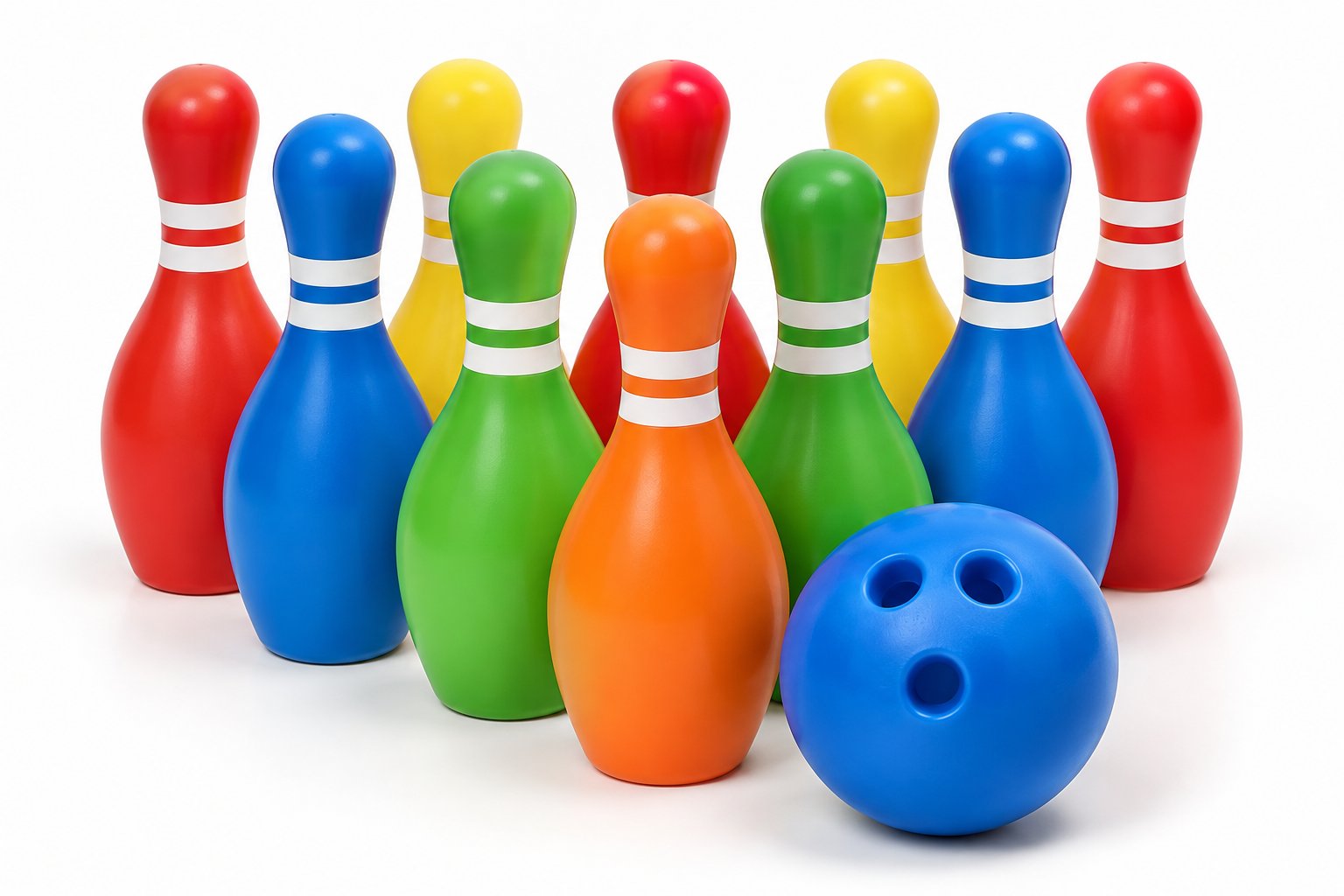
But if you are sourcing a kids garden bowling set or a 10 pin bowling set for children, the word "pin" takes on a completely different meaning. It refers to the standing targets — the skittle-shaped pieces a child aims to knock down. There is no marked pin on the ball itself in these sets, and that is normal.
This guide explains both meanings so you can talk confidently with suppliers, check product listings accurately, and avoid confusion when ordering for your store or catalog.
What the Pin Means on a Real Bowling Ball
On a regulation bowling ball, the pin is a small, colored dot — often called the positive axis point (PAP) marker — that indicates the orientation of the weight block inside. It is not a physical peg that sticks out. It is a visual reference.
Why does it matter? Because a bowling ball is not perfectly symmetrical inside. The core shape and its position relative to the finger holes determine how the ball rolls, how early it hooks, and how much it hooks overall. A pro shop uses the pin location to decide where to drill the holes. Two identical balls drilled differently around the same pin can react very differently on the lane.
That said, for a casual bowler or a child playing in the garden, pin placement is irrelevant. The ball is simply rolled. The pin is a technical detail for serious adult bowlers who want a custom fit.
Why Kids' Bowling Sets Don't Have a Pin on the Ball
Children's bowling sets are designed for fun, safety, and durability — not for hook potential. The balls in these sets are typically lightweight (often in the 1 to 3 pound range) and made from soft foam, plastic, or rubber. They do not contain a weight block, so there is no core axis to mark with a pin.
What you will find instead is a set of pins — usually 10 for a full frame, though smaller sets exist — plus one or more balls. The pins are the star of the show. Their height, weight, color, and stability determine how satisfying the game feels for a child.
What Buyers Should Look for in a Kids' 10-Pin Bowling Set
If you are purchasing for a toy store, a school, or an online catalog, these are the points that separate a good set from a frustrating one.
Pin Count and Configuration
A true 10 pin bowling set for children should include ten pins arranged in the standard triangle formation. Some compact sets use fewer pins to save space. Decide whether your customers expect a realistic ten-pin layout or a simplified version. Both can sell, but the packaging must be clear.
Pin Height and Weight
Pin size should match the age group. Taller, heavier pins are harder for small children to knock down and may tip over on their own. Shorter, lighter pins are easier to topple and give younger players a sense of success. A common range for indoor/outdoor kids' sets is 15 to 25 cm in height, but suppliers vary. Ask for exact dimensions.
Material and Durability
Plastic pins are the most common. They are lightweight, weather-resistant, and easy to wipe clean. Foam pins are softer and safer for indoor play but can be less stable in wind. Wooden pins offer a classic look but require more careful finishing to avoid splinters. Check whether the material is UV-stabilized if the set is marketed for garden use.
Ball Grip and Size
Most kids' bowling balls have molded finger holes. The spacing and diameter should suit small hands. A ball that is too large or too heavy will frustrate a child; too small and it may not roll straight. For garden sets, a slightly larger ball rolls better on grass, but it must still be manageable.
Stability and Base Design
Pins should have a flat, wide base so they stand upright until hit. A hollow or weighted base improves stability. If the set is intended for outdoor use, consider whether the pins can be filled with water or sand for extra weight — a common feature in garden bowling sets.
Indoor vs. Outdoor: What Changes
The biggest difference between an indoor set and a kids garden bowling set is the surface. Indoors, a smooth floor lets lightweight pins slide and topple easily. Outdoors, grass or uneven ground absorbs impact, so pins need more weight or a wider base to stand reliably.
Outdoor sets often use larger, heavier pins and a bigger ball. Some come with a carrying bag or a mat to define the lane. If you are sourcing for a garden toy range, prioritize materials that resist moisture and UV light.
| Feature | Indoor Set | Garden Set |
|---|---|---|
| Pin material | Foam, plastic, sometimes wood | Plastic, often UV-stabilized |
| Pin weight | Light, easy to topple | Heavier or fillable with water/sand |
| Ball size | Smaller, suited to small hands | Larger, rolls better on grass |
| Base design | Standard flat base | Wide or weighted base for stability |
| Portability | Often comes with a storage box | Carry bag or lightweight construction |
Common Misunderstandings When Buying
- "The ball has a pin." In toy sets, it does not. If a listing mentions a pin on the ball, it may be describing a different product or using the wrong term.
- "More pins is always better." A 10-pin set is standard, but for very young children a 5- or 6-pin set can be more manageable and less overwhelming.
- "All plastic pins are the same." Wall thickness, base design, and additives like UV stabilizers vary widely. These affect how long the set lasts outdoors.
- "Weight doesn't matter." It does. A pin that is too light will fall over in a breeze; too heavy and a child cannot knock it down.
What to Ask Your Supplier
Before placing an order, request the following information. A supplier who can provide these details quickly is usually easier to work with long term.
- Exact pin dimensions (height, diameter, base width) and weight per pin.
- Material composition and whether it is UV-stabilized or water-resistant.
- Ball dimensions, weight, and finger hole spacing.
- Whether the set is a true 10-pin configuration or a reduced count.
- Packaging details (box, bag, or none) and whether it is retail-ready.
- Age recommendation the supplier uses for safety and marketing.
If the supplier cannot provide specific measurements, consider that a warning sign. Vague answers often mean inconsistent production.
Frequently Asked Questions
Does a kids' bowling ball have a pin?
No. The balls in children's sets do not have a marked pin because they do not contain a weight block. The pin you see in real bowling is a drilling reference for adult balls.
How many pins are in a standard set?
A full 10-pin set has ten pins. Many children's sets also use ten, but smaller sets with five or six pins are available for younger players or tight spaces.
Can kids' bowling sets be used outdoors?
Some are designed for both indoor and outdoor use. Check the material and base design. Garden-specific sets often have heavier or fillable pins for stability on grass.
What is the best age for a 10-pin bowling set?
It depends on pin size and weight. Most sets are marketed for ages 3 and up, but smaller children may do better with lighter, shorter pins. Always check the supplier's age recommendation.
Bottom Line
The pin on a real bowling ball is a small marker that guides drilling. It has nothing to do with the pins in a children's bowling set, where the word simply means the targets a child knocks down. When sourcing a kids garden bowling set or a 10 pin bowling set for children, focus on pin count, dimensions, material, ball grip, and stability. Ask specific questions, get exact measurements, and choose a set that matches the age and play environment you are targeting.