If you are sourcing toys and keep seeing the label 'RC' on packaging or product lists, this guide explains what RC stands for, how a handheld controller connects to a toy, and which control specifications buyers should check before ordering. It uses two published product examples to show how channels, control range, power, age rating, and certification translate into questions you can ask any supplier.
You are looking at a toy listing or a physical carton and a two-letter label keeps appearing: RC. For buyers and parents comparing products across suppliers, the label is not just decoration — it signals a control method, and the specifications behind it determine whether the toy actually works as described in the hands of a six-year-old.
This guide decodes what RC means on toy packaging, explains how a handheld controller links to the toy, and translates the control specifications you will see on supplier lists into attributes you can check before placing an order. Two real published products are used as examples throughout.
Key takeaways
- RC stands for radio control — a handheld transmitter sends radio signals to a receiver inside the toy.
- Channels tell you how many independent actions the controller can manage (forward/back, left/right, and more).
- Control range is the usable distance between controller and toy; published examples show 15 m.
- Age rating and certification (for example EN71 / ASTM F963) are compliance checkpoints, not marketing extras.
- MOQ and power source shape your landed cost and after-sales profile.
On this page
What RC means on toy packaging
RC is short for radio control. A toy labeled RC includes a handheld controller — often called a transmitter or remote — that communicates with a receiver built into the toy. The receiver translates the controller's inputs into movement: a wheel turns, a robot walks, a car accelerates.
The term is sometimes confused with "remote control," which is a broader category. A toy with a corded controller, an infrared line-of-sight controller, or a smartphone app can all be called remote controlled, but only radio control specifically uses radio signals. On packaging and supplier specification sheets, the label RC usually points to a radio-based system.
For an international buyer, the important point is that RC describes an interaction method, not a quality level. Two products can both say RC while differing significantly in channel count, range, power, and compliance documentation.
How a handheld controller links to the toy
The link is a simple chain: you press a button or move a joystick on the controller, the controller encodes that movement into a radio signal, the receiver inside the toy picks up the signal, and a small motor or servo executes the action. Because the signal travels through the air, the toy does not need to stay in a fixed position relative to the controller.
Two practical consequences matter at the buying stage:
- Line of sight is not strictly required in the way it is for infrared toys, but physical obstacles still reduce usable distance.
- The controller and toy must be paired correctly. Suppliers usually ship them as a matched set; if you plan to source controllers and toys separately, confirm compatibility in writing.
Published products often name the radio band, such as 2.4GHz. That naming tells you the system operates in a common consumer band, but it does not by itself guarantee a longer range or better response. Use the stated control range as the practical number.
Translating control specs into buyer-checkable attributes
Supplier lists vary in format, but most RC toys can be compared across five attributes. The table below shows what each one means and what to verify.
| Attribute | What it tells you | What to check |
|---|---|---|
| Channels | How many independent actions the controller manages. A two-channel system typically covers two directions of movement. | Match the channel count to the toy's intended motion. A walking robot and an off-road car may both be two-channel but produce very different movement. |
| Control range | The practical distance between the controller and the toy. Published examples show 15 m. | Compare the range against the play space your target market expects (indoor floor, garden, playground). Ask how the figure was measured. |
| Power source | Whether the toy runs on disposable batteries or a rechargeable pack affects repeat-use cost and charging logistics. | For battery models, confirm cell count and type. For rechargeable models, confirm charging method and whether the cable is included. |
| Age rating | An age recommendation based on small parts, complexity, and safety considerations. | Check that the rating matches the market you are selling into. Age 6+ is common for motorized RC toys with small components. |
| Certification | Compliance with toy safety standards relevant to your destination market. | Ask for the certificate covering the specific model, not a generic company document. |
MOQ is a commercial attribute rather than a technical one, but it belongs in the same comparison. A published MOQ of 500 pcs means the supplier's quoted price and production schedule assume that quantity; smaller trial orders may be possible but should be confirmed separately.
Two product examples in practice
The following specifications come from two published product listings. They show how the attributes above appear on a real supplier list.
RC Walking Robot with LED Lights
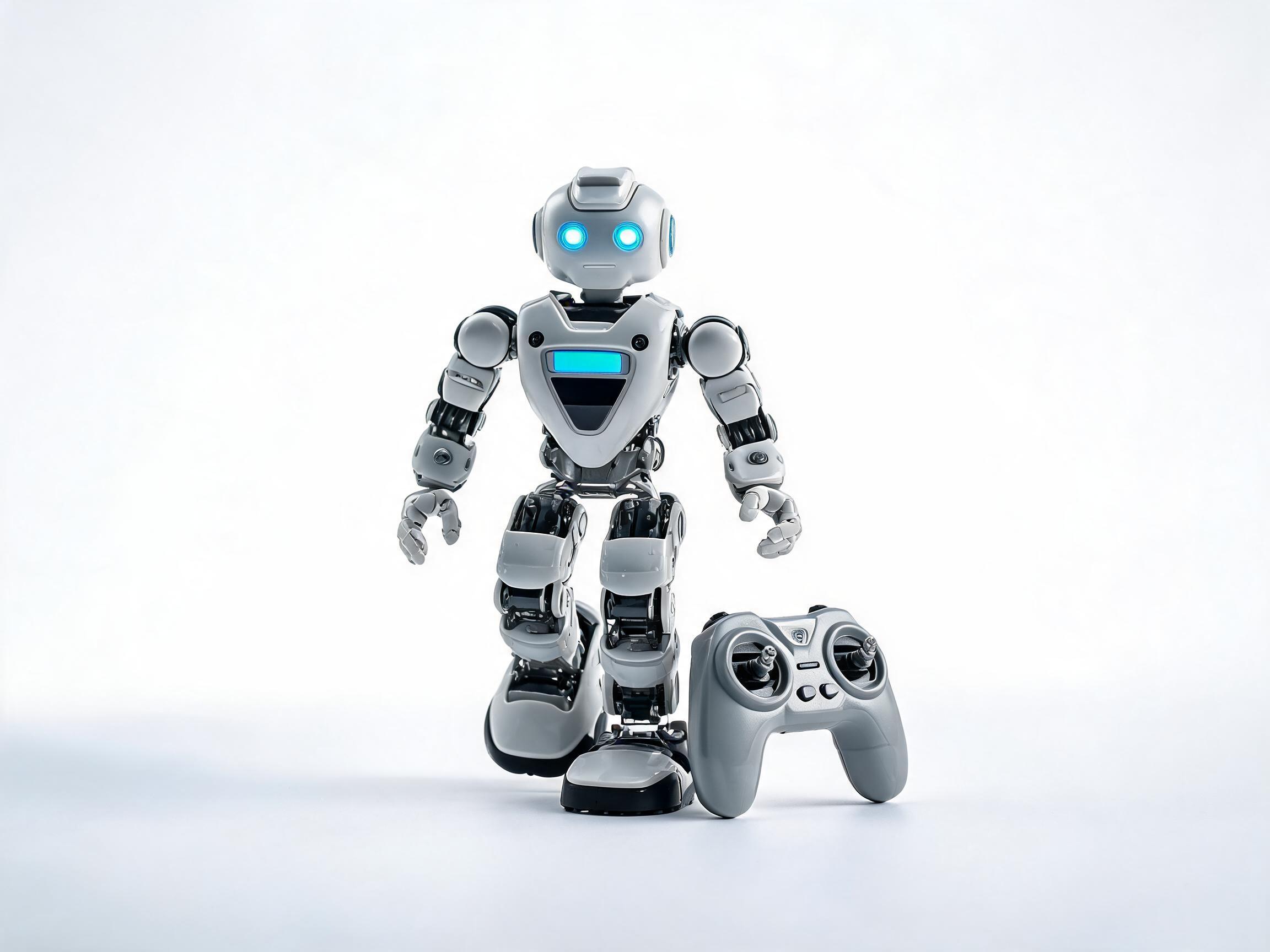
This product is a humanoid robot toy shown in a white-background photo with a white-grey body, blue LED accents, and a handheld controller. The controller is a two-channel unit with a control range of up to 15 m. The robot stands 28 cm tall, uses impact-resistant ABS, runs on 3 x AA batteries, carries an age rating of 6+, and is EN71 / ASTM F963 compliant. MOQ is 500 pcs. Full listing: RC Walking Robot with LED Lights for Indoor Play.
For a buyer, the two-channel controller tells you the robot's movement is organized around two control axes, which matches a walking action. The 28 cm height and ABS body are useful for shelf-presence and durability conversations, while the 3 x AA power source means you should plan battery sourcing or retail packaging that accommodates batteries.
2.4GHz Remote Control Off-Road Car
This product uses a handheld 2.4GHz controller and a rechargeable battery that charges via USB. It carries an age rating of 6+ and an MOQ of 500 pcs. Full listing: 2.4GHz Remote Control Off-Road Car for Gravel and Grass. The rechargeable power source changes the after-sales conversation compared with a disposable-battery toy: you should confirm charging time, cable inclusion, and how the battery is replaced if it fails.
The two products side by side illustrate a common buyer question: both are RC, both are age 6+, both have a 500 pcs MOQ, yet one runs on AA batteries and the other on a rechargeable pack. The label "RC" alone would not tell you that difference; the specification line does.
A quick pre-order checklist
Before confirming an RC toy order, gather these five items from the supplier:
- Channel count and which movements it controls.
- Control range with a note on how it was measured.
- Power source — battery type, count, and whether a charger or cable is included.
- Age rating and the small-parts documentation behind it.
- Certificate for the specific model, covering the standard relevant to your market.
These are the same questions that let you compare two RC products fairly, rather than relying on the RC label alone.
FAQ for buyers
Does a higher channel number mean a better toy?
Not automatically. More channels mean more independent actions, which can increase play complexity and price. A two-channel walking robot and a two-channel off-road car can both be well suited to their intended motion. Match channels to the toy's purpose.
Is 2.4GHz the same as RC?
2.4GHz describes a radio band commonly used in consumer RC systems. It is a detail within the RC category, not a separate category. The practical performance figure to compare is the stated control range.
Why does age 6+ appear on both examples?
Age 6+ is a common rating for motorized RC toys that contain small components or require a degree of coordination. The rating is a safety and usability guideline; confirm it matches the regulations of your destination market.
What does MOQ 500 pcs mean for a first order?
It means the supplier's pricing and production planning are set up for 500 units. If you need a smaller trial quantity, ask whether a sample or trial order is possible and what the terms would be.
How do I verify EN71 or ASTM F963 compliance?
Request the test report or certificate that names the specific model you are ordering. A company-level certificate is not the same as a model-level one.
Specifications in this article are drawn from published product listings. For current pricing, lead times, and model-specific documentation, confirm directly with the supplier.