A sourcing-channel guide for frisbees and flying disc sets. Compare manufacturer-direct, wholesale marketplaces and local distributors, and see which product checks — soft flexible material, rounded rims, set contents, age rating, MOQ and carton packing, EN71/ASTM documentation — actually decide landed value.
Sourcing Channel Guide
A buyer searching for where to buy frisbee stock is usually asking one of two different questions: where do I find a supplier, and which channel gives me the best landed value on a repeatable order. Those are not the same question, and they do not have the same answer. A marketplace listing that looks cheap per unit can cost more than a factory order once packing, inspection and documentation are priced in — or the reverse, if your order is small. This guide covers the three channels retail and program buyers actually use, the product checks that separate a catch-play disc from a novelty item, and how to read the documentation that decides whether your shipment clears customs and your retail listing survives scrutiny.
Key takeaways
- Channel choice follows order size, customization needs and how much verification work you can do yourself.
- For catch play, soft flexible material and a rounded rim matter more than flight distance.
- Set contents — discs plus a carry bag — change the retail price point and the carton math.
- MOQ, carton pack quantity and EN71 / ASTM F963 documentation are what your landed-cost sheet actually depends on.
- Unit price is driven by material, disc size and weight, set configuration, decoration and packing — not by the channel label alone.
On this page
The three sourcing channels, compared
Most retail buyers end up choosing between manufacturer-direct orders, wholesale marketplaces, and a local or regional distributor. Each makes sense under different conditions, and mixing them across a product range is normal.
Manufacturer-direct
Direct factory sourcing becomes the better option once you want control over material, set configuration, color assortment, packaging or branding. It also gives you a single point of contact for compliance paperwork, because the party that makes the disc is the party that knows what went into it. The trade-off is order size: factories quote against a minimum order quantity, and small trial orders may not be economical for either side.
Direct sourcing is also the only channel where OEM/ODM conversations are realistic. If your goal is a private-label flying disc set with your own bag, header card or colorway, this is where that discussion belongs — not in a marketplace message thread.
Wholesale marketplaces
Marketplaces are useful for small quantities, fast top-ups and testing whether a flying disc set sells in your store at all. You can often buy in carton quantities without a factory relationship, and several suppliers compete on the same listing.
The trade-off is verification. A listing photo does not tell you the foam density, the rim finish, the age rating printed on the packaging, or whether the supplier can produce a test report for the exact item. Treat marketplace purchases as sampling and short-fill, and move the repeat order to a factory once the item proves itself — unless the supplier can show you the same documentation a factory would.
Local and regional distributors
Distributors win on lead time and on risk. Stock is already in the country, so you avoid ocean freight, customs clearance and the cash-flow gap of a long production cycle. For program buyers — schools, camps, community sports programs — who need a known quantity delivered before a season starts, that can be worth a meaningful price premium.
The limit is range. A distributor carries what it carries. If you need a specific disc diameter, a specific color assortment or a specific age rating, you may not find it, and you will not be able to change it. Custom packaging is usually off the table entirely.
| Channel | Best fit | Main trade-off to manage |
|---|---|---|
| Manufacturer-direct | Repeat orders, custom sets, own-brand packaging, OEM/ODM | MOQ commitment; longer production and shipping cycle |
| Wholesale marketplace | Trial orders, small top-ups, first market test | Documentation and consistency vary by seller; harder to verify material |
| Local / regional distributor | Short lead time, seasonal programs, low import risk | Fixed range, limited customization, higher unit cost |
Product checks that decide landed value
Two flying discs can look identical in a photo and behave completely differently in a customer's hands. These are the checks that show up in returns rates and in whether a buyer reorders.
Material and rim geometry
For catch play — the use case for most retail flying disc sets sold to families and children — soft flexible material and a rounded rim are the deciding features. A soft foam disc that flexes on impact is far more forgiving for young and beginner players than a hard, stiff disc, and a rounded rim is more comfortable to catch and less likely to sting. If your target buyer is a parent shopping for a gift, this is the product characteristic that drives a positive review.
Harder plastic discs belong to a different use case: long-distance throwing by experienced players. Selling one as the other is a common sourcing mistake, and it shows up as complaints rather than as a spec error.
Set contents and retail price point
Whether you sell a single disc or a set changes the price point, the shelf presence and the packaging cost. A set with multiple discs in different colors plus a carry bag reads as a gift or activity kit, which supports a different retail positioning than a loose disc in a polybag. It also changes the carton math: a set has more components and usually more volume per selling unit, so carton packing quantity matters more when you are calculating freight.
Age rating
Check the age rating printed on the packaging and confirm it matches the intended use. An age 3+ rating suits a soft foam disc set; the rating also drives your warning-label requirements and can affect which retail channels will accept the listing. Ask for the rating in writing rather than reading it from a listing photo.
MOQ and carton packing
MOQ and carton pack quantity are where a quotation either fits your business or does not. A carton pack quantity that does not divide cleanly into your order means broken cartons, mixed pallets and extra handling. Ask for the MOQ per SKU, the units per carton, and whether the carton is the master carton for export or a retail-ready shipper. For set-based products, confirm whether the set is packed as one selling unit per inner box or loose in the master carton.
Flexibility and finish
Ask how the foam behaves at the temperature range your market operates in, and how the disc holds shape after repeated use. These are practical questions for a supplier, and the answers tell you whether the factory understands the product category or is simply relisting a generic item.
What actually drives unit price
Buyers searching how much do frisbees cost often want a single number. There isn't one, because unit price is the sum of several decisions you make during sourcing. Understanding the drivers lets you compare quotations that are not quoted on the same basis.
- Material and density. Soft PU foam, flexible PE and rigid plastic sit at different material costs, and within foam there are density grades. A lighter disc uses less material; whether it performs acceptably is a separate question you should settle with a sample.
- Disc size and weight. Diameter and weight determine material consumption and affect how the disc feels and flies. Larger discs also increase packaging volume, which feeds into freight.
- Set configuration. A set of three discs plus a mesh carry bag contains more material, more assembly and more packaging than a single disc. That cost is real, and it should be offset by a higher retail price point rather than absorbed silently.
- Decoration and branding. Pad printing, full-color labels, custom bag colors and retail packaging all add tooling or setup plus per-unit cost. Custom work usually also raises the MOQ.
- Packing format. Polybag, hang tag, color box, mesh bag, export carton — each layer adds cost and changes carton dimensions, which changes how many units fit in a container.
- Compliance testing. EN71 or ASTM F963 testing for the specific item and configuration adds a one-time cost and requires the item to stay unchanged. Switching foam, colors or set contents can invalidate a report you already paid for.
- Order quantity. Setup costs are spread across the run, so the per-unit figure moves with quantity. This is why a marketplace single-carton price and a factory quotation for a full production run are not directly comparable.
When you compare quotations, normalize them first: same disc diameter and weight, same set contents, same packing format, same quantity, same Incoterm. Only then does the per-unit number mean anything.
Documentation and compliance questions to ask
For toy-category flying discs sold into the EU or the US, the compliance file is part of the product. Ask for it before the order, not after.
- EN71 and/or ASTM F963 documentation covering the specific item and configuration you are buying — not a general statement that the factory "is compliant."
- Confirm the report matches your configuration. The tested item should correspond to the material, colors and set contents you are ordering. If you change the set from three discs to four, ask whether the existing report still covers it.
- Age rating in writing, plus the corresponding warning text required by your destination market.
- Packaging artwork in its final form, so the labels and warnings can be checked against the destination market's rules before printing.
- Sample approval before production. Keep the approved sample and the approval record; it is your reference if a later batch is questioned.
Compliance costs money and time, and a quotation that ignores it is not a cheaper quotation — it is an incomplete one.
Reading a real spec: soft foam flying disc set
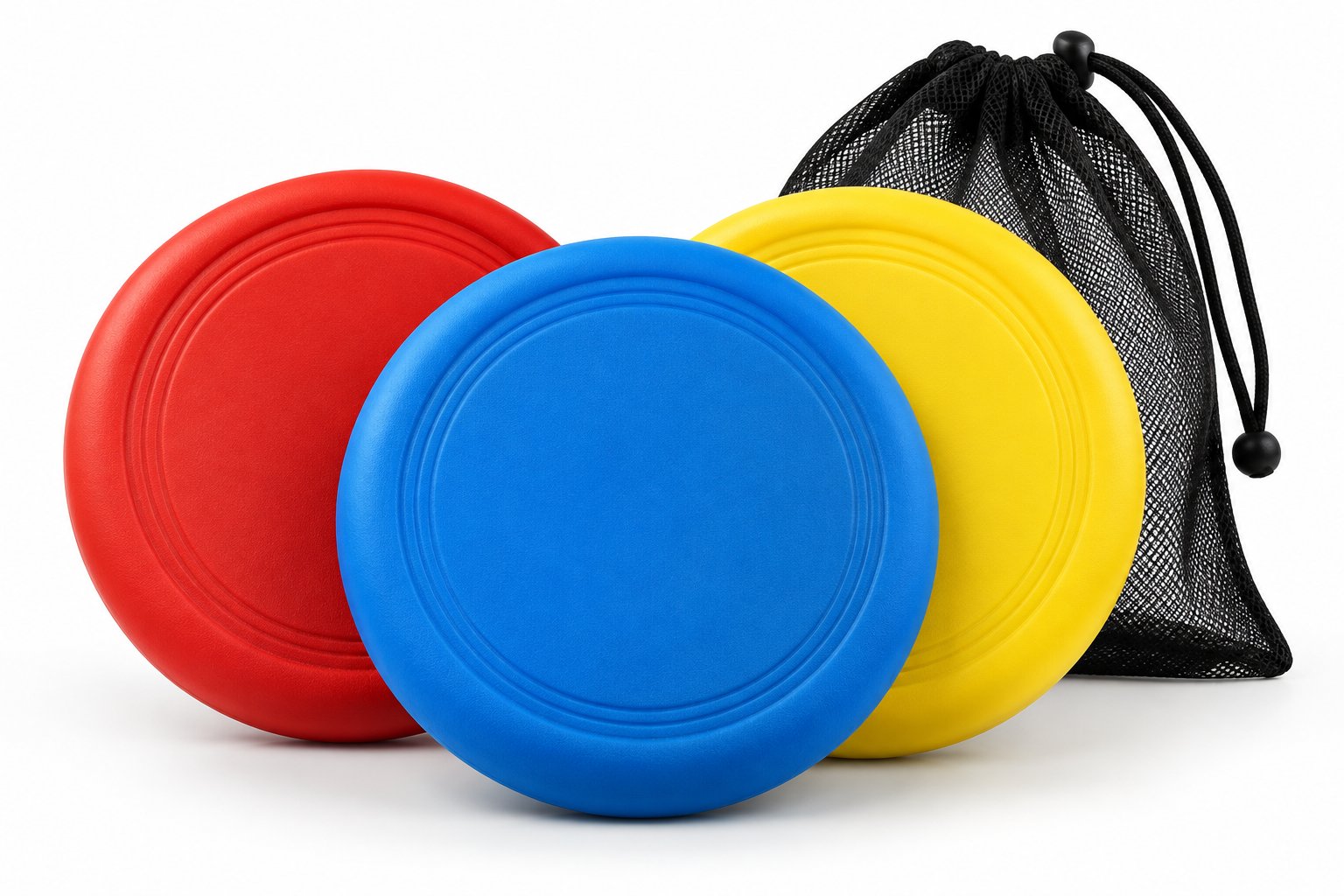
A concrete example makes the checks easier to apply. The Soft Foam Flying Disc Set with Mesh Bag is a set-format product built for catch play, and its published specification covers most of the points above.
| Specification | Value | Why a buyer checks it |
|---|---|---|
| Material | Soft flexible PU foam | Suits catch play and younger players; affects feel and safety perception |
| Rim | Rounded | Comfortable to catch; reduces sting on impact |
| Age rating | 3+ | Drives warning labels and retail channel acceptance |
| Set contents | 3 discs in different colours + 1 mesh carry bag | Supports gift and activity-kit positioning; sets the retail price point |
| Disc diameter | 20 cm | Hand size fit for the age group; affects packaging volume |
| Disc weight | 85 g | Material consumption and handling feel |
| MOQ | 500 sets | Order planning and setup cost spread |
| Packing | Mesh bag + export carton, 36 sets per carton | Freight math, pallet build and handling per carton |
| Compliance | EN71 / ASTM F963 compliant | Toy-category market access in the EU and US |
| Customization | OEM/ODM available | Own-brand colors, packaging and set configuration |
The carton figure is the one buyers most often skip. Thirty-six sets per carton at a 500-set MOQ means the order does not land on full cartons; plan the quantity so cartons, pallets and container fill work out, or confirm with the supplier how partially filled cartons are handled. Note also that the compliance listing is tied to this item and configuration — if you change the set contents or the foam under an OEM program, re-confirm the applicable test documentation for the revised version.
FAQ
- Where should I buy frisbees in bulk for a retail program?
- If you need a repeatable supply with your own branding or a specific set configuration, manufacturer-direct sourcing gives you control and a single point of contact for compliance paperwork. Use wholesale marketplaces for small trial orders and local distributors when lead time matters more than unit cost. The right answer depends on your order size, customization needs and how much verification you can handle internally.
- How much do frisbees cost?
- There is no single figure, because unit price depends on material and density, disc diameter and weight, set configuration, decoration, packing format, compliance testing and order quantity. To compare quotations meaningfully, fix all of those variables to the same basis — including Incoterm — before you look at the per-unit number.
- What is the difference between a soft foam disc and a hard plastic disc?
- Soft foam discs with rounded rims are forgiving on impact and easier for beginners and younger players to catch, which suits family and children's retail products. Harder plastic discs are intended for experienced players throwing for distance. Matching the material to the intended use case matters more than any single spec figure.
- What compliance documentation should I ask for?
- Ask for EN71 and/or ASTM F963 documentation that covers the specific item and configuration you are ordering, an age rating in writing, and the final packaging artwork for label review. Confirm the tested configuration matches what you are buying — changes to foam, colors or set contents can affect whether an existing report still applies.
- Can I order a custom set with my own brand?
- OEM/ODM is available on the soft foam flying disc set, which means colorways, set configuration, packaging and branding can be discussed with the supplier. Expect custom work to affect MOQ, setup cost and lead time, and confirm the compliance position for the revised configuration before production.
If you are comparing channels, request a quotation against your own specification — disc material, diameter, weight, set contents, packing format, quantity and destination market — and ask for the compliance documentation for that exact configuration. Send your requirements to the supplier and the quotation you get back will be directly comparable to the alternatives you are already holding.