
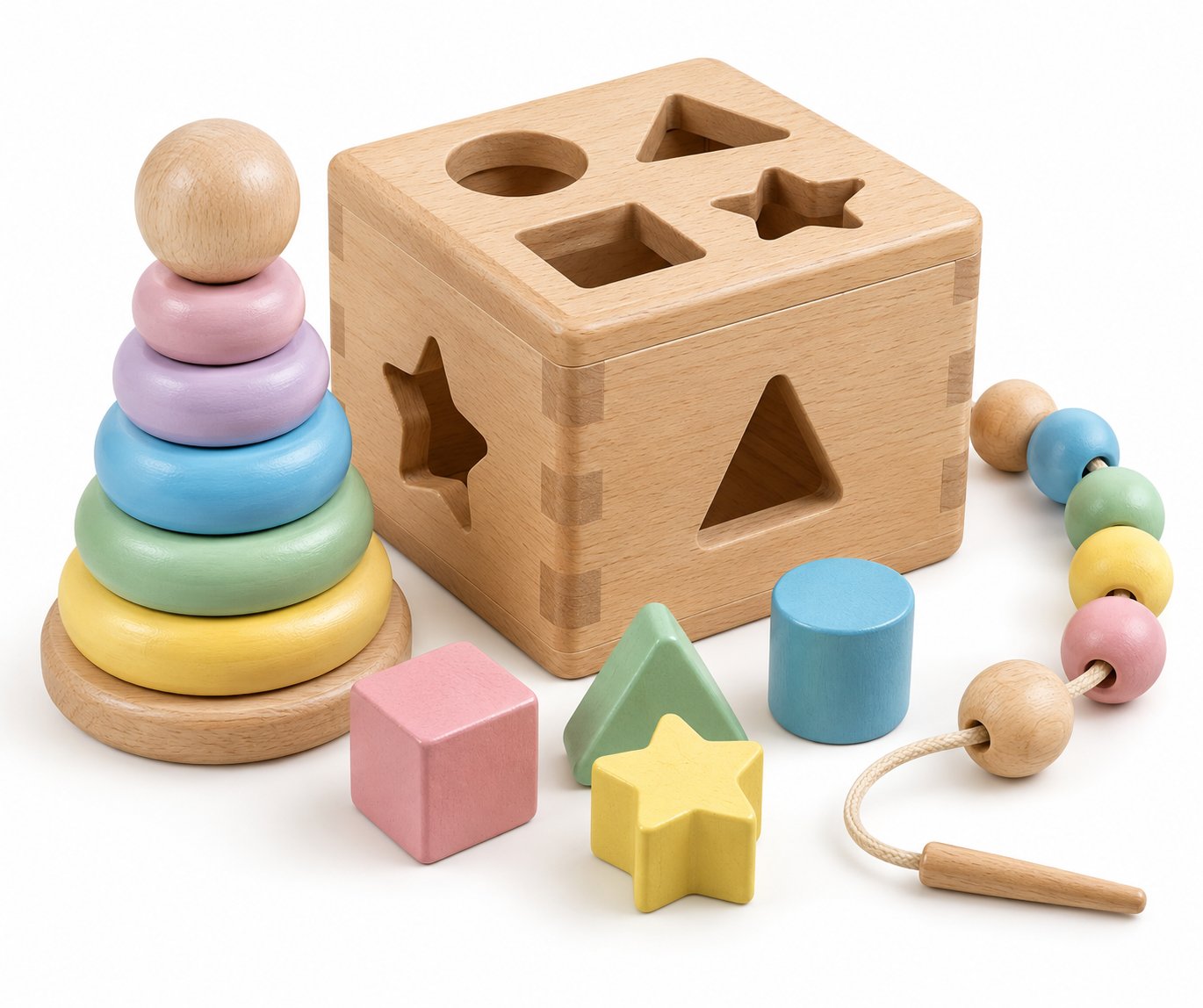
A practical sourcing guide for importers, distributors and school suppliers: the main channels for buying wooden Montessori toys, what to qualify at each one, how to evaluate a wooden Montessori learning set against its drawings, and a buyer checklist covering compliance, wood, finish, carton tests and production-stage inspection.
Sourcing Guide
You have a purchase requirement for wooden Montessori toys — a classroom order, a retail range, a distributor catalogue. The question is not whether stock exists somewhere, but which channel can supply a consistent wooden Montessori learning set, in your specified wood and finish, with the compliance paperwork your market requires, at terms you can live with. This guide sets out the channels, what each one is genuinely good at, and the checks that decide whether an order ships as approved.
What this article covers
Sourcing channels compared
Wholesale Montessori toys reach the buyer through five distinct routes. They are not interchangeable — each has a different answer to the question “can I repeat this order in six months, unchanged?”
| Channel | Best suited to | Main limitation | What to qualify before ordering |
|---|---|---|---|
| Brand manufacturer / factory direct | Private label, custom colours, multi-SKU programmes | Typically higher MOQ; tooling and sampling lead time | Factory audit report, chain of custody for the wood, in-house finishing and assembly |
| Specialist Montessori supplier | Buyers who need curriculum-mapped sets and spare parts | Narrower material options; catalogue-driven pricing | Whether sets are supplied as fixed kits or assembled per line item; spare-part availability |
| General educational toy wholesaler | Mixed containers, low per-SKU volume | Spec depth is thin; substitution between production runs | Named wood species and finish for each SKU, not “wood” |
| Trade fairs (Cologne, Nuremberg, Hong Kong, Canton) | First-round screening, handling samples | You see a sample, not the production run | Ask to take the show sample away and mark it as the approval reference |
| B2B marketplaces | Price benchmarking, spare capacity | Supplier identity behind the listing is often unclear | The legal entity, the actual plant address, and who signs the order |
Two practical rules cut most of the risk. First, buy the factory, not the catalogue: for wooden toys the finishing line (sanding, coating, edge radius) determines whether the goods pass your incoming inspection, and that line belongs to one plant. Second, when you shortlist, ask every candidate for the same four documents so the comparison is like-for-like: the applicable conformity document for your destination market, the material declaration for the wood and finish, the packaging artwork with carton dimensions and gross weight, and the QC plan for the SKUs you are buying.
Certification schemes differ by market — EN 71 and CE marking for the EU, ASTM F963 and CPSIA for the US, ISO 8124 in several other markets. A supplier may hold some or none of these for a given product. Ask for the specific document that names the product, not the factory system certificate alone — and confirm rather than assume.
What “Montessori” changes in the spec
Montessori materials are defined by function, not decoration: a piece is designed so that one attribute is isolated and the child can self-correct. That has direct sourcing consequences, because the things you must specify and approve are the things that make the material work.
- Self-correction by design. On a cylinder block, each cylinder should fit only its own hole. This is a fit-and-clearance requirement you can put in writing: state the pin diameter tolerance and the matching hole diameter tolerance, and inspect both.
- One attribute per piece. Colour, size or shape varies; everything else stays constant. Mixed-variation pieces in one set defeat the purpose, so the approval sample must be checked against the intended variable list, line by line.
- Proportion to the child. Knob sizes, grip diameters and piece weights are sized for a defined age band. Age grading is both a child-safety question and a spec question — the same shape for a 1–3 set and a 3–6 set will have different dimensions.
- Natural, uniform surface. Most programmes ask for a clear or lightly tinted wood finish rather than opaque colour, so grain, knots and sanding marks stay visible. Surface quality is therefore a visible acceptance criterion, not a hidden one.
- Sets, not single units. A learning set is ordered and shipped as a kit. Define the bill of contents with quantities, and treat short or extra pieces as a defect rather than a goodwill adjustment.
For a wooden Montessori learning set sold into schools or a subscription programme, write the bill of contents into the purchase order with item codes, quantities per set, and the spare-piece allowance for the run. That single document is what your receiving inspection checks against, and it removes most disputes before they start.
Inspection: what each stage catches
A toy order rarely fails for one dramatic reason. It fails because the approved sample and the production run diverge in small ways. Each inspection stage catches a different class of divergence:
| Stage | Catches | Document to record it |
|---|---|---|
| Sample / pre-production approval | Material, dimensions, colour and finish, assembly, printed artwork | Signed sample or golden sample plus a written approval record |
| Incoming raw material at the factory | Wood grade and moisture, hardware dimensions, packaging board | Material declaration and incoming inspection record |
| In-process | Machining tolerance, sanding, edge radius, fit between mating parts | Process inspection record per production lot |
| Pre-shipment / final random | Finish appearance, sharp edges, small parts, piece count per set, packing and labelling | Final inspection report with photos of the sampled units |
| Carton integrity | Compression, drop and vibration damage; marking errors | Carton test report for the actual box and weight |
The golden sample is the anchor. If it is sealed at approval and stored at the factory with a copy retained by you, the pre-shipment inspector has an objective reference instead of an opinion. When a question arises later — a shade that reads slightly darker, a knob that feels slightly larger — it is resolved by comparing to the sealed sample, not by description.
For the finish itself, ask for the coating type and the supplier's own material safety data before you approve, and confirm which surface-contact and age-related requirements apply in your destination market. Requirements vary by market and change over time; verify against the regulation in force rather than relying on a supplier summary.
Buyer checklist
Qualify the supplier
- Legal entity name, plant address and who signs the order — not just the trading name on the listing.
- Evidence of what is made in-house: machining, sanding, finishing, assembly, packing.
- Product-specific conformity documents naming your SKUs, with their scope and validity.
- Reference orders of comparable size and finish, if the supplier can release them.
Lock the specification
- Wood species and grade, stated by name rather than as “wood”.
- Finish type and colour, with the shade referenced to a physical sample.
- Bill of contents: item codes, quantities per set, spare-piece allowance.
- Dimensions with tolerances for every dimension that affects fit or self-correction.
- Edge radius and surface-finish requirements written as measurable criteria.
- Age grading and the corresponding small-parts and warning requirements for your market.
Agree the commercial terms
- MOQ per SKU and per combined order, with any set-assembly MOQ stated separately.
- Sampling cost and whether it is credited against the bulk order.
- Tooling or artwork charges, if any, and their ownership.
- Production lead time from approved sample and deposit, with the carton-marking cut-off.
- Incoterm, the named place, and which charges fall on which side.
- Payment schedule and whether the balance is released against a final inspection report.
- Replacement and short-shipment policy, and the window for claims.
Approve the packaging
- Carton dimensions, board grade, gross weight and stacking limit on the drawing.
- Retail labels, barcodes and multilingual text approved as artwork before printing.
- Whether the carton test was run on this box at this gross weight, or on a different one.
Where any item above cannot be confirmed from documents, record it as an open question for the supplier. An unconfirmed item is not a pass and not a failure — it is a question to close before you commit the order.
What actually moves your landed cost
Wooden toys are bulky and relatively light, so freight is charged on volume. Four factors usually outweigh the unit price on the quote:
- Carton cube. A few centimetres off a carton length, multiplied across a container, changes how many units ship. Ask for the packed carton dimensions per SKU before you compare quotes.
- Set assembly. If sets are assembled at packing rather than picked as single units, it adds labour and a piece-count risk that must be priced and inspected.
- Finish cost and rework. Hand finishing and natural finishes leave more room for rework than opaque painted surfaces; agree the acceptable touch-up limit in advance.
- Spare parts and top-up cartons. Spare knobs, pegs and hardware should be ordered with the run, priced as a line item, and packed so they are identifiable.
When comparing suppliers, put the unit price, packed carton dimensions, gross weight, MOQ and payment terms on one sheet for the same specification. Quotes built on different specifications — one in beech, one in a mixed hardwood, one with a tinted finish and one clear — are not comparable, and the cheapest line is often the one with the least defined.
FAQ
Should I buy from a factory or a trading company?
Either can work, but the specification, the approval sample and the QC records should come from the plant that makes the goods. If you buy through a trading company, ask for the plant name and confirm that the approved sample is held there.
How many pre-production samples should I request?
One is a sample; two is a comparison. Multiple units from the same batch let you check whether variation is controlled, and they let you retain one sealed set with the supplier while keeping another for your own records.
Can I add my own carton and retail artwork?
Usually yes, and it is best handled as an artwork approval step before bulk printing. Confirm the dieline, the required barcode format for your market, and the exact text that must appear on the retail and shipping labels.
What should the purchase order state about piece counts?
List each set's contents by item code and quantity, state the spare-piece allowance, and define short or extra pieces as a defect with a claim window. A piece-count clause is cheaper to write than to argue about after arrival.
How do I confirm certification for a specific product?
Ask for the document that names the product and the applicable standard or market, check its scope and validity, and confirm it covers the exact SKU and finish you are ordering. Requirements vary by destination and are revised over time, so verify against the regulation currently in force.
If you are setting up a repeatable wholesale Montessori toys programme, the work is front-loaded: one well-documented approval sample, one purchase order with a full bill of contents, and one inspection plan will save more time than any price negotiation. Put your specification and destination market in front of your supplier early, and ask them to respond in writing on the items you cannot yet confirm.