A beach ball rarely pops for a single reason. This article explains the mechanical causes — seam stress, over-inflation, heat expansion, sharp contact and valve faults — and turns each one into a quality checkpoint wholesale buyers can apply when evaluating beach ball durability before placing an order.
Whitepaper · Buyer's Guide
Why Beach Balls Pop: Durability Facts for Buyers
Search interest around "how to pop a beach ball" is usually the opposite of what it looks like. Few people want to destroy one — they want to understand why the ball in their hands lost its shape, tore at a seam, or went soft within a week. For buyers sourcing these products wholesale, the same question is a quality-control brief: if you can name the failure mechanisms, you know what to inspect before the carton leaves the factory.
This article separates the physical causes from the purchase consequences. It covers the reasons a beach ball fails in the field, then converts each cause into a checkpoint you can apply when evaluating a supplier's beach ball construction, based on the failure modes described here rather than on marketing claims.
What this article covers
Key takeaways
- Beach balls fail through specific, inspectable points — not through one general "weakness."
- Seam quality and valve assembly are the two failure points most buyers undervalue.
- Heat and over-inflation compound the same stress; they are not independent risks.
- A supplier's QC process should be described in terms of what is measured, not how many years they have been in business.
- For group-play sets, durability should be judged against the whole set's intended use, not the ball in isolation.
The five failure mechanisms of a beach ball
A beach ball is a thin-walled, low-pressure pressure vessel built from multiple panels welded or bonded together. Its failure is rarely a mystery: it is almost always traceable to one of five points — a seam, over-inflation, thermal expansion, a sharp contact surface, or the valve. Each has a distinct inspection signature, and each can be requested as a specific quality criterion in a purchase order.
1. Seams and panel joints
Beach balls are made from panels joined along continuous seams. Those seams carry the full hoop stress of the inflated ball, and they are the first thing to give when a batch has weak bonding, uneven panel alignment, or a heat-seal process that has drifted out of tolerance. A ball can look perfect when flat and fail after the second or third inflation. Seam integrity is a process outcome — it depends on the equipment, temperature control and inspection regime on the production line, not on the printed pattern on the ball.
What this means for QC: ask the supplier to describe how seam strength is checked and whether the check is destructive or sampled. A visual inspection alone will not detect a seam that is bonded but under-strength.
2. Over-inflation and heat expansion
A beach ball is not a high-pressure product. Its design assumes a lightly inflated, slightly yielding surface so it can be caught, thrown and sat on without rupturing. Inflate it harder than the design intends and the wall and seam stress rise immediately. The more common version of this in the field is thermal: a ball left in a car boot, a storage container or direct sun absorbs heat, the contained air expands, and the internal pressure climbs without anyone adding air. The two factors compound — an over-inflated ball in a hot car is a much higher-stress combination than either condition alone.
What this means for QC: quality control here is partly a matter of end-user instructions. Good manufacturers specify how full to inflate and warn against sun and vehicle storage. Ask whether the retail packaging carries that guidance, and whether the ball's intended inflation state was tested at an elevated temperature.
3. Sharp surfaces and play conditions
A thin plastic wall will puncture on gravel, a sharp edge, a fence wire, a key in a pocket or a pet's teeth. This is not a manufacturing defect in most cases, but the material choice determines how much a boundary surface tolerates before it fails. Softer, more elastic vinyl-type plastics deform around a sharp edge and resist a puncture longer than a stiffer sheet that has been formulated for a specific cost point. Durability here is a materials trade-off, and it belongs in the RFQ, not the after-sales file.
4. Valve and plug faults
The valve is the smallest component on the product and one of the most commonly overlooked. A valve seat that does not seal fully, an insert that is poorly bonded into the ball, or a plug that does not sit flush will let the ball go soft. Soft balls invite over-inflation to compensate — which brings the seam and heat risks back into play. The failure loops on itself.
What this means for QC: a simple leakage test on a sample after inflation is a meaningful check that many buyers never request. Ask whether the supplier performs it and at what sampling rate.
The buyer QC checklist
The table below maps each failure mechanism to a concrete item you can put into a purchase order or a pre-shipment inspection brief. It works for standalone beach balls and for multi-piece outdoor play sets that include one.
| Failure mechanism | What to request | Why it matters |
|---|---|---|
| Seam integrity | Seam specification from the supplier, plus a stated inspection point after sealing | Seams carry the ball's internal pressure; a visually clean seam can still be under-bonded |
| Wall material | Material and grade confirmed in writing, with the supplier stating it is a weather-resistant plastic or fabric | Puncture tolerance is material-dependent; it is a purchase decision, not a guess |
| Inflation guidance | Retail packaging that states a recommended inflation level and warns against heat/sun storage | Most field failures are end-user conditions the packaging can pre-empt |
| Valve and plug | Confirmation that valve seat and plug fit are checked, and whether a leakage test is performed on samples | A losing valve leads to over-inflation and secondary failures |
| Age suitability | Age marking confirmed as 3+ on packaging and product | Fits group-play use; also a compliance and labeling requirement |
| Compliance | Confirmation of EN71 and ASTM F963 compliance for the supplied configuration | Essential for children's toys in EU and US markets; verify the scope applies to your exact item |
| Finished-product checks | A written description of which checks happen after assembly and before packing | Lets you compare suppliers on process, not on adjectives |
Use the checklist as a set of questions to put to each supplier. The answers — not the presence of the questions — should drive the decision.
What to ask when you sample
When you sit down with a shortlist, the quality conversation is often more revealing than the price conversation. The following prompts separate suppliers who can describe their process from suppliers who cannot:
- Material inspection: Is incoming material checked against a stated specification, and by whom?
- Seam sampling: Are seams inspected on samples at a defined point in the line?
- Valve check: Is the valve tested for leakage, and what does the failure rate look like on the test sample?
- Packaging review: Does the retail packaging carry the inflation and heat-storage guidance?
- Finished-product inspection: What is checked after assembly and before packing, and is the record retained?
What an in-house QC laboratory should actually do
Suppliers commonly cite an "in-house QC laboratory" as a badge of reliability. For a buyer, the useful question is what that laboratory is for — specifically, whether it performs material inspection on incoming stock and finished-product checks before packing. Those two functions are the ones that map directly to the failure mechanisms above: incoming material inspection catches weak or off-spec sheet before it becomes a defective ball, and finished-product inspection catches seam and valve faults before they are boxed and shipped.
One workable reference is a supplier whose stated process covers exactly these two steps: Fujian Lequ Wanwan Co., Ltd. describes an in-house QC laboratory that performs incoming material inspection and finished-product checks before packing. Treat that as the supplier's own process statement rather than an independent certification, and verify it against order records and pre-shipment inspection reports.
Beach balls inside a multi-piece set
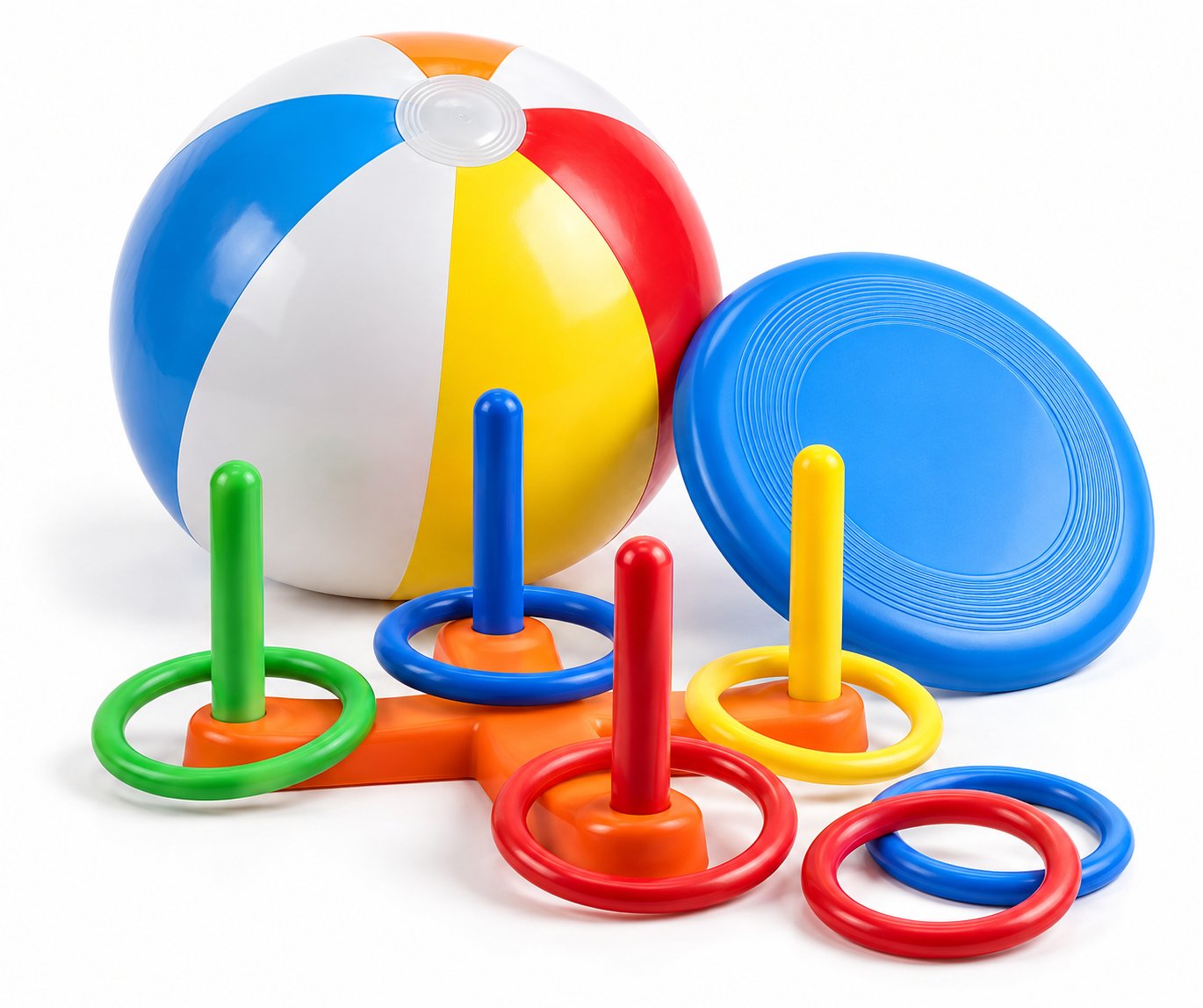
Many buyers source beach balls as part of an outdoor sports set rather than as a standalone item. That changes the durability question slightly. A set with a beach ball, a flying disc and a ring toss game is used by a group, in the sun, on grass and gravel — conditions that stress a ball harder than a single-user context. The ball must be judged against the set's whole intended play pattern: it will be handled by several people at once, sat on, dropped and stored outdoors.
If you are evaluating a set of this kind, it is worth treating the ball's seam and valve checks as the same priority as the other components' construction. Sets can also be sourced under OEM/ODM terms, and when the design is customized, the original material and seam specification should carry over unless you specifically ask for a change.
Compliance, MOQ and how the order fits together
Two practical constraints sit around any beach ball order and are worth confirming early:
- Compliance: For a children's toy sold in EU and US markets, the relevant benchmarks are EN71 and ASTM F963. Confirm the specific configuration of your order is within the supplier's compliance scope, and keep the compliance documentation with your purchase file.
- MOQ: Beach balls and play sets are commonly offered at minimum order quantities; a quote at one MOQ may not apply to a different packaging or OEM configuration, so clarify that early.
Order MOQ 500 sets, age marking 3+, EN71 and ASTM F963, color box plus export carton packaging and OEM/ODM availability are the current listed terms for the Outdoor Sports Set with Beach Ball and Ring Toss for Group Play. Those are catalog statements; confirm them in your quote for your specific order.
Putting the checklist to work
When you next receive samples, inflate them to the recommended level, leave one in a warm environment for a period, and inspect the seams and valve after a short cycle of play. That exercise does not prove long-term durability, but it will tell you how the supplier's process responds to the two most common field conditions — heat and normal handling. Combine the result with the written answers from the checklist and you have a decision built on evidence rather than brochure language.
If you are sourcing play sets that include a beach ball and want the durability conversation to start from process rather than promises, the Outdoor Sports Set with Beach Ball and Ring Toss for Group Play page lists the current configuration. From there, the questions in this article are the right ones to put to any supplier on your shortlist.
Frequently asked
Can a beach ball be repaired after a seam failure?
A seam that has opened along its bonded edge generally cannot be repaired to the original strength with a patch. A clean puncture in the panel is a different case and can sometimes be patched, depending on the material. The practical answer is that seam failure is a quality-control matter, not a field-repair matter.
Does the printed pattern affect durability?
Printing itself does not set seam strength. It can, however, indicate whether a batch came from the same production line as the sample you approved, which is why keeping the approved sample on file matters when you receive bulk production.
Are beach balls in outdoor play sets tested the same way as standalone balls?
The material and seam checks apply equally. The difference is the intended play pattern: a set for group play should be evaluated under multi-user handling and outdoor storage, so the valve and seam checks carry proportionally more weight.