For retail buyers and importers: a practical checklist for sourcing indoor RC drift and stunt cars. Covers movement type (drift slide vs. stunt spin), controls, chassis, battery, age rating, and the supplier checks to run before you place a 500-piece order.
A good indoor RC drift car is one that matches the movement a customer actually wants, runs on a controller with enough range for the room it will be used in, and comes from a supplier who can document the age rating, battery type and compliance file for the exact model on the order. Everything else — body style, colour, packaging — is a second-order decision you can negotiate once those four points are settled.
- Drift slide vs. stunt spin: two different products
- Control channels and operating range
- Wheels, chassis and indoor surfaces
- Battery, charging and the AA question
- Age rating and compliance documents
- What to verify with a supplier before ordering
Start with movement type: drift slide or stunt spin?
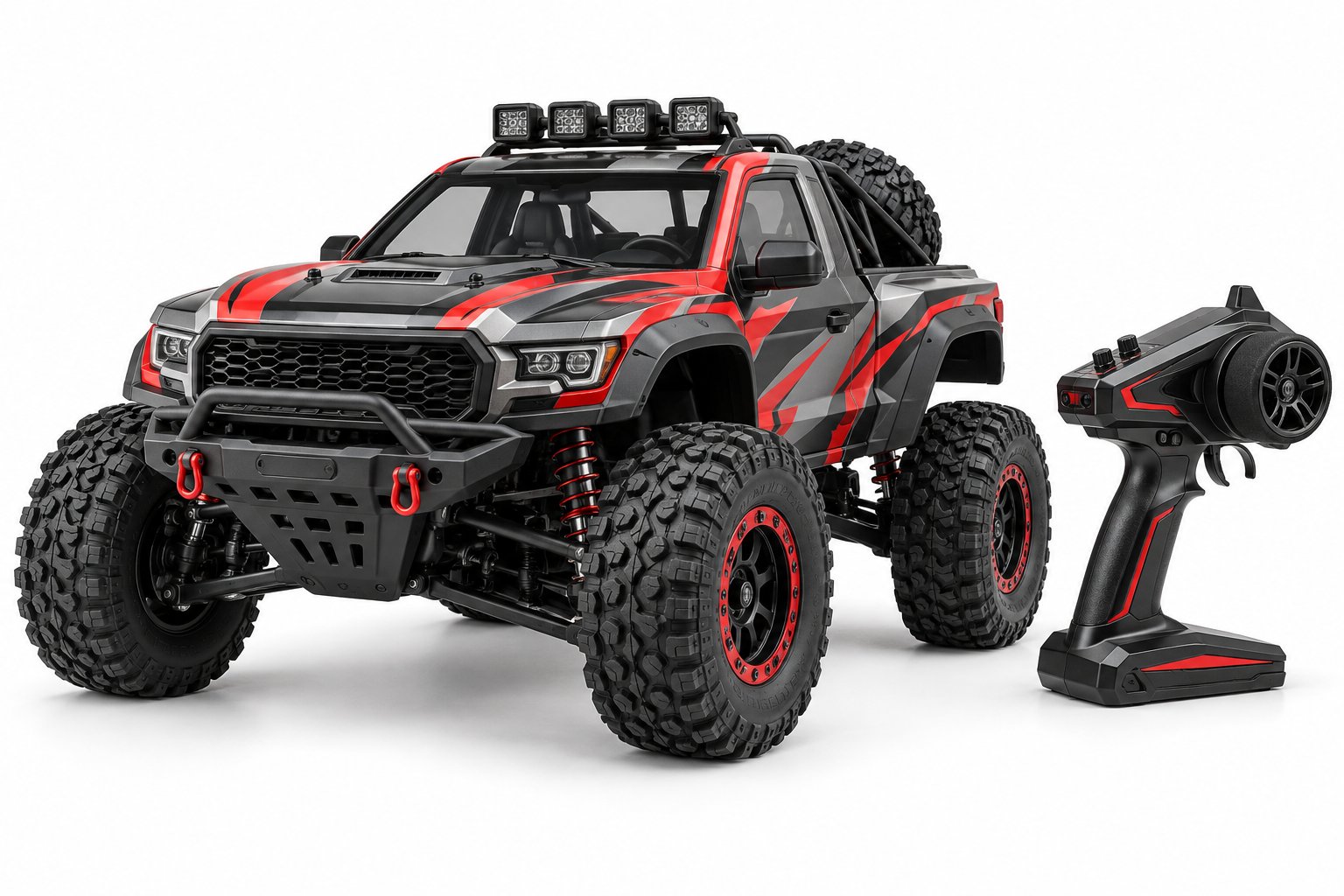
This is the single most common sourcing mistake in the indoor RC category. Buyers search for "drift car" and then order a stunt car, or the reverse, and the product does not do what the end customer expects.
A drift car slides. The rear end breaks traction while the front wheels steer, and the car travels through the corner at an angle. It requires a chassis and tyre combination that can hold a slide on a smooth floor, and it rewards throttle control.
A stunt car spins. The best-known format is a 4-channel car with a 360-degree spin function, where the body rotates in place on the spot or flips over and keeps driving. It is a different play pattern: quick, visual, easy to demonstrate in a shop, and it does not ask the user to learn a drift line.
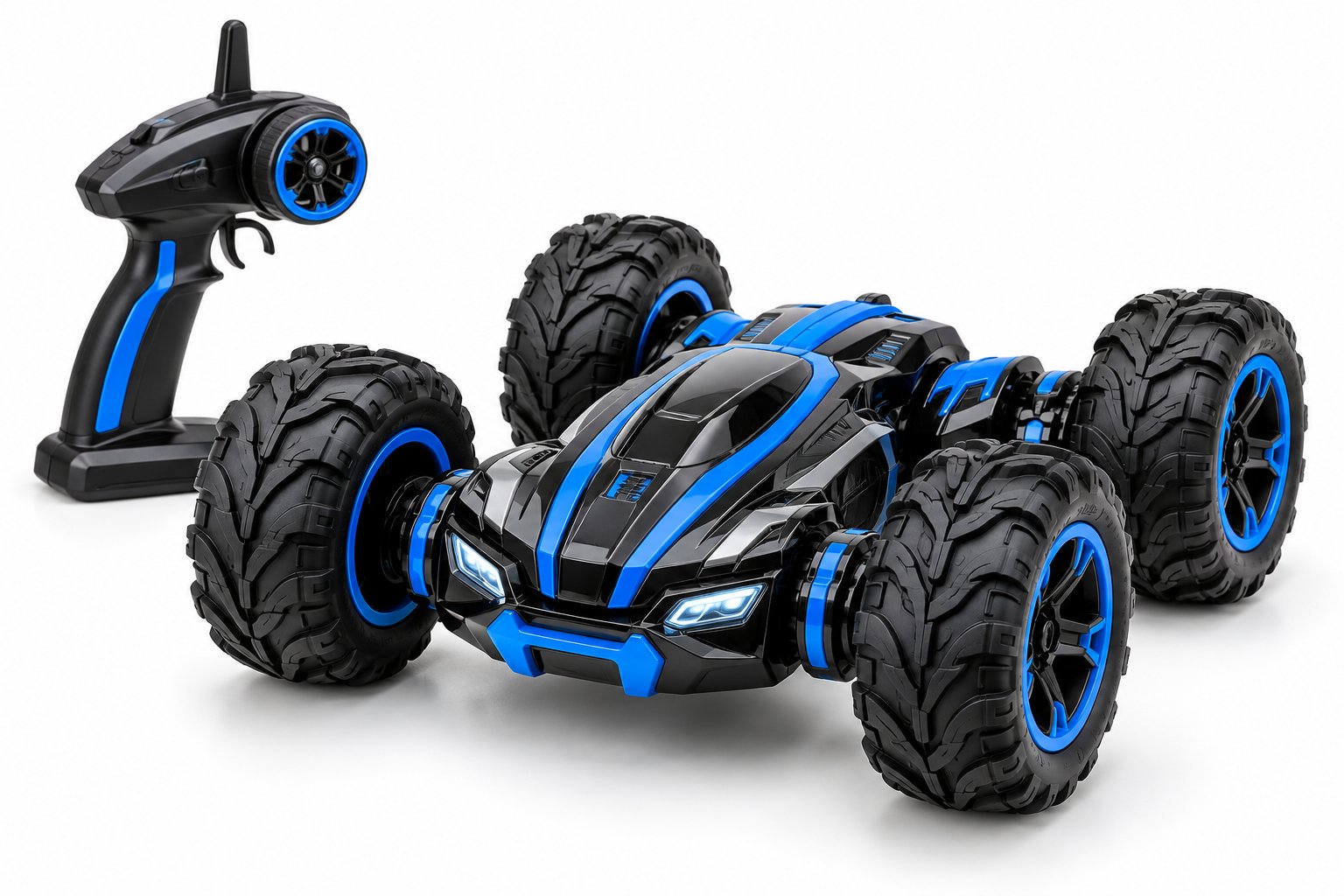
Neither is "better". They answer different briefs. If your shelf label says "drift", stock a car that slides. If your shopper is buying for a six-year-old who wants a car that spins and flips on the kitchen floor, a stunt car is the honest description. For that format, the 4-channel RC stunt car with 360-degree spin is a concrete reference: 24 × 16 × 9 cm, ABS body with soft rubber wheels, 3.7 V rechargeable USB battery, and a controller that takes 2 × AA batteries (not included).
Control channels and range
Channel count tells the buyer how many functions the handset controls — steering, throttle, and one or two extra functions such as spin or flip. A 4-channel handset therefore supports a car with more than forward/back and left/right, which is what makes the 360-degree spin function possible.
Range matters more indoors than outdoors, because the car stays within one room or one shop display area. A control range of up to 30 m is more than a typical living room or toy aisle needs, and that headroom is useful when the car is demonstrated on a shop floor or in a mall display where the operator stands back from the track.
For off-road style products, 2.4 GHz is the frequency to look for. It is the standard for the handheld controller on the 2.4 GHz RC off-road car, which uses USB charging and is rated for age 6 and up.
Wheels, chassis and indoor surfaces
Indoor RC cars run on tile, laminate, vinyl and low-pile carpet. That surface mix drives three spec questions:
- Tyre material. Soft rubber wheels grip smooth flooring without scratching it. Hard plastic wheels slide unpredictably and mark some surfaces. The stunt car above uses soft rubber wheels; for off-road bodies, soft rubber deep-tread tyres appear on the 4WD RC off-road truck.
- Body material. ABS shells resist the repeated knocks that indoor play produces. Impact-resistant body shells are specified on the 4WD off-road truck.
- Suspension. Independent suspension, as on that 4WD truck, helps the car stay settled when it crosses a rug edge or a floor threshold. For a pure indoor spin car, suspension is less critical than body clearance and wheel material.
Size is the fourth variable. A car around 24 × 16 × 9 cm fits a hallway or a shop demo table. Very large cars need more floor than most homes have.
Battery, charging and the AA question
Two battery decisions affect returns and reviews more than anything else on the box.
Car battery. USB-rechargeable packs are the current default across the category and are used on all three reference models here. A 3.7 V rechargeable USB battery keeps the car light and removes the cost of disposable cells from the end user's running cost.
Controller battery. This is where customers get caught out. The 4-channel stunt car's controller takes 2 × AA batteries that are not included. If you plan to sell through retail, decide early whether to bundle AA cells, add a "batteries not included" callout on the packaging artwork, or leave it to the retailer. A clear callout prevents the most common one-star complaint in the category.
Age rating and compliance documents
All three reference models are rated age 6 and up, which is typical for this category. The rating is a claim on the product file, not just a line on the box — it should be supported by the same documentation set that covers the toy safety standards for your destination market.
EN71 and ASTM F963 compliance are stated for the 4-channel stunt car and the 2.4 GHz off-road car. If your market requires either standard, ask for the test report that names the exact model number on your purchase order, and check the report's date and scope. A report for a different model in the same family is not the same document.
What to verify with a supplier before ordering
Once the format is clear, the commercial conversation is mostly a checklist. The points below are the ones that change cost, lead time or compliance risk.
| Item to verify | Why it matters |
|---|---|
| Movement function of the exact SKU | Confirm in writing whether the car drifts (slides) or performs a 360-degree spin, so the listing description matches the product. |
| Control range and frequency | Up to 30 m for the stunt car; 2.4 GHz for the off-road car. Match the number to the room or display area your customer uses. |
| Battery type and what is in the box | Car: 3.7 V USB rechargeable. Controller: 2 × AA not included on the stunt car. Decide bundling before artwork is finalised. |
| Certification file for that model | EN71 / ASTM F963 per the model; request the report naming the order's model number. |
| MOQ and whether OEM/ODM applies | MOQ is 500 pieces on the stunt car and the 2.4 GHz off-road car. OEM/ODM is available on the stunt car; colour and body style customisation are offered on the 2.4 GHz car. |
| Packaging and labelling content | Battery callouts, age marking and language set must match the destination market. |
Quick answer for buyers
If you need an indoor spin-and-flip product for age 6+, a 4-channel car with a 360-degree spin function, up to 30 m range, ABS body and soft rubber wheels is the straightforward brief, at an MOQ of 500 pieces with EN71 / ASTM F963 documentation and OEM/ODM available. If you need indoor off-road play, a 2.4 GHz USB-rechargeable car at the same MOQ is the closer fit, with colour and body style customisation. If you need rough-surface capability, the 4WD truck with independent suspension and deep-tread tyres is the spec to quote.
Where to buy RC drift cars as a trade buyer
Most importers source this category through one of three routes: a factory that manufactures the chassis and can run OEM/ODM for your brand; a trading company that consolidates several toy categories into one container; or a domestic wholesaler for small trial orders.
The route determines what you can change. If custom branding or body style is central to your listing, confirm early whether the supplier manufactures the mould or buys finished units — the answer decides whether your customisation is a colour change or a new tooling project. For OEM/ODM questions on the stunt car platform, or to discuss colour and body style options on the 2.4 GHz car, the practical next step is to send your target market, order quantity and packaging requirements and ask for the spec sheet and test report for the exact model quoted.
FAQ
Is a drift car the same as a stunt car?
No. A drift car slides through corners at an angle. A stunt car typically spins 360 degrees in place or flips. The 4-channel model here is a spin car — the correct description for a listing is "360-degree spin", not "drift".
What is the best RC car for beginners?
For indoor play by a first-time user, the simpler the better: a 4-channel car with a spin function needs less throttle control than a drift car, and a 2.4 GHz controller removes the antenna matching that older frequencies required. Both reference models are rated age 6 and up.
How much do RC cars cost?
Trade pricing depends on order quantity, customisation and packaging, so it is quoted per order. MOQ is 500 pieces on the stunt car and the 2.4 GHz off-road car; request a quotation with your target quantity and packaging spec.
Do the cars come with batteries?
The car itself uses a 3.7 V rechargeable USB battery. On the 4-channel stunt car, the controller takes 2 × AA batteries that are not included — plan the packaging callout or bundle accordingly.
Can I put my own brand and packaging on the order?
OEM/ODM is available on the 4-channel stunt car, and colour and body style customisation is offered on the 2.4 GHz off-road car. Confirm the exact scope — logo, box artwork, manual language — when you request the quotation.
Before you place the order, ask for four documents and one confirmation: the spec sheet for the exact model, the EN71 or ASTM F963 report naming that model, the battery specification, the packing list with the AA callout, and written confirmation of whether the car drifts or spins.