
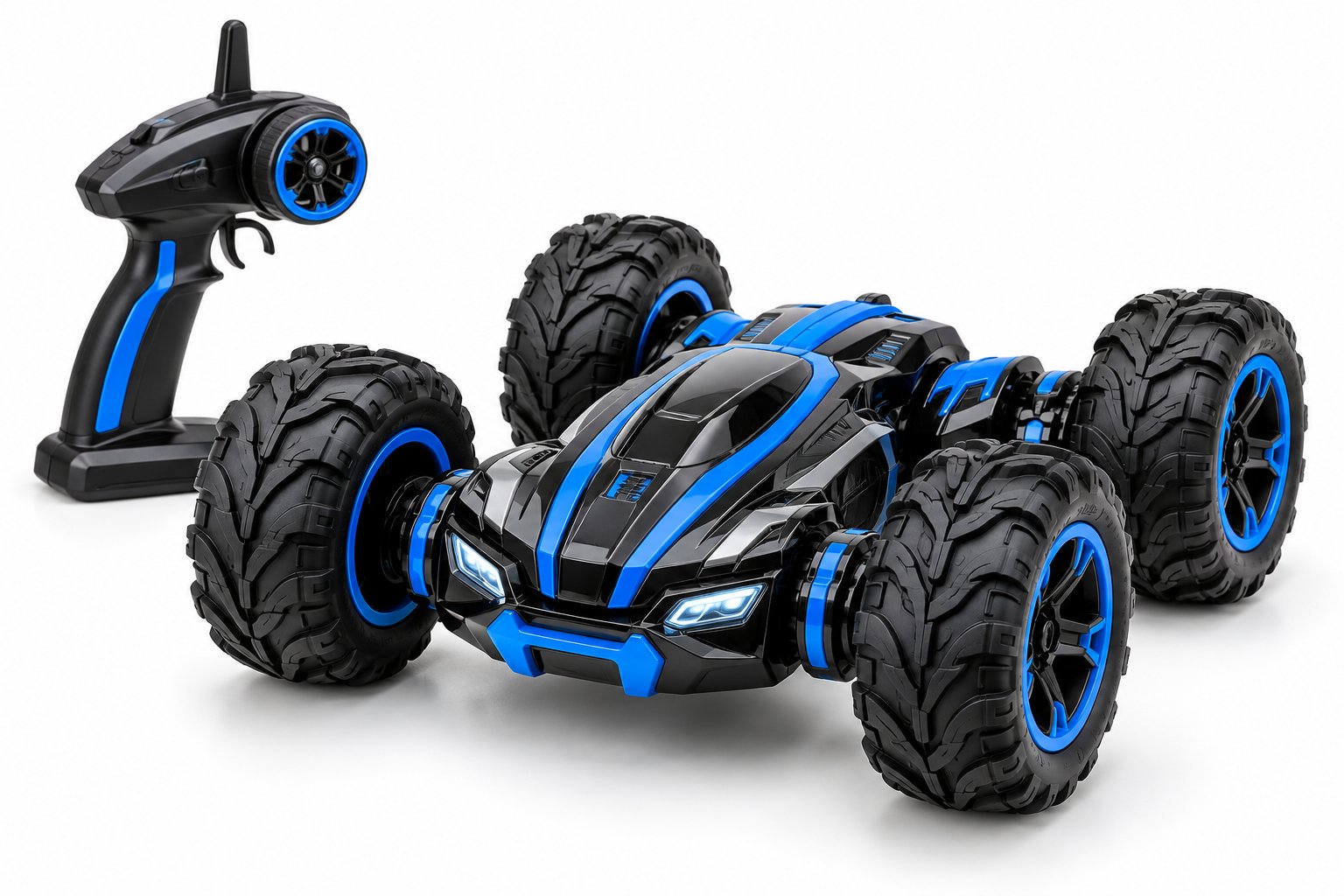
A buyer's checklist for evaluating remote control stunt cars: how 360-degree spin is implemented, channel count and control, tires and chassis design, battery and charging, age suitability, and MOQ with customization options.
Buyer's Selection Guide
A stunt car is not judged by how fast the box looks. It is judged by how the trick is actuated, how the driver keeps control, and whether the battery, chassis and compliance paperwork hold up in the retail channel you sell into.
Key Takeaways
- Confirm how the stunt is triggered — a controller command such as a 360-degree spin is easier to merchandise and demo than a trick that depends on body momentum.
- Channel count tells you the control set: 4-channel means throttle plus steering plus the stunt function.
- Chassis height and tire compound decide whether hard cornering tips the car or holds the line.
- Check battery format and charging method, and count the controller batteries a shopper must supply separately.
- Match the age grading and EN71 / ASTM F963 status to your destination market before placing a purchase order.
Start With the Stunt Itself
The search phrase most buyers type — “what is the best rc stunt car” — really asks a narrower question: which features decide whether a stunt car is worth stocking? The first answer is mechanical, not cosmetic. A trick is either commanded by the remote or produced by the shape of the vehicle.
The 4-Channel RC Stunt Car with 360-Degree Spin is an example of the first type: the 360-degree rotation is triggered from the controller. That matters at the point of sale, because a store associate or a parent can demonstrate the feature with one button instead of needing a runway and the right surface. Stunt execution driven by body geometry can look impressive on video but is harder to reproduce on a shop counter or a living-room rug.
When you compare suppliers, ask for a short demonstration video showing the stunt performed on a normal indoor surface, not a cutaway clip. If the supplier cannot show the trick being triggered from the transmitter, treat the stunt claim as unconfirmed.
Channel Count, Control Range and Response
Channel count is a shorthand for how many functions the transmitter drives. A four-channel set covers forward/reverse, left/right, and the stunt command — the configuration on the 360-spin model above. Two-channel toys steer and drive but leave no dedicated stunt channel.
Remote range is a specification buyers often overlook. The 360-spin model lists a range of up to 30 m. For indoor play that is far beyond what most rooms allow; outdoors it defines the useful play area. Buyers writing product copy or shelf talkers should stay with the supplier-stated figure and not extend it — quoted range varies with interference, battery state and surroundings, so a longer number printed on packaging invites complaints.
Tires, Chassis and How the Car Handles a Turn
Two physical details decide whether the car keeps its line during a spin or rolls onto its roof.
- Tires: the 360-spin model uses soft rubber tires with a deep tread pattern. Rubber grips better than hard plastic on tile and low-pile carpet, which is where most gifting purchases actually get used.
- Chassis height: a low-slung chassis is specified on the same model specifically to reduce rollover during sharp turns. A tall body raises the center of gravity and makes quick direction changes more likely to tip.
Neither point is a performance guarantee. They are design choices you can look at in a sample and discuss with the factory. If your market skews toward rough pavement or gravel, ask what surface the chassis and tires were evaluated on before assuming the same behavior.
Body, Size and Materials
Body material affects both the price and the return rate. The 360-spin car uses an ABS body, a common choice for impact-prone toys because it holds shape and takes printed decoration cleanly. The assembled body measures 24 × 16 × 9 cm — a size worth checking against your packaging plan and against the shelf or gift-box dimensions you already run.
At this size the vehicle fits standard gift packaging and is light enough for e-commerce parcel rates, but confirm the packed weight and carton dimensions with the supplier before you commit to freight estimates.
Battery, Charging and the Hidden Battery Count
Battery details drive two different costs: the unit cost of the toy, and the shopper's complaint rate after purchase. On the 360-spin model:
- Vehicle power: 3.7 V rechargeable battery, charged via USB.
- Transmitter power: 2 × AA batteries, not included.
That last line is the one to plan for. Customers who open a gift on a holiday morning and find no AA batteries in the box generate a predictable spike in negative reviews. Some buyers bundle AA cells or add a “batteries not included” callout directly on the retail box front. Decide which approach fits your channel and confirm packaging artwork with the factory early.
USB charging also means the toy does not need a wall adapter, which simplifies the electrical compliance file for many markets — but the charging cable itself should be listed in the components and packing list.
Age Grading and Compliance
The 360-spin stunt car is specified for ages 6 and up, and is stated as EN71 and ASTM F963 compliant. EN71 covers the European toy safety standard; ASTM F963 is the corresponding US consumer safety specification for toys. Both are relevant if you sell into Europe or North America, but the certificate you receive must match the exact model and batch you are importing — a similar product's paperwork does not transfer.
Ask for the test report reference, the model it covers, and its validity date before you place a bulk order. If you sell into additional markets, ask which certifications are available for those destinations.
MOQ, Packaging and Customization
| Item | Specification |
|---|---|
| MOQ | 500 pieces |
| Packing quantity | 24 pieces per carton |
| Packaging | Color box + outer carton |
| Body size | 24 × 16 × 9 cm |
| Age grading | 6+ |
A 500-piece MOQ with 24 pieces per carton works out to roughly 21 cartons for a full minimum order — useful when you estimate warehouse space or a container load. The color box plus outer carton format is standard retail packaging; whether custom printing, private label or an alternative gift-box structure is available needs to be confirmed with the supplier per project, since tooling and print setup vary by design.
Checklist Before You Order
- Confirm the stunt is triggered from the controller, and request a normal-surface demo video.
- Match channel count to the functions you intend to advertise.
- Inspect tire compound and chassis height on a physical sample, not a render.
- Confirm battery format, charging method, and which cells the customer must supply.
- Verify the EN71 / ASTM F963 report covers the exact model and batch.
- Reconcile MOQ, carton quantity and box dimensions with your freight and shelf plan.
- Settle packaging customization and artwork approval timing in writing.
For the setup side of the conversation — charging, pairing and first-drive checks — see our guide on how to set up a remote control car.
Buyer FAQ
Is a 4-channel stunt car better than a 2-channel one?
They serve different price points. Four channels give the transmitter a dedicated stunt function, which supports on-shelf demonstration and clearer marketing claims. Two-channel cars are simpler and cheaper but the trick depends on the vehicle's body geometry rather than a commanded action.
Does the stated 30 m range apply outdoors?
Range is stated as up to 30 m. Real-world range depends on battery charge, obstacles and radio interference, so treat the figure as a maximum and avoid printing a stronger claim on packaging.
Are batteries included?
The vehicle uses a 3.7 V rechargeable battery charged by USB. The transmitter requires 2 AA batteries, which are not included. Decide whether to bundle them or label the box clearly.
Can the packaging be customized?
The standard format is a color box plus outer carton. Customization options depend on the design and order volume, so confirm availability for your specific artwork and quantity with the supplier.


