A channel-comparison sourcing guide for educational toy buyers in North America and Europe. Compare manufacturer-direct, wholesale marketplaces, and local distributors on MOQ, packaging, compliance, and OEM/ODM flexibility.
Sourcing Guide
If you are a retailer, school program buyer, or distributor searching for where to buy building blocks in bulk, the first decision is not which product to pick. It is which sourcing channel to use. The three main options — manufacturer-direct, wholesale marketplaces, and local distributors — each come with different minimum order quantities, packaging options, compliance documentation, and flexibility for your own branding.
This guide compares those channels against the criteria that matter most in educational toy procurement: MOQ, packaging, certifications, and OEM/ODM availability. It also flags the questions you should ask before placing a first order.
Key takeaways
- Manufacturer-direct sourcing typically offers the most control over packaging and customization — but only when the factory is set up for export compliance.
- Wholesale marketplaces reduce search effort but often limit your ability to change packaging or request OEM/ODM work.
- Local distributors shorten lead times and simplify returns, but you pay for their inventory risk and may not get direct access to compliance documents.
- For compliance in North America and Europe, EN71 and ASTM F963 are the baseline; confirm the certificate covers your exact product and order.
In this article
Channel overview: three routes to market
Each channel solves a different problem. Manufacturer-direct gives you the widest customization window and the clearest view of compliance. Wholesale marketplaces give you speed and variety. Local distributors give you proximity and smaller order sizes. The right choice depends on your volume, branding needs, and how much control you want over the supply chain.
| Criteria | Manufacturer-direct | Wholesale marketplaces | Local distributors |
|---|---|---|---|
| MOQ | Set by factory; often higher but negotiable for repeat orders | Usually low; per-listing minimums | Low to medium; based on stocked inventory |
| Packaging control | High — custom boxes, inserts, carton marks | Low — standard packaging unless platform supports customization | None beyond what the distributor stocks |
| OEM/ODM | Available with most export factories | Rarely; limited to label changes | Not available |
| Compliance documents | Direct from factory QC and testing files | Varies; often a generic certificate or none | May pass through distributor — check the original |
| Lead time control | You see production scheduling directly | Depends on marketplace warehouse | Shortest — goods are already local |
For buyers who need a consistent product for classroom programs across multiple school districts, manufacturer-direct is usually the only channel that supports custom packaging, OEM/ODM, and a single compliance file for the entire order. Marketplaces work well for pilot programs or mixed product orders. Distributors are practical when you need small quantities quickly and your branding requirements are minimal.
MOQ and packaging: what each channel expects
MOQ is not just a number. It determines whether you can test a market before committing to a full container, and it shapes your packaging options.
Manufacturer-direct
A factory sets MOQ based on tooling, material runs, and carton configuration. For building block sets, an MOQ of 500 sets is common for a first order, with room to adjust after a repeat order. Packaging usually means a printed storage box plus an export carton. For example, a set might pack 12 units per carton, which simplifies container loading and warehouse handling. Custom box artwork and language variants are typically part of the OEM/ODM conversation.
Wholesale marketplaces
Marketplaces list MOQ per seller or per listing. You can often buy in smaller quantities, but packaging is whatever the seller already has. If you need a specific carton mark or a multilingual box, most marketplace sellers cannot accommodate it. Compliance documents may be generic and not tied to the specific batch you receive.
Local distributors
Distributors hold inventory in your region, so MOQ is effectively the quantity they have on hand. Packaging is fixed. You get fast delivery, but if you want to build a brand or run a school program with custom kits, the distributor channel will not support it. You also pay a margin that reflects their storage and logistics costs.
Compliance checks for North America and Europe
For educational building blocks sold in North America and Europe, two standards come up repeatedly: EN71 for the European market and ASTM F963 for the United States. These are baseline requirements for toy safety. When you buy through any channel, ask for the test report that covers the exact product, material, and age grade you are ordering. A certificate for a different model or a different factory does not automatically apply to your order.
Material matters too. ABS plastic that is BPA-free is a common specification for interlocking building blocks. Ask the supplier to confirm the material and provide the corresponding test documentation. If you are sourcing through a marketplace or distributor, request the original test report, not a re-typed summary.
Other checks worth building into your supplier evaluation:
- Does the factory have a quality management system in place, such as ISO 9001:2015?
- Is there an in-house QC laboratory, or does testing rely entirely on third-party labs?
- Can the supplier show that the product is sized and intended for group play with several children building together, which affects small-parts warnings and age labeling?
- Are export cartons configured for your region’s shipping and labeling requirements?
Compliance requirements vary by product and destination. Confirm the applicable standards and documentation with your supplier before ordering.
OEM/ODM and private label options
If you want your own brand on the box or a custom piece count for a school program, OEM/ODM capability is the deciding factor. Manufacturer-direct sourcing is the only channel that typically offers it. A factory with OEM/ODM experience can adjust colors, packaging artwork, instruction languages, and sometimes the piece mix itself — for example, changing the ratio of beams, plates, wheels, and connectors to suit a specific curriculum.
Wholesale marketplaces rarely go beyond a label sticker. Local distributors do not customize at all. If your program requires a consistent product identity across multiple orders, plan for a manufacturer-direct relationship rather than a series of marketplace purchases.
A product built for group play: 120-piece STEM set
To see how these channel differences play out in practice, consider a specific product configuration. The STEM Building Blocks Set with 120 Pieces for Classroom Group Play is designed for exactly the kind of buyer this guide addresses: schools, retailers, and distributors who need a set that works for multiple children at once.
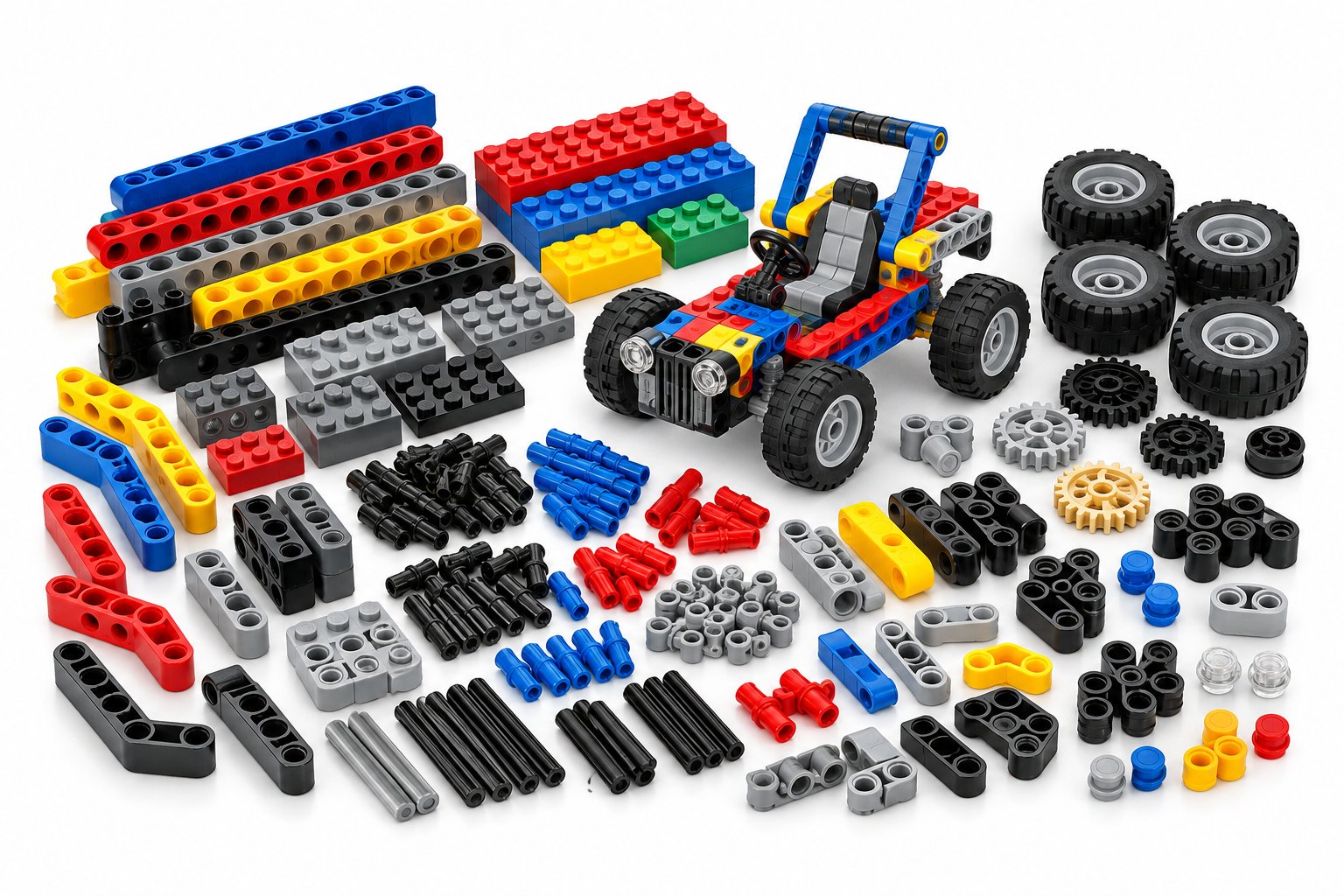
The set contains 120 interlocking pieces — beams, plates, wheels, and connectors. Connections are press-fit, so no tools are required, and the set is sized for group play with several children building together. The material is ABS plastic, BPA-free, with an age rating of 4+. For export orders, the MOQ is 500 sets, and the standard packaging is a storage box plus an export carton with 12 sets per carton. The product is EN71 and ASTM F963 compliant, and OEM/ODM customization is available.
If you are comparing channels, this product illustrates why manufacturer-direct often wins for program buyers: the MOQ is set for a first production run, the packaging can be adapted for your market, and the compliance file is tied to the product you are actually ordering. You can view the full specification on the product page.
FAQ
What is the typical MOQ for building blocks bought directly from a manufacturer?
MOQ varies by factory and product. For a 120-piece classroom set, an MOQ of 500 sets is a common starting point for a first order. Some factories negotiate lower trial quantities for buyers who plan repeat orders.
Can I get custom packaging for a school program?
Yes, if you source manufacturer-direct and the factory offers OEM/ODM. Custom box artwork, language variants, and carton marks are typical. Marketplace and distributor channels usually cannot support this.
Which certifications should I ask for when buying building blocks wholesale?
For North America and Europe, ask for EN71 and ASTM F963 test reports that specifically cover the product and material you are ordering. Confirm that the documentation is current and tied to your batch, not a generic certificate for a different item.
Is it better to buy from a distributor if I need a small quantity?
Distributors are useful for small, fast orders where branding and customization do not matter. If you need OEM/ODM, custom packaging, or a consistent compliance file across multiple orders, manufacturer-direct sourcing is the more practical route.
How do I compare a wholesale marketplace listing against a factory quote?
Compare the total landed cost, not just the unit price. Include packaging, carton configuration, compliance documentation, and any customization fees. A factory quote may look higher per unit but include packaging and OEM/ODM work that a marketplace listing does not.
Choosing where to buy building blocks for a school or retail program comes down to how much control you need over packaging, compliance, and branding. If those factors matter, start with a manufacturer that exports to North America and Europe and can document its quality process. You can request current product details and OEM/ODM options through the product page above.