A set-level selection checklist for kids' badminton sets: racket length and grip, net size and setup, shuttlecock type, set completeness, school durability, and retail packaging. Includes a comparison framework and a worked example based on a published school junior set.
Best Badminton Set for Kids: What to Compare Before Ordering
If you are buying a kids' badminton set for schools, retail, or family use, the question "what is the best badminton set?" has no single answer. The right set depends on who will use it, where it will be used, and how it will be sold. This article gives you a set-level selection checklist: racket length and grip, net size and setup, shuttlecock type, set completeness, school durability, and retail packaging. It does not cover racket selection in isolation or channel buying strategies; those are separate topics.
Key takeaways
- For children aged 6+, a racket length around 53 cm is a common starting point; check grip size and weight.
- A tool-free net system saves setup time and reduces lost parts in school use.
- Nylon shuttlecocks are durable for lessons; feather shuttlecocks suit competitive play but need replacement.
- Set completeness (rackets, net, pegs, shuttlecocks, carry bag) affects perceived value in retail.
- For retail, packaging and carton configuration matter as much as the product itself.
Contents
- 1. Start with the player: age and racket length
- 2. Grip size and frame weight
- 3. Net size and tool-free setup
- 4. Shuttlecock type: nylon vs. feather
- 5. Set completeness: what should be in the box
- 6. Durability for school lessons
- 7. Packaging for retail and export
- 8. Comparison framework and worked example
- 9. FAQ
1. Start with the player: age and racket length
Racket length is the first filter. A racket that is too long is hard for a child to control; too short and the child cannot reach the shuttle. For children aged 6 and up, a racket length of about 53 cm is a common starting point, and junior sets come in several lengths — so check the stated age recommendation on each set rather than assuming one size fits all. Use the child's height as a guide: if the racket reaches roughly to the child's hip, it is in the right range. But always confirm the intended age group with your supplier, because sizing is not standardized across brands.
2. Grip size and frame weight
Grip size affects control and comfort. For small hands, ask the supplier for the grip circumference and choose a size children can actually wrap their hand around. A soft grip reduces slipping and blistering during long lessons. Frame weight matters too: lightweight composite frames (often aluminum or graphite) are easier for children to swing. Ask for the frame material and weight per racket when comparing sets. Remember that a lightweight frame may trade off some durability, so check how the set is used.
3. Net size and tool-free setup
Net size determines where the set can be used. A common junior net size is 300 x 60 cm, which fits a driveway or school hall. For school lessons, tool-free assembly is a practical requirement: teachers need to set up and take down quickly, and loose parts get lost. Look for nets that use push-button or slot-together frames, and check that ground pegs are included for outdoor use. A carry bag makes storage easier and keeps the set together.
4. Shuttlecock type: nylon vs. feather
Shuttlecock choice depends on use. Nylon shuttlecocks last longer and are cheaper per hour of play, which makes them suitable for schools and family use. Feather shuttlecocks offer better flight consistency for competitive play but are more fragile and expensive. Many kids' sets include two nylon shuttlecocks. If you are buying for a club, you might consider a set that can be paired with feather shuttlecocks separately. For most school buyers, nylon is the practical choice.
5. Set completeness: what should be in the box
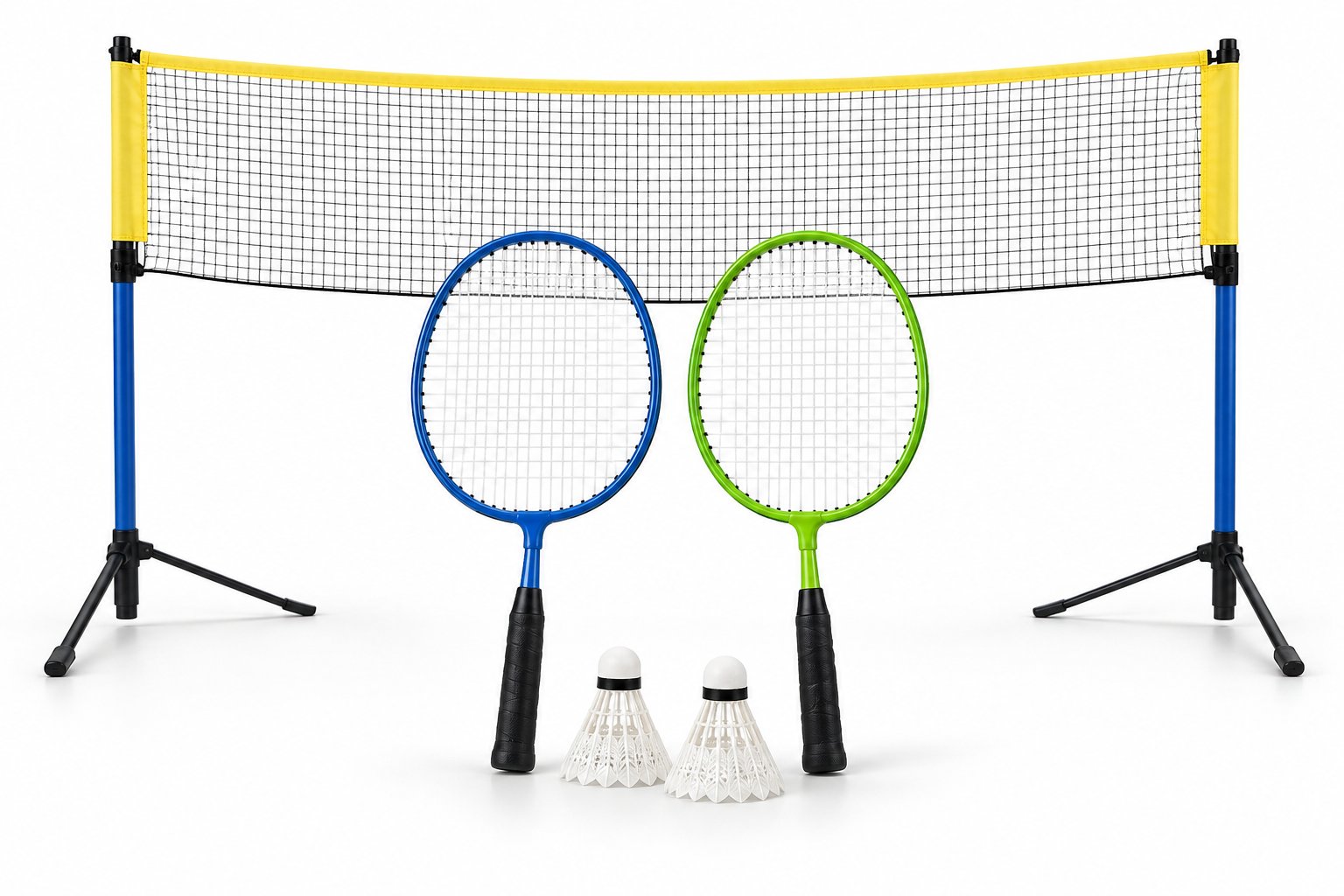
A complete set reduces the risk of complaints and returns. For a two-player kids' set, the box should contain at least two rackets, one net with pegs, and two shuttlecocks. A carry bag is a plus for storage and transport. Retail buyers should also check whether the set includes assembly instructions. Incomplete sets lead to negative reviews, so verify the contents list with the supplier before ordering.
6. Durability for school lessons
School use is harsher than home use. Rackets get dropped, nets are dragged, and shuttlecocks are hit by many different players. Look for rackets with reinforced frames, nets with thicker mesh, and pegs that are easy to push into grass. Tool-free assembly also contributes to durability because there are fewer small screws to lose. For the frame, composite materials are common; ask the supplier about the specific material and any reinforced joints. School buyers should also consider whether replacement rackets can be ordered separately, which extends the set's life.
7. Packaging for retail and export
For retail, packaging is part of the product. A printed carry bag and a colorful box help sell the set. Check the carton configuration: how many sets per carton, and what is the carton weight and volume. For export, compliance matters: toys and sporting goods for children may need EN71 or ASTM F963 certification. Verify with the supplier which standards the set meets and ask for test reports if needed. MOQ (minimum order quantity) also affects your order planning; typical MOQs for junior sets are around 500 sets, but this varies by supplier.
8. Comparison framework and worked example
Use this table to compare sets across the criteria above. Below is a worked example based on a published product: a Junior Badminton Set with Net for School Sports Lessons. The facts are taken from the product listing.
| Criterion | What to check | Worked example: Junior Badminton Set with Net for School Sports Lessons |
|---|---|---|
| Racket length | Sized to the target age group | 2 rackets, 53 cm length each |
| Grip | Soft grip, suitable for small hands | Lightweight composite frame with soft grip |
| Net size | Fits the intended play space | Nylon net, 300 x 60 cm |
| Setup | Tool-free, quick assembly | Tool-free assembly |
| Shuttlecocks | At least 2 nylon shuttlecocks | 2 shuttlecocks included |
| Anchoring | Ground pegs for outdoor use | 4 ground pegs |
| Age recommendation | Matches target user | Age 6+ |
| Carry/storage | Carry bag for transport | Carry bag included |
| Compliance | EN71 / ASTM F963 for children's products | EN71 / ASTM F963 compliant |
| MOQ | Fits your order plan | 500 sets |
| Packaging | Retail-ready carton | Export carton, 16 sets per carton; OEM/ODM available |
This example shows a set designed for school use and retail. The 53 cm rackets and 6+ age rating target young children. The tool-free assembly and ground pegs suit outdoor lessons. The included carry bag and 16-set carton support retail distribution. If you need a different configuration, OEM/ODM is available, but confirm details with the supplier.
For a deeper look at this set, see the Junior Badminton Net Set product page. If you are also comparing racket specifications, our guide on how to choose badminton rackets covers racket-level details.
9. FAQ
What is the best badminton set for kids?
There is no universal best set; it depends on the child's age, the playing environment, and your channel. For school lessons, prioritize tool-free assembly, durable nylon shuttlecocks, and a net size that fits the space. For retail, packaging and set completeness matter. Use the checklist above to compare options.
What racket length should I choose for a 6-year-old?
A racket length of about 53 cm is commonly used for children aged 6 and up. Always check the manufacturer's age recommendation.
Are nylon shuttlecocks suitable for school use?
Yes, nylon shuttlecocks are more durable and cost-effective for school lessons. They are included in many junior sets.
What certifications should a kids' badminton set have?
For children's products, EN71 (Europe) and ASTM F963 (US) are common standards. Confirm with your supplier which standards the specific set meets and request test reports.
Can I customize the set for my brand?
OEM/ODM availability varies by supplier. The worked example above offers OEM/ODM; ask your supplier for details on customization options and MOQ.
When you are ready to compare sets, prepare a checklist with your target age group, net size, shuttlecock type, and packaging needs. Request samples and test reports to verify compliance. For further assistance, contact our sales team.