
A practical pre-purchase checklist for camera drones: camera resolution and storage, flight stability aids, control range, battery and charging, safety guards, certifications, and supplier terms such as MOQ and OEM options.
The short answer: before you order a drone with camera, fix the camera spec and storage first, then confirm the stability aids, control range, battery and charging path, safety guards and certifications, and only then close the commercial terms with the supplier. Each of those items changes what the drone can actually do and what your landed cost looks like, so they belong in the decision in that order.
This checklist is written for two readers buying the same category for different reasons: B2B toy retailers and distributors building a line, and informed parents buying a first camera drone for a child aged 8 and up. The trade-offs differ, but the questions you need answered before ordering are largely the same.
Key takeaways
- Camera resolution and storage are separate limits: what the sensor records and where the file lands both need a clear answer.
- Flight stability aids decide how usable the footage is for a beginner, regardless of resolution.
- Control range and battery time should be read together, since they define a realistic flight session.
- Safety guards, age grading and toy certifications are compliance items, not accessories.
- MOQ, packaging and OEM/ODM terms determine whether the product fits your channel at all.
What this checklist covers
- Camera resolution and storage
- Flight stability aids
- Control range
- Battery and charging
- Safety guards and age grading
- Certifications and materials
- Supplier, MOQ and OEM terms
- Questions to send before you order
Start with the camera: resolution and storage
A camera drone is bought for the camera, so this is where the evaluation should start, and it is also where vague claims do the most damage. Ask two separate questions.
What resolution does the camera record?
Resolution defines the file you can hand to a customer or a child, not the marketing description on the box. On the verified reference model, the camera records 720p. That is a useful beginner and entry-channel figure: the file is small enough to move easily and the price point stays accessible. If your channel advertises a higher resolution tier, do not assume this model covers it. Resolution is a fixed product fact, not a setting you can raise at the packaging stage.
Where does the video go?
Storage is the second half of the same question. On this model, footage is recorded to a microSD card. That matters for retail because the card is a separate component: it affects what goes in the box, what the instruction sheet has to explain, and what a customer will ask about at the return desk. Confirm with the supplier whether a card is included, what capacity is supported, and whether the card is pre-formatted. If footage instead streams to a phone, the questions change to app compatibility and pairing steps.
For a first camera drone, 720p to removable storage is a defensible combination: the file is easy to retrieve, and the storage is not locked to a worn-out battery.
Flight stability aids: how the drone handles in real air
Beginners rarely complain about resolution first; they complain about a drone they cannot hold steady. Stability aids are what make the footage usable, and they are worth more attention than a resolution upgrade at the same price.
- Altitude hold. The verified model holds altitude, which removes the hardest part of manual flying for a first-time user. The drone stays at its height while the operator concentrates on direction.
- One-key take-off and landing. A defined start and end to the flight reduces the launch and landing failures that generate beginner returns.
- Headless mode. Control orientation stays fixed, so the drone moves relative to the operator rather than to its own nose. This is the single most useful aid for a child aged 8 and up, and for any adult flying a camera drone for the first time.
- Four-axis layout. A four-axis configuration is the baseline platform for this class and is what the stability aids above are built around.
None of these replace practice. They reduce the skill needed to get a stable, watchable clip, which is exactly the outcome a first-time buyer is paying for.
Control range: match it to where the drone will fly
Control range is stated in metres and should be read as a ceiling, not a routine. The verified model has a control range up to 50 m. Fifty metres is ample for a garden, a small park or an indoor hall, and it is a sensible beginner limit rather than a shortcoming: at that distance the operator can still see orientation clearly.
The trap in this category is buying range you cannot use. Range beyond line of sight is difficult to exercise legally, and a higher nominal figure rarely changes the experience of a first-time flyer. Match the figure to the intended flying space, and treat any range claim as something to verify on the specification sheet rather than an assumed performance guarantee.
Battery and charging: the realistic session length
Flight time and charging method decide how the product behaves in the hands of the end user.
| Item | Verified specification | What it means when buying |
|---|---|---|
| Flight time | About 8 minutes | Sufficient for a beginner session; plan for spare batteries if long sessions are the expectation |
| Battery | 3.7 V rechargeable | Confirm whether spares are offered as an accessory and how they are packed |
| Charging | USB charging | No proprietary charger required; cable and port details belong in the manual and on the box |
USB charging removes a power-adapter question for international retail, which simplifies the packaging and the compliance file. The 8-minute flight time is a real constraint: if your channel or your customer expects longer sessions, ask about spare battery availability and how multiple batteries are packaged, because that changes the carton weight and the accessory list.
Safety guards and age grading
For a toy-channel camera drone, safety features are part of the product specification, not upsells.
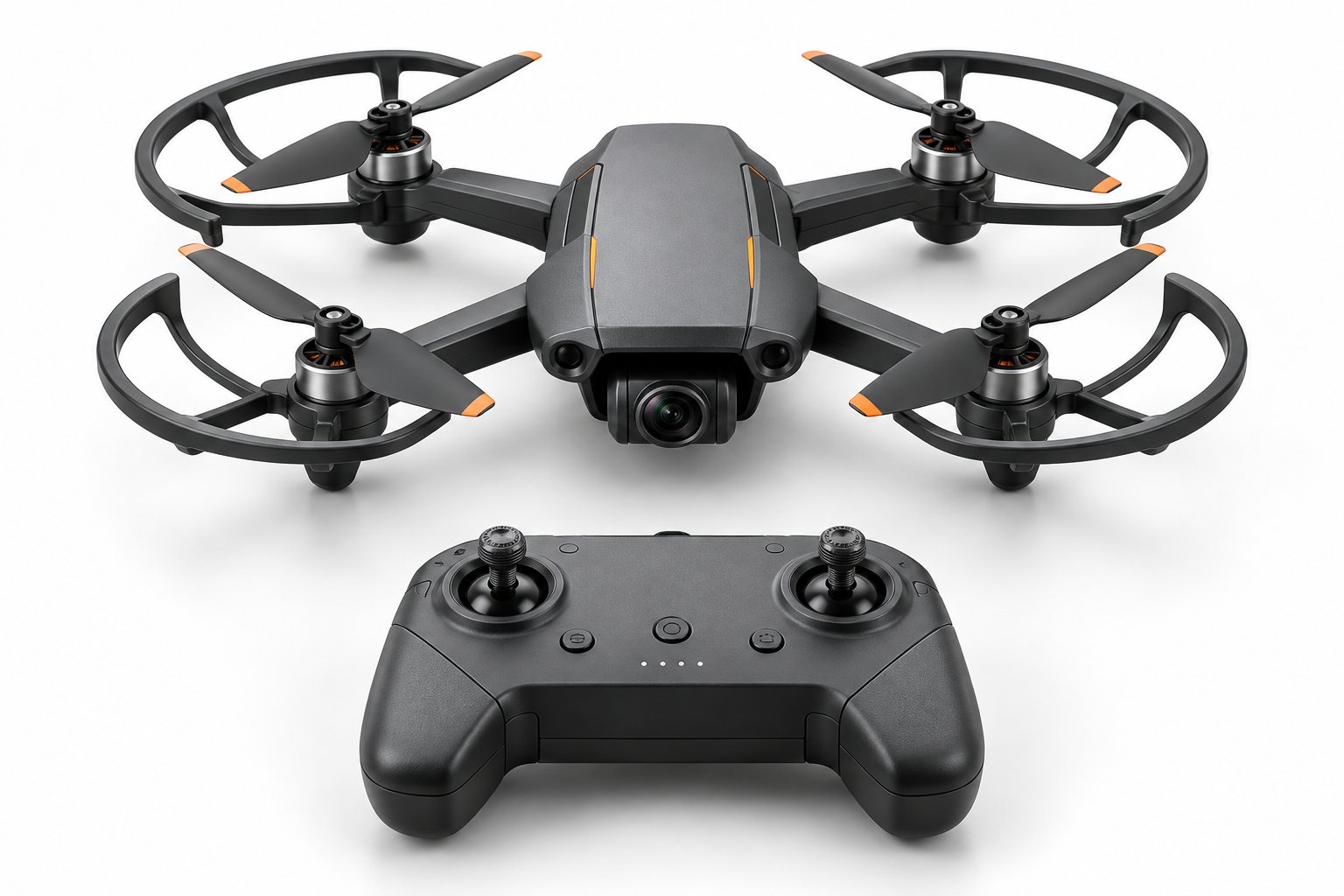
- Propeller guards on all four arms. The verified model carries guards on every arm. Guards protect the blades and reduce the chance of contact injuries during indoor first flights.
- Frame material. The frame is ABS with PP propeller guards. ABS gives the body its shape and stiffness; PP is used for the guards. Both are standard toy-grade materials, and both matter when you assess drop behaviour and packaging protection.
- Age grading. This model is rated for age 8 and up. Keep the on-pack age statement consistent with the instruction manual and with your channel's own rules.
Safety claims should be checkable. Rather than accepting a general assurance that the drone is safe, ask which guards are fitted and where, and confirm the age grading is stated on the packaging artwork.
Certifications and materials to have on file
Compliance is where a promising product can stall at the port. The manufacturer holds EN71 and ASTM F963 toy safety certificates and ISO 9001:2015, and this model is compliant with EN71 and ASTM F963. For a European or North American toy channel, those are the working references.
Two practical points when you request documentation:
- Ask for the certificate copies that apply to this model, not a general company capability statement. Toy safety standards are applied per product.
- Confirm the certificate scope and the product name match your purchase order, so the file you pass to your own compliance contact is traceable.
If your market requires additional documents beyond EN71 and ASTM F963, raise that in the first enquiry so the supplier can tell you what is available for this model. Do not assume an untested standard is covered.
Supplier, MOQ and OEM terms
Once the product checks out, the commercial terms decide whether you can actually stock it.
| Term | Verified detail | Why it matters to a buyer |
|---|---|---|
| MOQ | 500 pieces | Sets your minimum order value and first-order risk |
| Packaging | Colour box plus export carton | Determines shelf presentation and shipping protection |
| OEM / ODM | Available | Allows your own branding or specification changes, subject to agreement |
| Facility | 12,000 sqm with in-house QC lab | Relevant to batch consistency, sample review and follow-up orders |
The 500-piece MOQ is a realistic starting point for a distributor test order rather than a container commitment. If your plan is a trial listing, ask how the colour box artwork and any OEM branding are approved before production, and ask for a sample so you can compare the delivered drone against the specification sheet. An in-house QC lab supports that process, but it does not replace your own sample check.
The full specification for this model is listed on the Mini RC Drone with 720p Camera and Altitude Hold product page. If you are still choosing between body sizes and control layouts, the companion guide on what a mini drone is and which specs buyers should compare before ordering covers the platform-level questions, while this article stays on the camera side of the decision.
Questions to settle before you place the order
- What resolution does the camera record, and is footage stored on a microSD card or streamed to a phone?
- Is a memory card included, and what capacity and format are supported?
- Which stability aids are fitted, and is headless mode included?
- What is the stated control range, and does it suit the intended flying space?
- What is the flight time, is the battery rechargeable via USB, and are spare batteries available?
- Are propeller guards fitted to all arms, and what is the on-pack age grading?
- Can you supply the EN71 and ASTM F963 certificates that apply to this model?
- What is the MOQ, what packaging is standard, and what OEM/ODM changes are possible?
Frequently asked questions
Is 720p enough for a children's camera drone?
For a first drone at an entry price point, 720p is a workable resolution: the file is small and easy to handle. If your channel sells on resolution as a headline feature, confirm the model on offer matches the tier you advertise.
Does headless mode replace the need to practise?
No. Headless mode keeps control orientation fixed, which shortens the learning curve, but the operator still has to learn throttle and direction control.
Can the drone be branded with our own logo?
OEM/ODM is available on this model. The scope of changes and the artwork approval steps should be agreed with the supplier before production starts.
What is the minimum order?
The verified MOQ is 500 pieces. Confirm the current MOQ and packaging details when you request a quotation, since terms are agreed per order.


