
A cost-driver breakdown for wholesale buyers of plastic construction block sets: how piece count and piece variety, ABS material and safety compliance, custom-shape tooling, packaging format, order volume and carton packing move a quotation, and how to compare two suppliers' offers line by line without assuming price per piece is comparable.
Wholesale cost guide
Two suppliers can quote the same "500 sets" and land far apart, without either being dishonest. A building block set is priced by what goes into the box, not by one headline number, so the only way to read the gap is to compare the same drivers line by line.
What actually moves a quotation
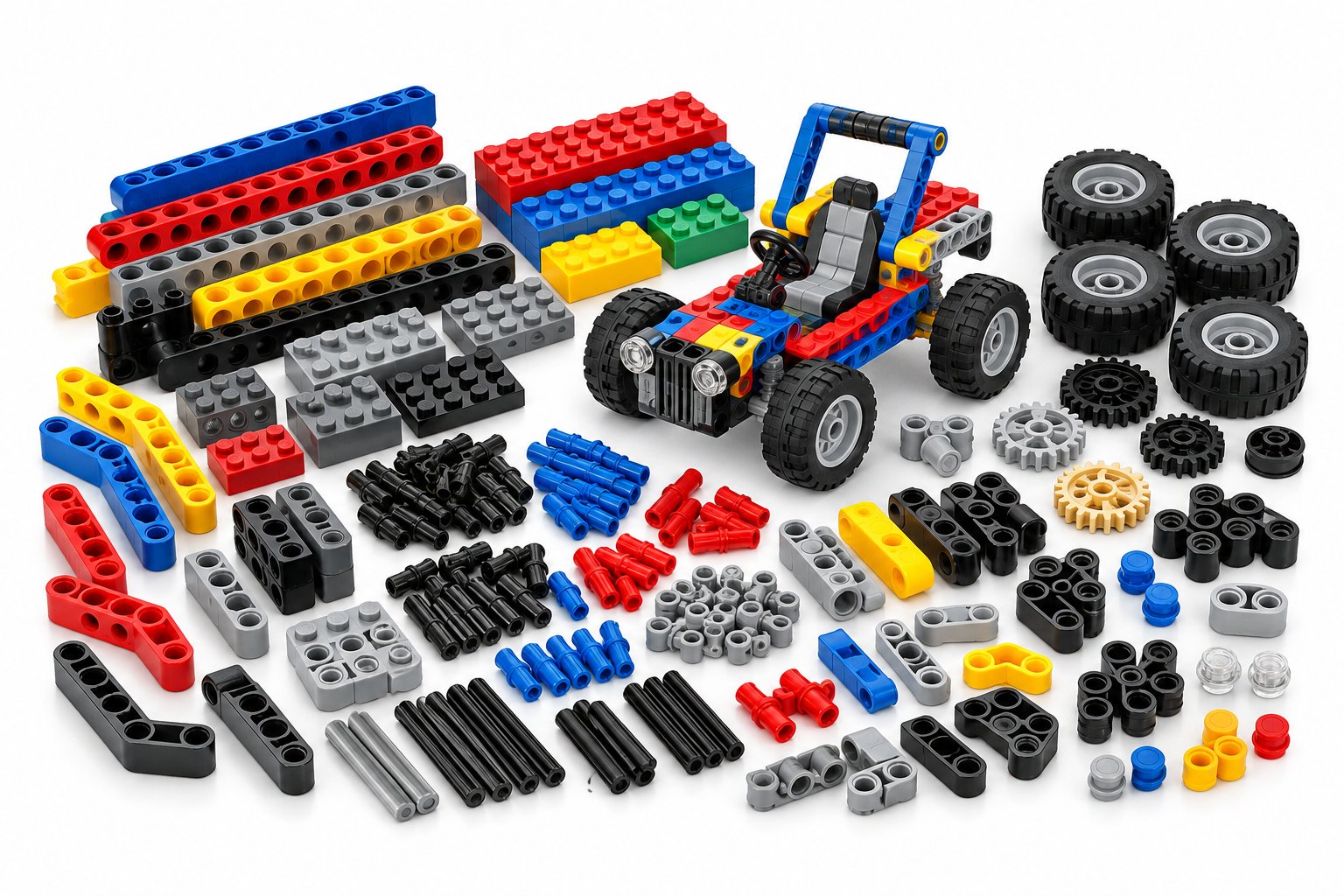
- Piece count and piece types — a 120-piece set mixing beams, plates, wheels and connectors is not the same production load as 120 identical bricks.
- Material and compliance — ABS vs. lower-grade resin, plus EN71 / ASTM F963 testing, which is charged per item and per test scope.
- Custom shapes — a new mold is a one-time tooling cost that only pays back across volume.
- Packaging — storage box vs. color box changes both material cost and carton cube.
- Order volume and packing — 12 sets per export carton sets your freight and handling math before the price is even discussed.
Start with the piece list, not the piece count
Piece count is the first number buyers ask about and the weakest one to compare on its own. What drives cost is the number of distinct piece types and the tooling behind each. A set containing beams, plates, wheels and connectors requires separate molds, separate inspection points and a more complex counting and bagging routine at packing than a set built from one repeating element.
Our STEM building blocks set with 120 pieces for classroom group play is a useful reference point: 120 pieces across beams, plates, wheels and connectors, age 4+, press-fit connectors that need no tools. If you are pricing a classroom or group-play order, that mix of four piece categories — not the 120 alone — is the part to put in front of a supplier.
When you compare quotes, ask each supplier for a piece-type breakdown, not just a total. A quote that lists how many of each element is included can be checked against your own specification; a single "120 pcs" line cannot.
Material and safety compliance
Resin grade is a real cost line. Our set uses ABS plastic, BPA-free. ABS is specified for its moldability and impact behaviour in a handled toy, and a buyer sourcing for age 4+ should keep the grade in the written specification rather than leaving it to the supplier's discretion.
Compliance testing is the second, often underestimated line. Our set is EN71 and ASTM F963 compliant. Testing is usually quoted per item and per test scope, so it behaves differently from raw material: it does not scale down neatly with a smaller order, and re-testing may be required when a design, colorant or material changes. Two practical questions to ask:
- Which standards is the quotation tested against, for which target market?
- Who holds the test report, and does it cover the exact item and configuration you are buying?
Test reports belong to a specific item and configuration. A compliant reference product in a supplier's catalogue does not automatically cover a new shape, colorway or packaging version you request.
Custom shapes mean tooling, and tooling means volume
If you want a proprietary piece — a branded connector, a themed plate, a shape unique to your product line — the first cost is a mold, not a part. Tooling is a one-time investment, and it only makes commercial sense spread over a run size that absorbs it.
This is why custom projects usually price in tiers: the tooling appears as a separate line, then the per-piece cost drops as volume rises. Two cautions for buyers:
- Ask whether tooling is quoted once, and who retains the mold.
- Confirm what happens to the tooling cost if the first order is smaller than the volume the supplier assumed.
OEM/ODM capability tells you a supplier can take on custom work; it does not tell you what that work costs. Get the tooling figure and the minimum run in writing before comparing total project cost.
Packaging: storage box vs. color box
Packaging changes price twice — once in material and printing, once in carton cube and freight. A reusable storage box is a sturdier construction than a printed color box, and it is also the part end users keep, so it carries more of the perceived product quality. Our set ships in a storage box, packed 12 sets per export carton.
That ratio is worth doing arithmetic on before you commit to a packaging format. If a carton holds 12 sets, then a 5,000-set order is roughly 417 cartons and any change to box dimensions shifts total volume, container utilization and handling. When comparing two quotes with different packaging, compare the packed carton dimensions and sets-per-carton too, not only the unit price.
Order volume and carton packing
Minimum order quantity sets the floor of the comparison. Our MOQ is 500 sets, which is the point below which a quotation is typically not meaningful — setup, testing and packing runs have to be absorbed.
Volume affects price through several channels at once: material purchasing, production run length, testing amortization, packing labor and carton consolidation. A useful way to read a price tier table is to ask what changes between tiers — material, defect allowance, packaging, or simply the same product at a longer run. If the only difference is quantity, the step in price should track the production economics; if packaging also changes, you are comparing two different products.
How to compare two supplier quotes
The fastest way to make quotes comparable is to force them into the same six fields. Ask every supplier to quote against this grid:
| Comparison field | What to require in the quote |
|---|---|
| Piece specification | Total pieces plus a count by piece type (beams, plates, wheels, connectors, etc.) |
| Material | Named resin grade, and whether BPA-free is confirmed |
| Compliance | Standards tested (e.g. EN71, ASTM F963), target market, report holder |
| Tooling | One-time mold cost for any custom shape, and who retains the mold |
| Packaging | Storage box or color box, box dimensions, sets per export carton |
| Order terms | MOQ, price tiers, and which tier the quoted price refers to |
A quote missing three of these fields is not cheaper or more expensive — it is simply not yet comparable. The number that follows from this grid is a packed, tested, cartoned set price, which is the figure your landed-cost calculation should actually use.
A worked example of the logic (illustrative only)
Suppose you need 2,000 sets of a 120-piece classroom configuration. Quote A is based on a standard storage box and the supplier's existing piece shapes. Quote B adds a custom connector. The two per-set figures are not directly comparable until you add B's one-time tooling to the project total and divide it across the 2,000 sets. That calculation tells you the real gap; the per-set line on its own does not. No price figures are given here because they depend on your specification, destination and current material costs.
Where the supplier's own process fits
Cost drivers are only half of a sourcing decision; the other half is whether the supplier can hold the specification across repeat orders. We have operated from a 12,000 sqm facility since 2013 with 180 staff and an in-house QC lab, working under ISO 9001:2015 — a company-level quality management certification. In practice, that means incoming material, in-process assembly and packed goods can be checked before cartoning rather than after arrival. Ask to see how a supplier's inspection points map to the stages of your order; a certificate alone does not describe the routine.
For a classroom or group-play programme, where sets are handled heavily and mixed by many hands, also confirm the age grading (ours is 4+) and how replacement pieces are supplied. Those are not usually on a price sheet, but they affect total cost of ownership.
FAQ
Why do two quotes for "the same" 120-piece set differ so much?
Usually because one or more of the six fields above differs — piece-type mix, resin grade, testing scope, tooling, packaging or carton packing. Ask both suppliers to fill the comparison table; the reason for the gap generally appears in the first two rows.
Does a higher piece count always mean a higher set price?
Not necessarily. A set with more pieces of a few simple types may cost less than a set with fewer pieces requiring several distinct molds and more complex packing. Piece types matter as much as piece count.
Is compliance testing charged per order or per item?
Testing is typically tied to the item and configuration tested rather than to order quantity, which is why small runs carry a heavier testing load per set. Confirm the scope and who holds the report when you request a quote.
What is the minimum order for the 120-piece classroom set?
MOQ is 500 sets. For custom shapes, the minimum run may be set by the tooling economics, so confirm both figures together.
Can packaging be changed without re-quoting the product?
It should be re-quoted, because packaging changes material cost and carton cube. Give the supplier your preferred box type and check the revised sets-per-carton figure alongside the new price.
Get a line-by-line quotation
Send your piece-type breakdown, target market and required standards, packaging preference and annual volume. We will return a quote against the six comparison fields above, with tooling shown separately for any custom shape.
Review the 120-piece STEM building blocks set specifications and use its configuration as a starting reference for your own brief.
Figures in this article refer to the 120-piece STEM building blocks set, ABS plastic (BPA-free), age 4+, MOQ 500 sets, storage box with 12 sets per export carton, EN71 / ASTM F963 compliant, OEM/ODM available. Prices are not stated because they depend on specification, destination and current material costs — request a quotation for your configuration.


