LiPo and NiMH packs in RC toys should be compared under the same conditions, not by a single lifespan number. This buyer-focused article explains the qualitative tradeoffs between the two chemistries and lists the supplier questions that make a lifespan claim verifiable before you commit to an order.
RC Battery Sourcing
"How long do LiPo batteries last" and "how long do NiMH batteries last" are usually answered with a number that ignores how the pack is used. For buyers, that number is close to useless. What follows is a same-conditions comparison framework you can apply to your own RC toy line, plus the supplier questions that turn a vague lifespan claim into something you can check.
LiPo packs generally win on energy density and weight for the same capacity, while NiMH packs are more forgiving in storage and handling. Lifespan depends far more on discharge depth, charge protocol, storage voltage, temperature and how often the toy is run than on the label on the pack. Neither chemistry has a market-wide "X months" figure — get the claim in writing per SKU.
Why a single lifespan number is the wrong comparison
Search results for how long do LiPo batteries last and how long do NiMH batteries last often quote round figures. Those figures come from different test conditions, different discharge depths and different end-of-test definitions, so they are not comparable with each other. A pack cycled to full discharge weekly will not last the same as one topped up after a light run, even if both are the same chemistry and the same nominal capacity.
To compare fairly, define the conditions first, then compare the chemistries inside those conditions. The four variables that matter most are:
- Discharge depth — how far the pack is run down before recharging.
- Charge protocol — charge rate, cutoff method and whether the charger matches the pack.
- Storage state — voltage and temperature between sessions.
- Duty cycle — how hard the motor and ESC pull current, and how often.
Same-conditions comparison framework
Assume the same toy, the same run pattern and the same maintenance routine. Under those matched conditions, the differences below are the ones buyers should expect.
| Factor | LiPo | NiMH |
|---|---|---|
| Energy density | Higher — more energy per unit of weight and volume, which suits light, fast RC toys. | Lower — often a heavier or larger pack for the same stored energy. |
| Robustness | More sensitive to over-discharge, overcharge and physical damage; a swollen pack must be retired. | More tolerant of casual handling and less prone to damage from irregular use. |
| Maintenance sensitivity | Rewards a proper balance charger and consistent storage voltage. | Forgives simple chargers and less disciplined routines, though performance still degrades with abuse. |
| Storage behavior | Performs best when stored at a partial charge rather than full or empty. | Also prefers partial charge for long storage, but is less punishing when stored full. |
| Perceived lifespan | Long when treated well; short and unpredictable when abused. | Often described as steady rather than long; gradual loss of runtime over time. |
None of these rows is a lifespan number, because the number depends on the buyer's usage assumptions. What the table does show is where the risk sits: LiPo rewards good charging discipline, NiMH tolerates more casual handling but gives up energy density.
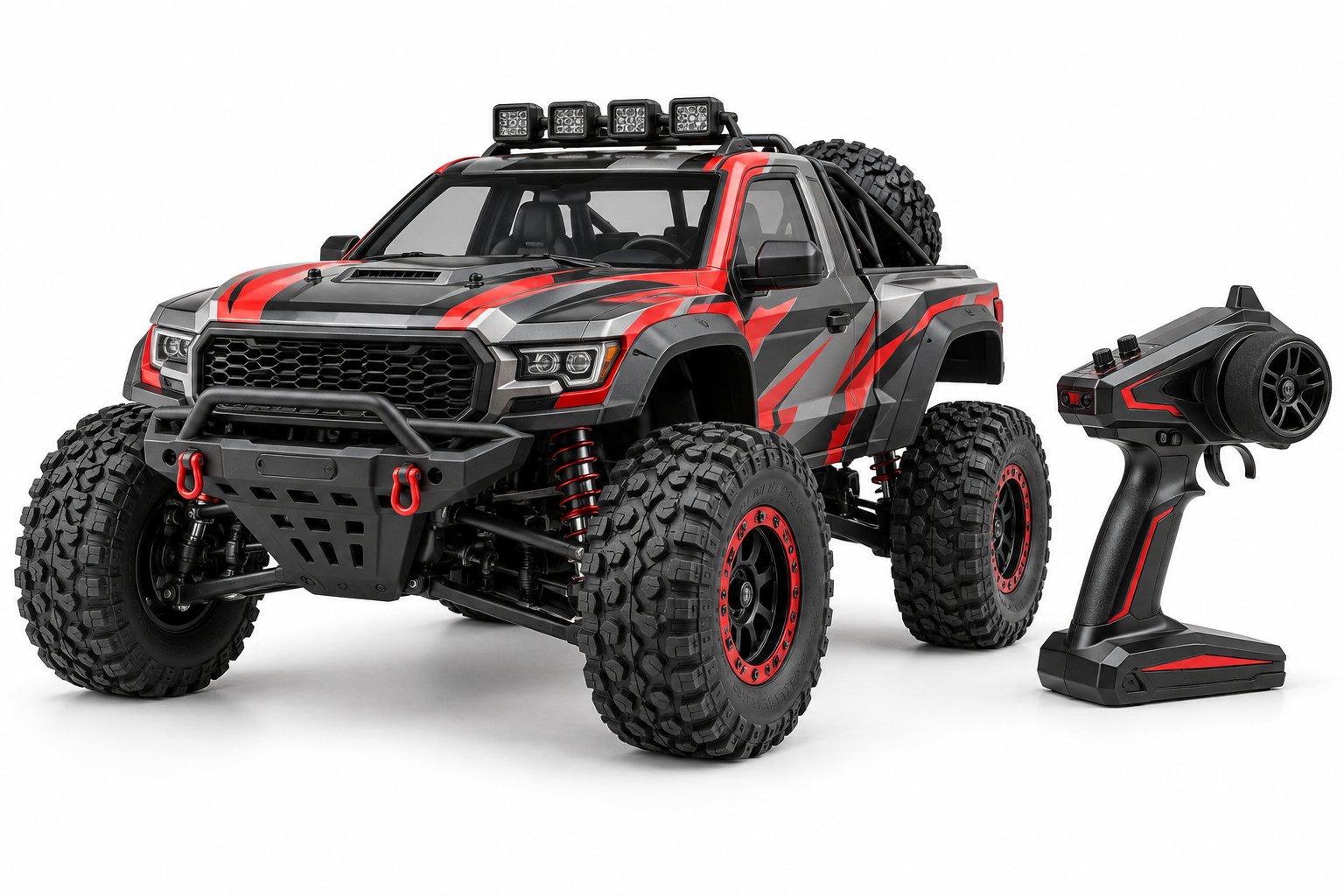
What this looks like on a real RC truck
On a 4WD off-road truck with independent suspension and a 7.4 V rechargeable battery with USB charging, the pack sits at the center of the weight budget. Four-wheel drive pulls more current than a two-wheel-drive toy, so discharge depth per run is higher and the pack works harder per session. The 40 m control range lets the truck run farther from the operator, which usually means longer continuous runs — again, more cycles per month on the same pack.
That product context is why buyers should not compare LiPo and NiMH in the abstract. The correct comparison is: how does each chemistry behave in this chassis, with this motor and this run pattern? A useful reference point is the product's own spec sheet (for example, our 4WD RC off-road truck), because the truck's weight and drivetrain set the current draw that determines how quickly a pack ages.
How to read a supplier's lifespan claim
A defensible lifespan claim names the conditions. If a supplier says "500 cycles," ask at what discharge depth, at what charge rate and under what ambient temperature. If the answer is "standard conditions," the number is marketing, not engineering.
Three things are worth pinning down before you place a purchase order:
- The test definition. Which standard or internal protocol was used, and to what end-of-life threshold?
- The SKU. Does the claim apply to the exact pack you are buying, or to a different cell?
- The failure mode. Does the supplier expect capacity fade first, or an internal resistance rise that cuts runtime before capacity drops?
Buyer checklist: questions to send suppliers
Send these before committing to a program. They translate directly into a comparable answer across vendors.
- Which chemistry is actually in the pack — LiPo, NiMH, or another chemistry — and is the nominal voltage stated on the cell and the pack?
- What cycle life is specified for this SKU, and under what discharge depth and temperature?
- What charge protocol does the pack require — constant current/constant voltage, trickle, or a matched USB charging circuit — and what happens if the end user uses the wrong charger?
- Is a spare battery available as a separate SKU, and can it ship in the same carton as the toy?
- How is the pack shipped — at what state of charge, and with what documentation for the destination market?
- What documentation comes with the shipment — spec sheet, safety warnings and any test report the supplier can share?
FAQ
-
Is LiPo always the better choice for RC toys?
No. LiPo is preferable when weight and runtime matter most and the user will follow a disciplined charge and storage routine. NiMH suits simpler toys and users who value tolerance over peak performance.
-
Do both chemistries fail the same way?
Both lose usable capacity over time. LiPo can also swell or become unsafe after over-discharge or physical damage; NiMH typically just delivers shorter and shorter runs.
-
Can I ask a supplier for a lifespan figure in writing?
You can ask for a cycle-life statement tied to a defined test protocol. Treat any number without stated conditions as indicative, and confirm it against the exact SKU you intend to buy.
-
Does the toy's compliance status cover the battery?
EN71/ASTM F963 compliance applies to the toy as tested and documented. Ask the supplier which documents cover the battery pack itself, and keep toy-level and pack-level documentation separate.
Where the decision lands
For a buyer, the useful question is not "which chemistry lasts longer" but "which chemistry lasts under the conditions our end users will actually create." LiPo and NiMH each earn their place depending on target price, expected handling and the chassis they go into. If the platform is a 4WD truck with a 7.4 V pack and USB charging, add the six checklist questions above to your RFQ so you compare suppliers on facts rather than on rounded numbers.
When you are ready to discuss a program, share the target chemistry, expected pack capacity, the number of spares per unit and your destination market. That is enough to start a specification review.