
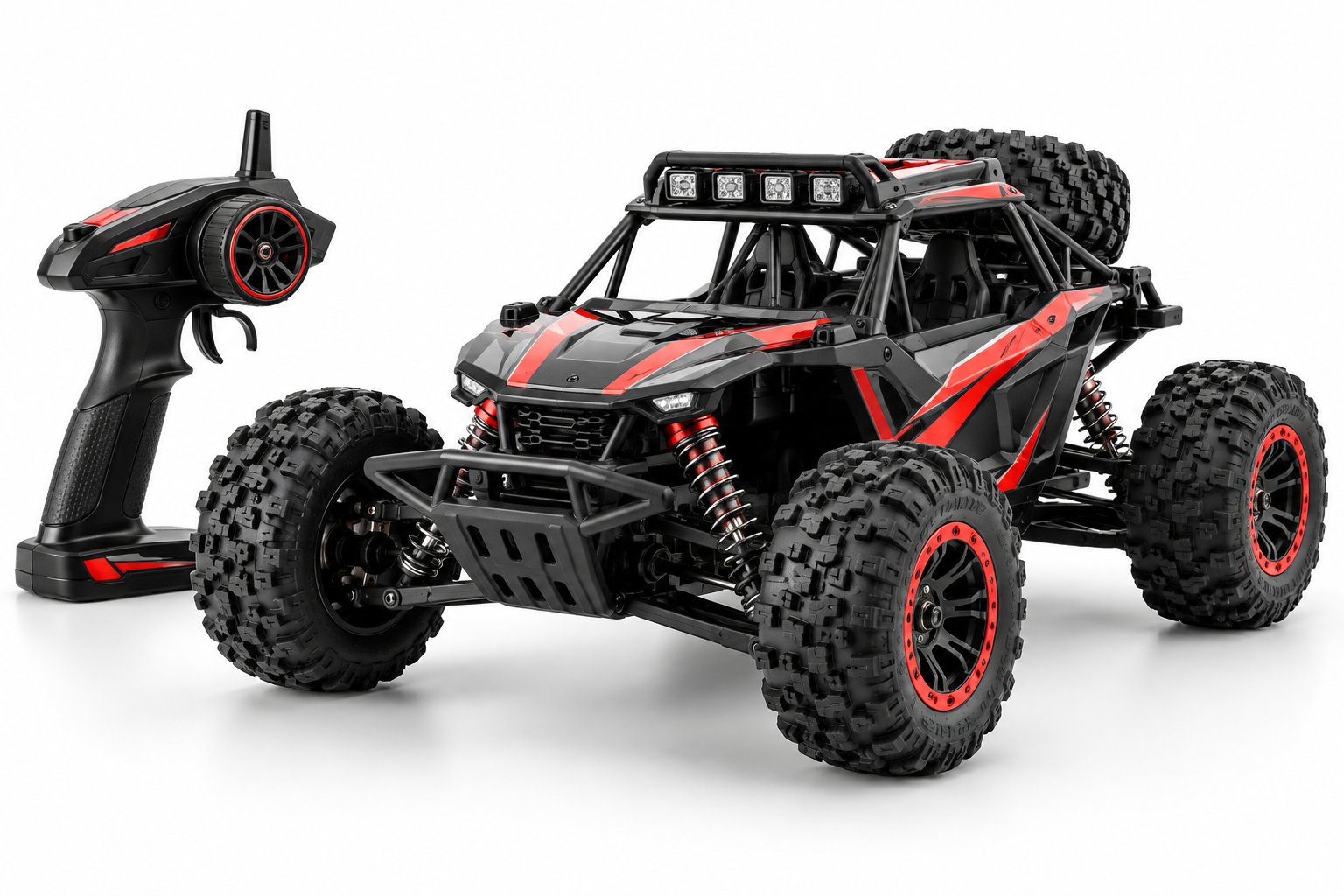
RC toy car prices are driven by specs, not brand stories. This article explains how control channels, drive and suspension, battery and charging, size and materials, certification, packaging and order quantity each push the unit price up or down, and what to confirm with a supplier before quoting.
Sourcing guide
Buyers searching for how much do RC cars cost usually get two kinds of answers: a retail shelf price that tells them nothing about wholesale terms, and a vague 'it depends' that never explains on what. For a B2B buyer, the useful question is different. It is which specifications move the unit price, so you can decide what your product actually needs before you ask for a quote.
There is no single number for an RC car. Two cars that look similar on a listing page can sit at very different price levels once you compare what is inside them. The sections below walk through the specs that consistently change cost, using the three off-road and stunt models in our current range as working examples.
Key takeaways
- Control channel count and controller type set the electronics cost baseline.
- Drive layout and suspension are the biggest mechanical cost drivers.
- Battery chemistry, voltage and charging method affect both unit cost and compliance work.
- Size and material choices scale material weight and tooling, and therefore price.
- Certification, packaging and order quantity change the landed cost per unit, not just the factory price.
Why 'RC car price' has no fixed answer
An RC toy car is not one product. It is a bundle of decisions: how many channels the radio uses, whether the car is two-wheel or four-wheel drive, what battery it runs, how big the body is, which toy safety standard it must be tested against, how it is packed and how many units you order. Each decision adds or removes cost. When a supplier gives you one price without naming these variables, you cannot compare it to another quote.
A practical approach is to fix a target retail or wholesale position first, then specify the features that support it. The rest of this article is a guide to that specification work.
Control channels and controller design
The radio system is the first cost step. A basic car needs a forward/reverse and left/right channel to move. A stunt car that spins 360 degrees needs additional control logic on top of the basic channels. Our RC stunt car with 360-degree spin is built around a 4-channel control set with a control range up to 30 m, and it uses a separate controller powered by 2 x AA cells while the car itself runs on a 3.7 V rechargeable USB battery. That combination of a stunt function, a defined control range and a separate AA controller is a different cost structure from a plain off-road car.
Controller design also matters. A handheld 2.4 GHz controller, as used on our 2.4 GHz off-road car, pairs instantly and does not need a crystal or a channel switch, which reduces field returns and support cost even if the unit price is slightly higher than a simple analog set.
Drive layout and suspension
Nothing changes the mechanical bill of materials more than the drive system. A two-wheel-drive car needs one driven axle and a simple gearbox. A four-wheel-drive car needs a second driven axle, a transfer path, and usually independent suspension to keep the wheels planted on uneven ground. Our RC off-road truck with 4WD and independent suspension is the clearest example in the range: four-wheel drive plus independent suspension, a control range up to 40 m, and a truck body measuring 32 x 20 x 14 cm. The extra axle, the suspension arms and the larger chassis are all real parts with real cost.
If your target market is flat indoor floors, two-wheel drive may be enough and you can spend the difference elsewhere. If buyers expect rough ground, 4WD and suspension are not optional features you can quietly drop — they are the product.
Battery, voltage and charging
Battery specification affects three cost lines at once: the cell itself, the charging circuit, and the safety testing required for a rechargeable lithium product. USB charging has become the default because it removes the need for a separate wall charger in the box, but voltage still separates product tiers. A 3.7 V single-cell pack (used on the stunt car) and a 7.4 V pack (used on the 4WD truck) sit at different energy levels and require different protection and testing work.
When you compare quotes, compare the battery voltage and the charging method, not just the run time claim. Two suppliers quoting the same run time at different voltages are often quoting different packs.
The controller's own power source matters too. A car with a rechargeable car battery plus a controller that takes 2 x AA cells means the buyer supplies some batteries separately, which can lower the packed unit cost but changes what the customer experiences on first use.
Size and materials
Scale drives material weight, shipping volume and packaging size. Our three models span a range: the stunt car at 24 x 16 x 9 cm, the 4WD truck at 32 x 20 x 14 cm. Bigger cars use more plastic, need a larger box, and occupy more container volume, so freight per unit rises even when the factory price looks similar.
Material grade matters as much as size. Impact-resistant body shells and metal drivetrain components cost more than thin ABS and plastic gears, but they change how the product survives shipping and play. Decide which of those two risks your market punishes more, then specify accordingly.
Certification and testing
For toy cars sold into the EU and the US, EN71 and ASTM F963 testing is part of the product's compliance path, and our current off-road car is specified against both. Testing is a per-model, per-configuration cost: change the battery chemistry or the age grading and the test scope may change with it. Age grading such as age 6+ is not just a label — it shapes small-part requirements and therefore design and testing cost.
In practice, certification cost is spread across your order quantity. A larger run carries the same lab fee over more units, which lowers the certification contribution per piece. This is one reason two quotes for the same toy can differ even when the hardware looks identical.
Packaging and order quantity
Packaging is where many buyers find hidden cost. A plain brown box with a single-color label is cheaper than a full-color retail carton with a window and a printed manual. Multi-language packaging for several export markets adds cost but avoids repacking later. Our current models carry an MOQ of 500 pieces, which sets the production run size those tooling, printing and testing costs are divided across.
Order quantity interacts with everything above. Below MOQ, some suppliers will still quote, but setup and printing costs per unit rise sharply. Above MOQ, you gain room to negotiate on components — for example, upgrading a battery or adding a spare parts bag — without losing your price position.
Spec comparison across the current range
| Spec | 2.4 GHz off-road car | Stunt car with 360-degree spin | 4WD off-road truck |
|---|---|---|---|
| Control system | Handheld 2.4 GHz controller | 4 channels | Not specified in current material |
| Control range | Not specified in current material | Up to 30 m | Up to 40 m |
| Drive and suspension | Off-road chassis | 360-degree spin function | Four-wheel drive, independent suspension |
| Car battery | Rechargeable USB | 3.7 V rechargeable USB | 7.4 V rechargeable USB |
| Controller power | Handheld controller | 2 x AA | Not specified in current material |
| Dimensions | Not specified in current material | 24 x 16 x 9 cm | 32 x 20 x 14 cm |
| Age grading | Age 6+ | Not specified in current material | Not specified in current material |
| Certification | EN71, ASTM F963 | Not specified in current material | Not specified in current material |
| MOQ | 500 pcs | 500 pcs | 500 pcs |
Read the table as a cost map rather than a ranking. A buyer targeting young children who need a simple first car may be over-specifying with 4WD. A buyer targeting hobby-minded users may find a two-wheel-drive car undersells the category no matter how good the body looks.
How to frame a quote request
Suppliers can only price what you specify. A quote request that names the following is far faster to answer:
- Target market and applicable toy standard.
- Control channels and whether a stunt function is required.
- Drive layout (two-wheel or four-wheel) and suspension.
- Battery voltage and charging method.
- Body dimensions and material expectations.
- Packaging format and languages.
- Order quantity and whether you expect repeat runs.
If a spec is still open, say so. A supplier who knows the range can suggest the combination that best matches your price target, instead of quoting a single configuration and leaving you to guess why it lands where it does.
Frequently asked questions
Does a higher channel count always mean a more expensive car?
Not by itself. Channels add electronics cost, but drive layout, battery and body size usually have a larger effect on the total. A well-built 4-channel stunt car can cost more or less than a simple 2-channel car depending on the other specs.
Why is there no price on this page?
Unit price depends on configuration, certification scope, packaging and order quantity. Quoting one number without those details would be misleading. Send your specification and target quantity and the relevant configuration and terms can be confirmed.
Can we customize the car for our market?
Customization options depend on the model and the order quantity. State what you want to change — body color, packaging, battery, controller — and the supplier can confirm which changes are feasible against the current MOQ.
What is the minimum order quantity?
The models in the current range are listed at an MOQ of 500 pieces. Confirm the MOQ for your exact configuration when you request a quote, because some changes can shift the minimum run size.
Next step
If you are comparing RC toy car price levels, the fastest path is to send your target market, required features and order quantity. The configuration and the terms that fit your price position can then be confirmed directly.