
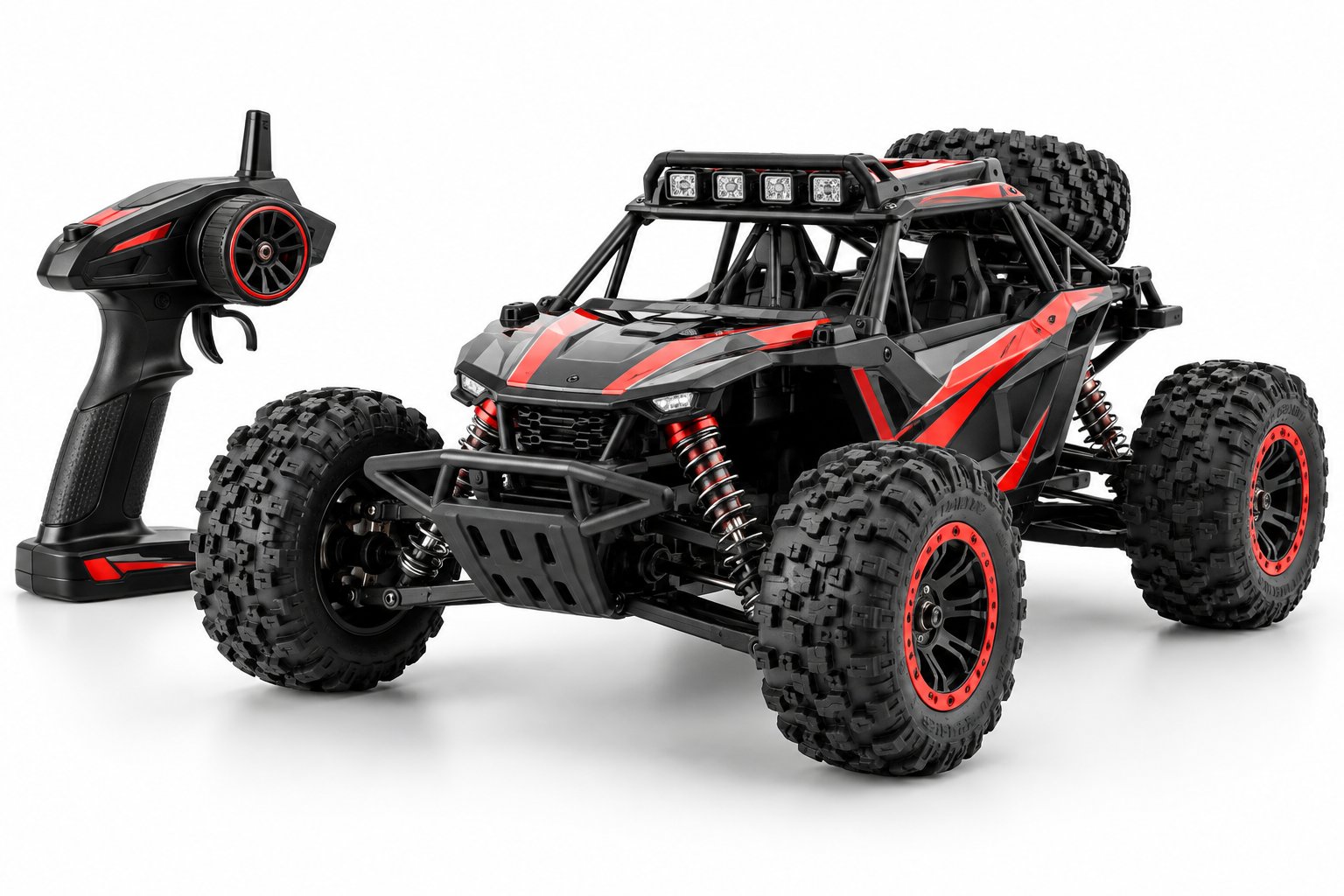
A buyer-side decision guide for matching RC car types — stunt/indoor cars, off-road cars and 4WD off-road trucks — to target age, play surface and sales channel, with plain explanations of 2.4GHz control and rechargeable battery specs.
Sourcing Guide
Most sourcing mistakes with remote control cars are not manufacturing faults. They are range mismatches: a car built for a smooth living-room floor gets returned because the buyer's customers drive it on gravel, or a large off-road truck underperforms for a five-year-old who cannot yet steer it. This guide maps three common car types to target age, play surface and sales channel, and explains the two specs buyers ask about most.
Key takeaways
- Start from the customer's age and play surface, then pick the car type; product features come last.
- Stunt/indoor cars suit younger children and smooth surfaces; off-road cars and trucks suit rougher ground and older users.
- 2.4GHz control matters for channel and multi-unit use; confirm details with the supplier rather than assuming.
- Battery voltage and charging method affect how a product is positioned and used; check the actual spec per model.
- Ask for range, runtime and packaging data model by model — no two types behave the same.
In this guide
Start with the buyer, not the feature list
When a retailer, distributor or gift channel asks for a remote control car, the useful first question is not "which car has the most features?" It is "who will use it, and where?" Age determines hand size, reaction time and the amount of adult supervision likely to be present. Play surface determines wheel type, suspension needs and how far the car can travel before it hits something. Sales channel determines packaging, display appeal and how much battery handling the end user is willing to accept.
Get those three answers and the car type usually selects itself. If you begin with a feature list, you end up buying whichever model looks busiest on a spec sheet, and then trying to find a customer for it.
It also helps to separate two kinds of buyers. A gift-driven retail channel needs a car that works well in the first ten minutes and looks good on the shelf. A hobby-oriented or outdoor channel needs a car designed for repeated outdoor use on uneven ground. These are different products, even when they come from the same factory.
Match car type to age, surface and channel
Stunt and indoor cars: smooth floors, younger users
A stunt car is the easiest place to start for younger children and indoor play. The 4-Channel RC Stunt Car uses 4 channels, can spin 360 degrees, and has an ABS body with soft rubber wheels. The listed working distance is up to 30 m, and it runs on a 3.7 V battery charged by USB. It is specified for ages 6 and up.
The 360-degree spin is not a gimmick for this tier of product. It keeps the car exciting within a small space, where a fast straight-line car would hit a wall immediately. Soft rubber wheels and an ABS body fit hard indoor floors and the occasional collision. The 4-channel layout suggests a broader control set than simple forward/back and left/right, but verify the exact button functions with the supplier before you print a product description.
This type suits toy stores, gift channels and indoor-focused retail. It is the weakest fit for gravel, grass or steep outdoor ground.
Off-road cars: a middle option for mixed surfaces
The 2.4GHz RC Off-Road Car comes with a handheld 2.4GHz controller and a USB-rechargeable battery, and is specified for ages 6 and up. It sits between the stunt car and the 4WD truck: built for outdoor or mixed surfaces, but without the drivetrain complexity of a full off-road truck.
For a distributor whose customers use a mix of patios, playgrounds and light trails, this is often the most flexible listing. Because the available product data does not state maximum range or runtime for this model, treat those figures as confirmable per order rather than assuming they match the larger truck.
The handheld 2.4GHz controller is relevant commercially: it is a familiar format for parents and gift buyers, and it avoids the long telescopic antenna that older 27MHz or 49MHz products used. That detail affects both the product presentation and how many units can be used in one space.
4WD off-road trucks: rough ground, older or experienced users
The 4WD RC Off-Road Truck is the most capable of the three for difficult ground. It uses four-wheel drive with independent suspension, a 7.4 V USB-rechargeable battery, and is listed for ages 6 and up, with a working distance of up to 40 m.
Independent suspension is the structural reason this type handles uneven ground better than a flat-chassis design: each wheel can move independently over bumps instead of lifting the whole body. Actual durability still depends on materials and construction, so treat this as a design advantage rather than a tested lifetime claim. The 7.4 V battery is a higher-voltage configuration than the 3.7 V stunt car, which matters for how the product is documented and how charging is explained on the packaging.
The truck is listed for ages 6 and up. Its larger size, higher-voltage battery and 4WD drivetrain generally make it a better fit for older or more experienced users than for first-time drivers; confirm the right end-user positioning with the supplier based on the model's size and speed before you write box copy. Also confirm what operating and runtime information is available for this model before you publish claims.
Side-by-side specification comparison
| Spec | 4-Channel RC Stunt Car | 2.4GHz RC Off-Road Car | 4WD RC Off-Road Truck |
|---|---|---|---|
| Control | 4 channels | Handheld 2.4GHz controller | Not specified in the provided data |
| Drive / handling | 360-degree spin; ABS body, soft rubber wheels | Not specified in the provided data | 4WD with independent suspension |
| Working distance | Up to 30 m | Confirm per model | Up to 40 m |
| Battery / charging | 3.7 V, USB rechargeable | USB rechargeable (voltage to confirm) | 7.4 V, USB rechargeable |
| Age marking | 6+ years | 6+ years | 6+ years |
| Best fit | Indoor, smooth floors, younger users | Mixed and light outdoor surfaces | Rough ground, older or experienced users |
Runtime and maximum range vary by model and use. Confirm the figures for the exact model and order before quoting them to your customers.
What 2.4GHz control actually means for a buyer
The 2.4GHz band is a radio frequency used by cordless phones, Wi-Fi and many RC controllers. For a buyer, the commercial implications are straightforward even without deep radio knowledge.
First, with 2.4GHz controllers, multiple cars can often run at the same time without channel conflicts — but whether a specific model supports this depends on its controller design (pairing and frequency-hopping), not on the frequency band alone. Confirm this with the supplier per model before you promise multi-car play in your listing. Second, the controllers are compact handheld units rather than long-antenna types, which affects packaging size and how the product looks in a catalogue. Third, working distance depends on the controller and the environment: the listed figures — up to 30 m for the stunt car and up to 40 m for the truck — should be read as listed maximums under normal use, not guaranteed figures at every location.
Note that the product data confirms a handheld 2.4GHz controller for the off-road car. It does not confirm the radio system for the stunt car or the truck. Do not describe those two as 2.4GHz until the supplier confirms it for the specific model and order.
For channel planning, this is also a positioning point: 2.4GHz is the modern expectation for RC toys, so a channel selling to informed buyers will compare on it. A product without a confirmed 2.4GHz spec is better positioned on other strengths.
Rechargeable battery basics worth checking
All three products use USB-rechargeable batteries, but at different listed voltages: 3.7 V for the stunt car and 7.4 V for the 4WD truck. Voltage is a configuration detail, not a single measure of quality. It tells you how the product is documented and what charging routine the end user needs.
USB charging has practical appeal for retail: no separate charger to lose, and a familiar cable format. Ask the supplier these questions before ordering:
- What is included in the box — battery, charging cable, or both?
- What charging time and run time should be printed on the packaging?
- What is the battery capacity and chemistry for the exact model?
- Are spare batteries available as an accessory line?
- What safety information must appear on the label for your destination market?
Do not publish runtime figures until the supplier provides them for the exact model. A justified buyer would rather see an honest confirmed number than an impressive unverified one.
A short pre-order checklist
- Age and user: is the real user 6–8, 9–12, or an adult? The 6+ marking is a floor, not a target.
- Primary surface: smooth indoor floor, patio, grass, gravel, or mixed?
- Channel: gift, toy retail, outdoor, or hobby-oriented?
- Control system: confirm 2.4GHz where the listing depends on it.
- Battery: confirm voltage, capacity, charging time and what is in the box.
- Range and runtime: obtain the model-specific figures in writing.
- Packaging: check box dimensions and language requirements for your market.
FAQ
Which type is best for younger children?
The stunt car is the most natural starting point: it is built for smooth indoor floors, uses soft rubber wheels and an ABS body, and its 360-degree spin keeps play interesting in a small space. It is listed for ages 6 and up.
Can an off-road car be used indoors?
It can, but its design intent is outdoor or mixed surfaces. If most of your customers use smooth indoor floors, the stunt car type is the better product fit.
Why does battery voltage differ between models?
The stunt car is listed at 3.7 V and the 4WD truck at 7.4 V. These are different product configurations with different charging needs. Confirm the included accessories and charging instructions for each model before ordering.
How far can the car travel from the controller?
Listed working distances are up to 30 m for the stunt car and up to 40 m for the 4WD truck. The provided data does not state a range for the off-road car, so confirm it per model. Treat all range figures as listed maximums under normal conditions.
Can several cars be used at the same time?
Many 2.4GHz controllers support this through pairing and frequency-hopping, but it depends on the specific model's controller design. Confirm with the supplier for the exact model before making multi-car play part of your product claim.
What should I confirm before printing product claims?
Runtime, charging time, battery capacity, control system details and packaging specification — all for the exact model and order. These are the facts your customers will check first.
Next step: shortlist the car type by customer age and surface, then send the supplier the exact model numbers and the checklist above. Ask for confirmed battery, range and packaging data in writing so your listing and your packaging agree.


