A practical buying guide for parents, preschool buyers and retail buyers: how to pick educational toys by developmental age band and by teaching scenario — fine motor, early maths, construction and group play — plus what wholesale buyers must check before ordering, from wood finish and piece counts to MOQ.
Choosing an educational toy comes down to three questions: what developmental skill is it for, does the format fit the group using it, and can the supplier deliver it consistently at the quantity you need. Age is the filter, not the goal — a toy can be right for a five-year-old and still fail in a classroom because there are not enough pieces or the finish will not survive daily handling.
This checklist is written for parents buying one or two items, and for preschool, kindergarten and retail buyers ordering in bulk. Work through the age bands first, then the learning scenarios, then the wholesale checks at the end. Use it as a decision sheet before you place an order.
Quick summary
- Pick the age band first: the toy's size, grip and complexity should match the child, not the other way around.
- Then pick the learning scenario: sorting and threading, early maths, or construction and group play.
- Then check the order-level details: finish and edges, piece count against class size, and MOQ.
In this guide
Checklist by age band
Early-childhood development guidance generally groups children into rough bands rather than exact birthdays. The useful question for a buyer is not "what age is on the box" but "what can a child in this band physically do, and what will keep them engaged long enough to learn something."
Toddler years — large pieces, one-step actions
- Grip and size: pieces should be large enough for a whole-hand grasp and too big to swallow. Avoid small beads, tiny connectors and anything a child can snap into a sharp edge.
- Action: one clear movement per piece — put in, take out, stack up, knock down. Multi-step logic is not yet the point.
- Colour and shape: a small number of distinct colours and shapes works better than twenty variations. Recognition comes before naming.
- Durability: expect pieces to be dropped, mouthed and thrown. Smooth, rounded wooden parts hold up well here.
Preschool years — sorting, matching, simple sequences
- Two-variable matching: sort by colour, then by shape, then by both. This is the stage where sorting boxes and threading toys carry the most learning weight.
- Hand control: threading, stacking and fitting pieces build the pincer grip and hand-eye coordination that later support writing.
- Counting in context: numerals start to connect to quantity — one peg, one number. A toy that shows both is worth more than a toy that only shows digits.
- Repeatability: the same task should be re-doable many times without breaking or losing meaning.
Kindergarten and early primary — rules, construction, cooperation
- Open-ended building: interlocking pieces with wheels, beams and connectors let children plan, test and rebuild.
- Shared goals: toys that support two or more children working on one structure teach turn-taking and verbal planning.
- Persistence: a slightly harder challenge that can be solved with effort — not a puzzle that is finished in ten seconds.
- Piece count: group play needs enough parts for several children to build at once, not enough for one child to take turns.
Checklist by learning scenario
Age tells you what a child can do. The scenario tells you what you actually want the toy to teach. Most educational toys sit in one of three groups.
Fine motor skills, sorting and threading
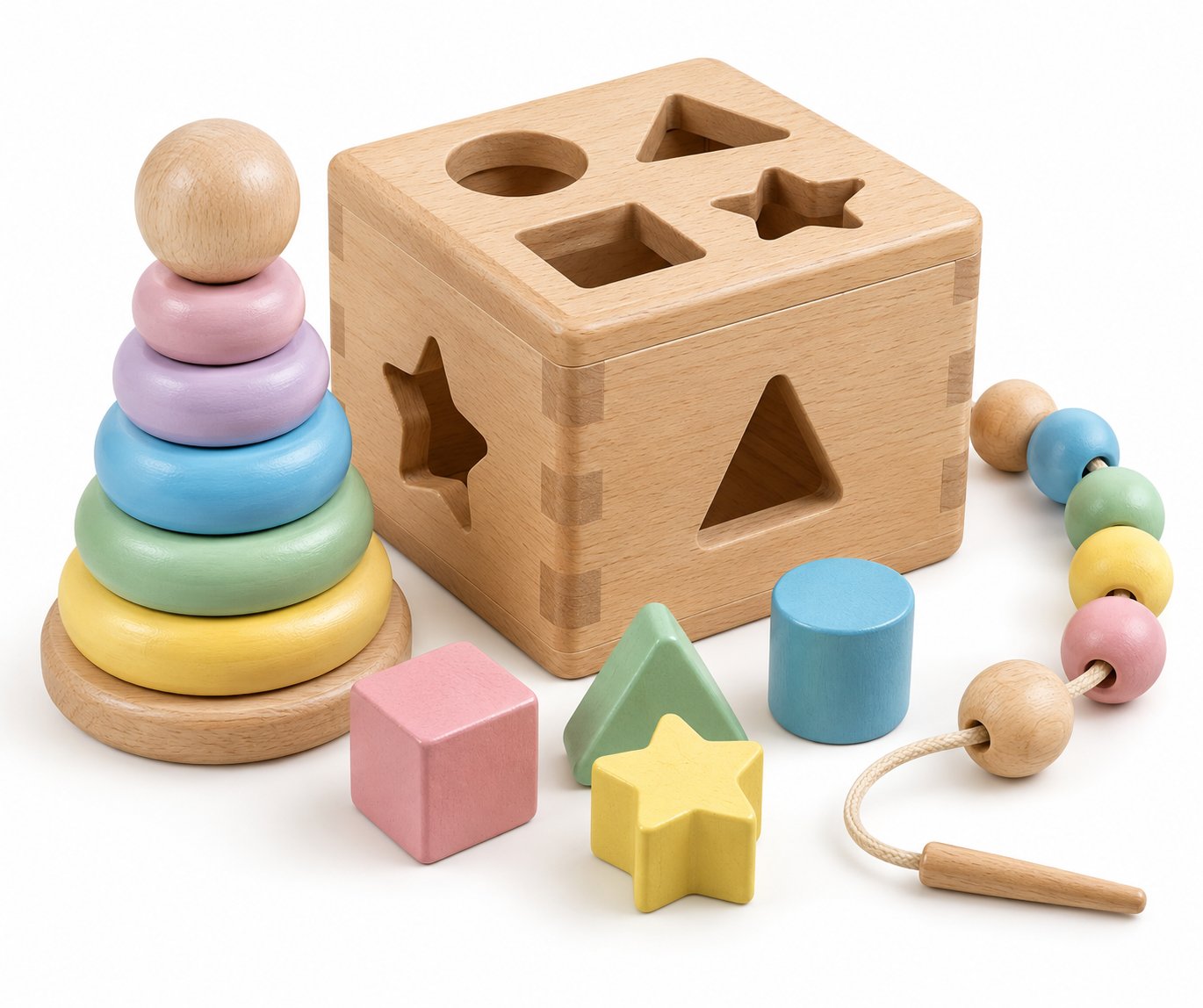
This is the group that develops grip, hand-eye coordination, colour recognition and early problem-solving. A good sorting and threading set combines several actions in one box: fit a shape into its slot, stack pieces by size, thread a bead onto a lace. The child practises the same underlying skills through different movements, which keeps attention longer than a single-format toy.
Our wooden Montessori learning set is built around this idea: a shape-sorting box, stacking toys and a bead threading toy in one set, made from smooth child-safe wood with non-toxic finishes. For buyers, the relevant questions are whether the shapes are distinct enough to sort by feel, and whether the threading lace and beads survive daily classroom use.
Early maths and number sense
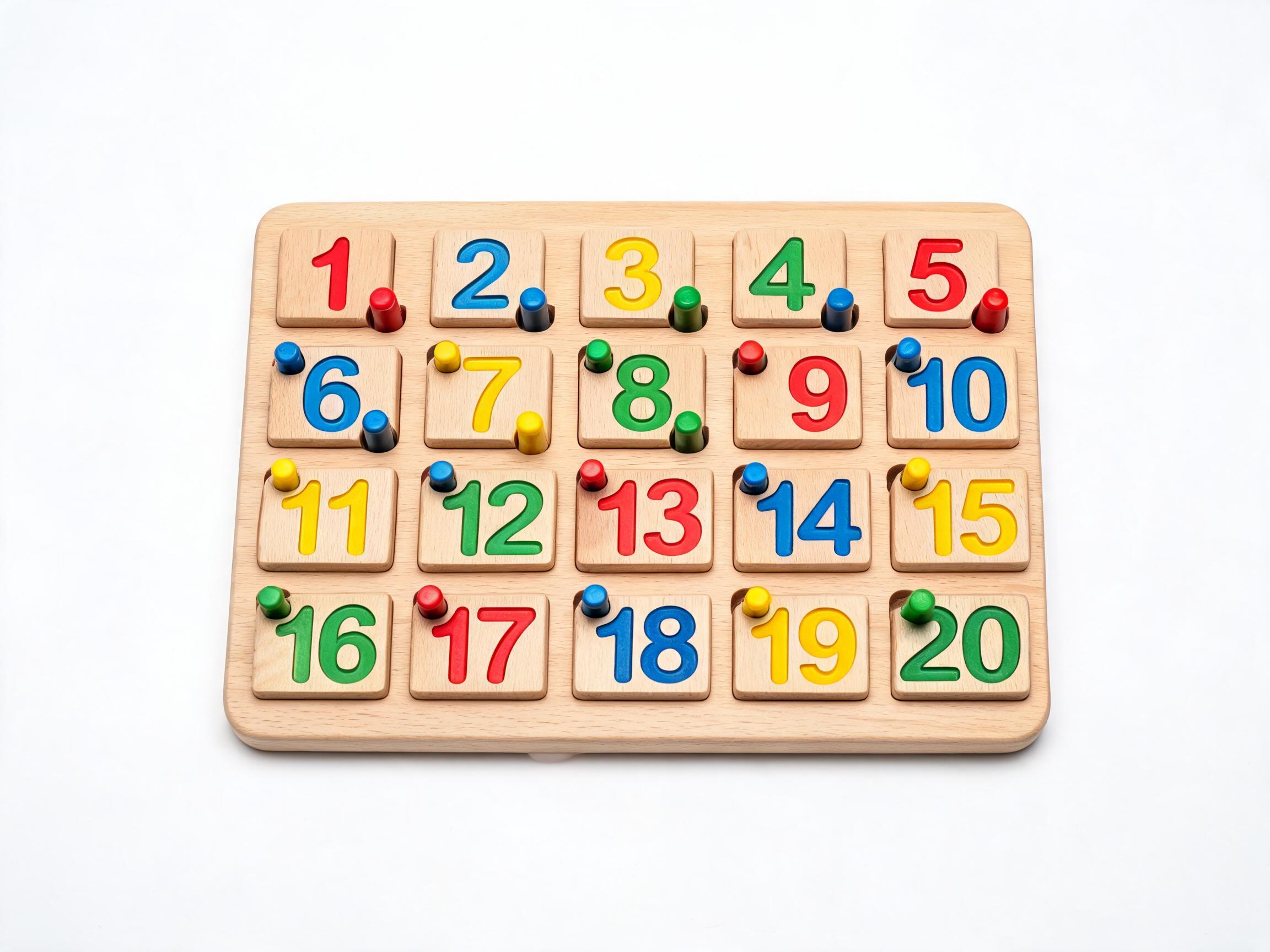
Early maths toys should link the numeral to the quantity, not just display numbers. Look for a physical action that forces the child to count: placing a peg into a slot, matching a counter to a card, building a stack of a given height. If the child can complete the task without counting, the toy teaches recognition rather than number sense.
Our wooden number puzzle board uses 20 numbered pieces in recessed slots, each slot with matching counting pegs so the numeral and the quantity sit together. It is sanded smooth with rounded corners and a non-toxic water-based coating, which matters if the board is going to be handled every day in a classroom rather than occasionally at home.
Construction and group play
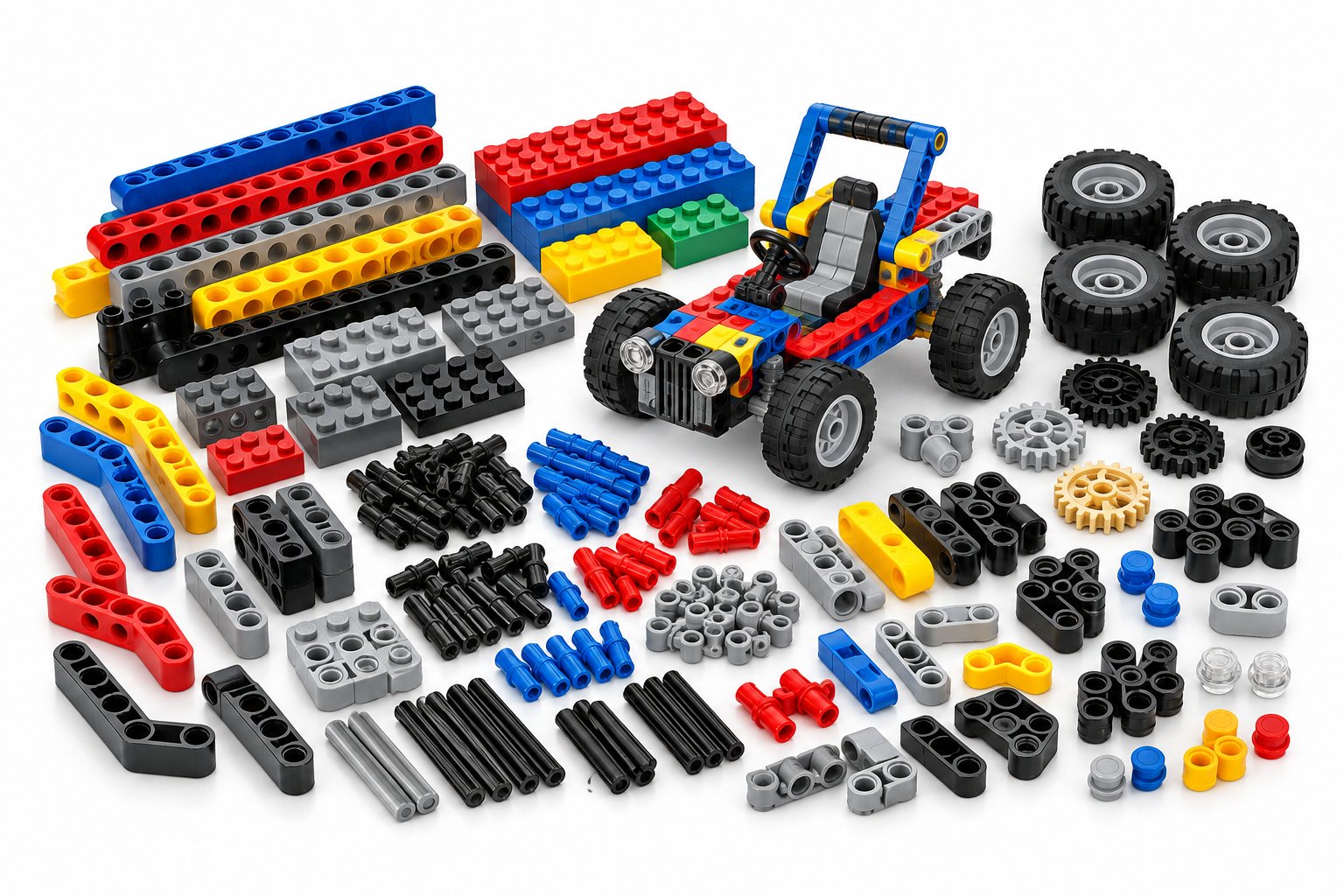
Construction toys are the easiest group-play format to buy, provided the piece count is high enough and the pieces are easy to handle. Interlocking systems that press together and pull apart with light hand pressure let children build, fail and rebuild without adult help — and without tools that would make the toy unsuitable for young children.
Our STEM building blocks set has 120 interlocking pieces — beams, plates, wheels and connectors — designed for group work with enough pieces for several children to build at the same time. The light-pressure connection is the practical detail: it determines whether a young child can work independently or needs an adult at every step.
What wholesale buyers should check before ordering
For a parent, the decision ends at the product. For a preschool, kindergarten or retail buyer, the product is only half the decision — the order terms decide whether the toy works in practice.
| Check | What to look for | Why it matters |
|---|---|---|
| Material and finish (wooden toys) | Smooth sanded surfaces, rounded corners, non-toxic finishes and coatings, no rough edges or splinters | Wooden toys in group settings are handled daily; finish quality determines how long they stay presentable and safe |
| Piece count vs class size | Count how many children will use one set at a time, then check the piece count per set | A 120-piece construction set supports several builders; a sorting set with only a handful of pieces creates waiting, not learning |
| MOQ and line consistency | Confirm the minimum order quantity for the wooden toy line — 500 sets — and whether items can be combined on one order | MOQ affects your initial stock commitment and how many different products you can test at launch |
| Replacement parts | Ask whether single pieces (pegs, connectors, laces) can be reordered separately | Lost pieces are the most common reason a classroom set stops being used |
| Packaging for retail vs classroom | Clarify whether boxes suit shelf display or bulk classroom storage | The same product may need different packaging depending on whether you resell it or use it in-house |
Two of these checks carry most of the weight. First, the finish on wooden products: confirm with the supplier what the coating is and how the edges are treated, since this is the detail that separates a toy that lasts a school year from one that looks worn after a month. Second, the piece count against the number of children who will use the set simultaneously — a number you know and the supplier does not.
On quantity, the MOQ for our wooden toy line is 500 sets. If you are testing a new classroom programme or a new retail category, that figure is the threshold to plan around: decide how many sets one site or one store actually needs before committing, and whether a mixed order across the wooden range makes the volume easier to absorb.
Frequently asked questions
How do I know which age band a toy belongs to?
Work backwards from the action required. If a child needs to sort by two attributes or count a quantity, the toy belongs to the preschool band. If the task is a single put-in or stack-up movement, it suits toddlers. If it requires planning a structure with others, it fits kindergarten and early primary.
Should I buy one multi-skill set or several single-skill toys?
A multi-skill set covers more ground per unit and takes less storage, which suits classrooms. Single-skill toys are easier to match to a specific lesson. For most buyers, a small core of multi-skill sets plus one or two focused items covers both needs.
What is the minimum order quantity for your wooden toy line?
500 sets. If you need to confirm how that applies to a mixed order, or want the material and finish details for a specific product, ask us before ordering.
Ready to plan your order?
Tell us the age band, the learning scenario and the number of sets you need, and we will confirm the material, finish and order details for the products you are considering.