A practical claim-testing method for parents and preschool or retail buyers: judge any toy by what the child physically does, whether the task can be repeated, whether the skills map to developmental goals, how it behaves in group use, and which marketing claims deserve a second look. Worked examples apply the checks to a Montessori learning set, a shape sorter cube, and an interlocking STEM building set, with a supplier confirmation list at the end.
Buyer's Evaluation Guide
Most toys sold as "educational" carry the label because it sells, not because anyone measured what the child does with the toy. The useful question is not whether a toy is marketed as educational, but whether it holds up against five checks: what the child physically does, whether the task can be repeated, whether the skill maps to a developmental goal you can name, how the toy behaves when several children use it, and whether the marketing claim survives contact with the actual product. If a toy passes those checks, it teaches something. If it fails one, the label is decoration.
In this article
- The five checks, in the order that filters fastest
- Worked examples: applying the checks to three real toy types
- Marketing claims that deserve skepticism
- What buyers and parents should confirm with suppliers
Start With What the Child's Hands Actually Do
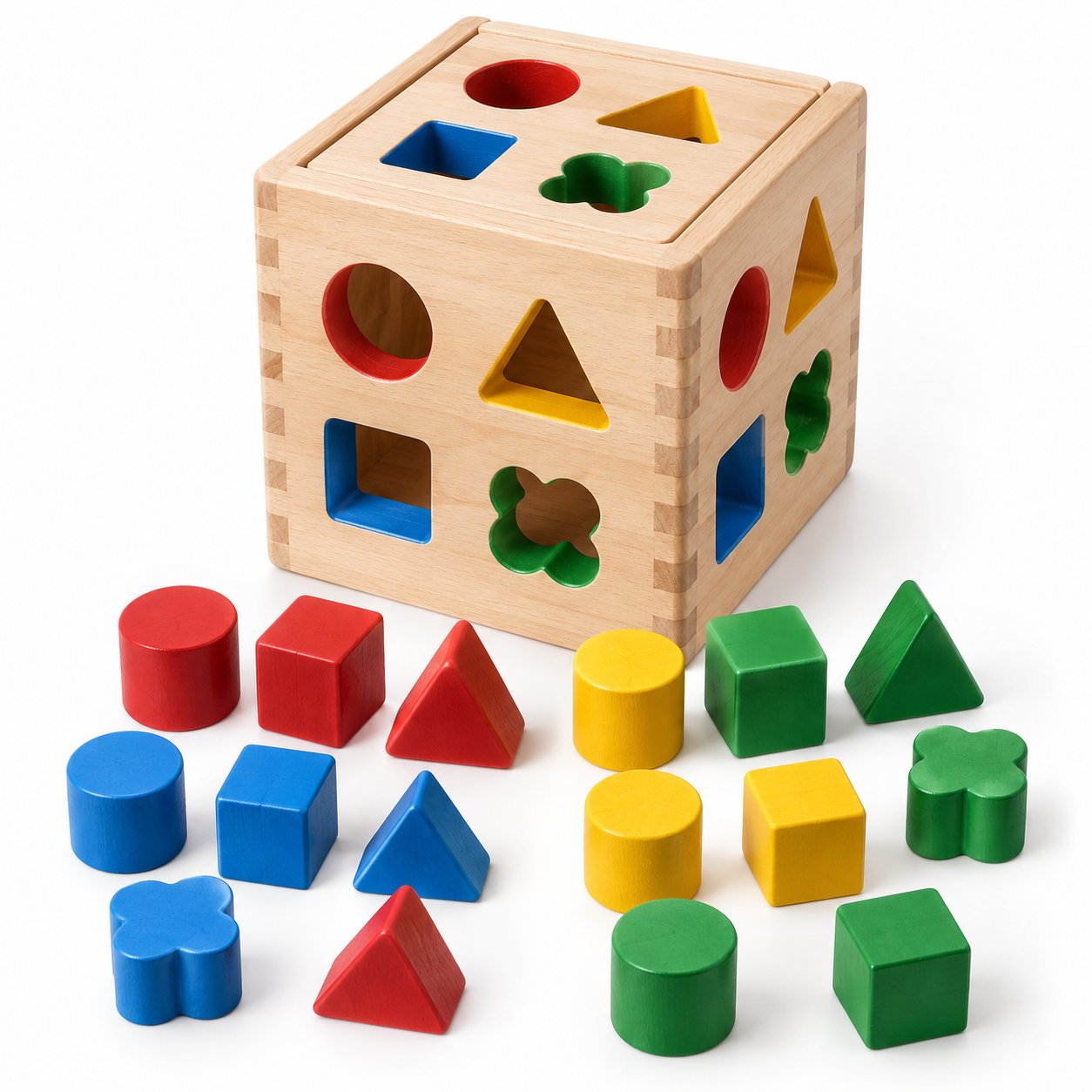
Pick up the toy and ask what physical action it requires. Sorting, stacking, threading, pressing pieces together, turning a lid, matching a shape to an opening — these are actions with a defined outcome. A toy that asks the child to do one of them is doing something. A toy that asks the child to press a button and watch a light is asking for almost nothing.
The specific action matters because it tells you which skill is being exercised. Threading a lace through a bead trains hand control and grip. Pressing two interlocking pieces together trains alignment and applied force. Dropping a block through the matching hole trains shape recognition and trial-and-error correction. "Educational" without an action attached is a claim with no mechanism behind it.
Check Whether the Task Can Be Repeated
A learning task has to be repeatable, because repetition is where the skill consolidates. This is the check that separates a toy from a demo. Ask: after the child finishes, how hard is it to start again? If resetting requires an adult — rethreading, re-hiding, re-sorting by hand — the toy will be used once and abandoned.
Design details answer this question quickly. A removable lid that lets the pieces drop out and the whole thing reset in seconds passes. A sealed box that must be shaken upside down does not. Look for a reset that the child can perform alone, because independence in resetting is what makes the second and twentieth attempt happen.
Map the Skill to a Goal You Can Name
Write down the skill in one sentence before you buy. If you cannot, the toy is probably entertainment with a learning-sounding label. Examples of nameable goals: matching shapes to openings, sequencing a multi-step build, coordinating both hands, following a build order, recognizing colors by name, applying the right amount of force to connect parts.
One caution for buyers: age suitability printed on the box is a starting filter, not proof of learning value. The compliant age marking on a product tells you it is intended for a certain age group; it does not tell you what the toy teaches. Treat the printed age as a safety and suitability statement, and evaluate the skill separately.
Watch How the Toy Behaves in Group Use
Preschool and retail buyers should test this directly, because group behavior is where classroom toys succeed or fail. Put the toy in front of several children and watch what happens. A toy with enough pieces to share supports parallel play and turn-taking; a toy with one central mechanism and one seat creates a queue and a dispute.
Look for pieces that can be distributed, parts that do not depend on a single component to function, and a format that lets a second child work alongside the first. For a setting with several children at once, piece count and part independence matter more than any printed skill claim.
Worked Examples: Applying the Checks to Real Toy Types
Shape-Sorting and Threading Set
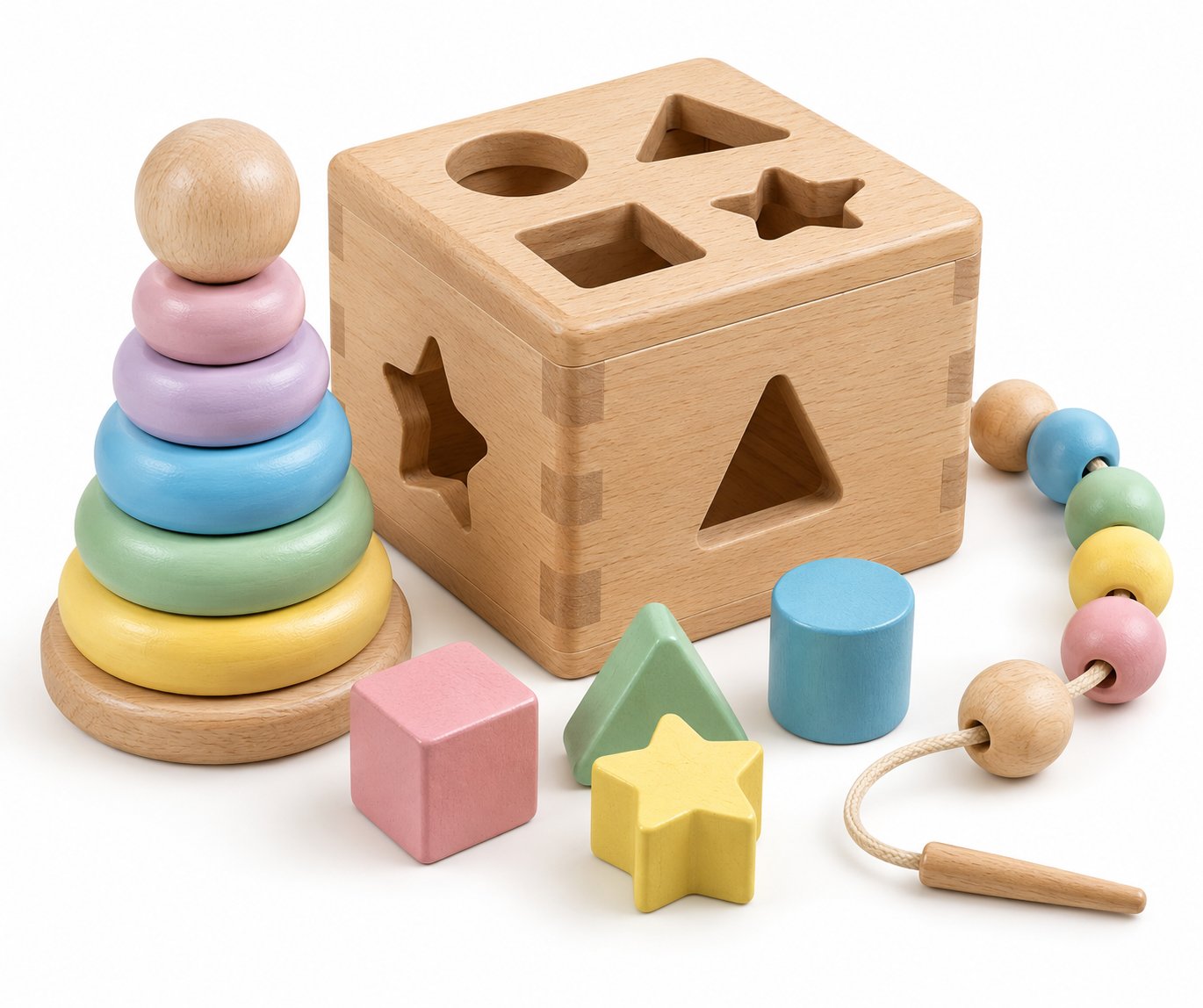
Take a set that combines a shape-sorting box, stacking toys, and a threading toy, such as the Wooden Montessori Learning Set, made in child-safe wood with a non-toxic finish and marked for 3+ years. Run the checks: the actions are distinct (sort, stack, thread), so more than one skill is covered. The tasks are repeatable because the pieces can be emptied and reused. The skills are nameable — shape matching, balance, and lace control. In group use the loose pieces can be shared across several children. That combination is what the label should mean.
Single-Mechanism Shape Sorter
A cube with 12 chunky blocks in four shapes and four colors, such as the Wooden Shape Sorter Cube, marked for 2+ years, shows why the reset check matters. The cube's removable lid lets an adult or child dump the blocks and start over without dismantling anything, which keeps the matching task available for repeated attempts. The action is simple and the skill maps cleanly to shape and color recognition. What it does not do is support complex building, so the group-use check returns a mixed answer: fine for two or three children sharing blocks, less suitable as a centerpiece for a larger group.
Interlocking Construction Set
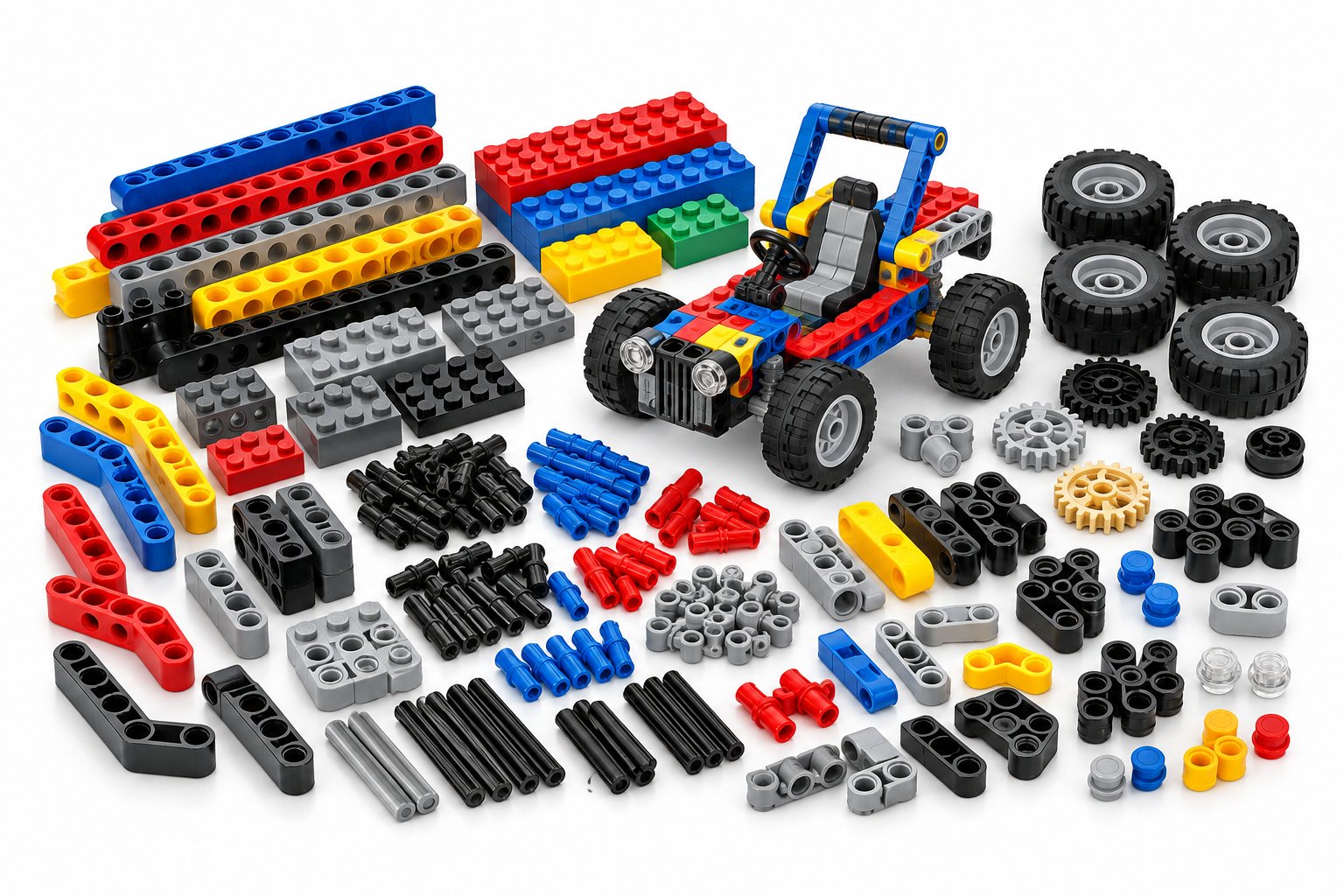
A set with 120 interlocking pieces — beams, plates, wheels, and connectors — that press together without tools, such as the STEM Building Blocks Set in BPA-free ABS plastic, marked for 4+ years. Here the checks read differently. The physical action is press-fitting parts, which demands alignment and force control. The task is repeatable because the build can be taken apart and rebuilt in a different order. The skill is nameable as following a sequence and reasoning about how parts connect. Group use is the strongest of the three, because 120 pieces can be divided among several builders.
| Check | Shape sorter and threading set | Shape sorter cube | Interlocking building set |
|---|---|---|---|
| Physical action | Sort, stack, thread | Match block to opening | Press-fit and align parts |
| Repeatable without adult | Yes, pieces are reusable | Yes, via removable lid | Yes, rebuild or reconfigure |
| Nameable skill | Shape matching, balance, lace control | Shape and color recognition | Sequencing, structural reasoning |
| Group use | Parts shareable across children | Adequate for two or three children | Strong — 120 parts divide easily |
| Age marking on record | 3+ years | 2+ years | 4+ years |
Marketing Claims That Deserve Skepticism
- "Teaches STEM" with no build sequence. If the child only presses buttons, the STEM claim has no task behind it. Ask what the child assembles and in what order.
- "Montessori" as a word on the box. The word describes an approach, not a certification. Evaluate the toy by its actions and reset, not by the term.
- "Develops problem-solving" with one solution. A task with only one possible outcome trains trial-and-error at best. Multiple valid outcomes are the stronger signal.
- Skill lists with no matching parts. If the box lists five skills but the toy has one mechanism, the list is copywriting, not design.
- Age range stretched wide. A very broad range usually means the lower end is a safety floor and the upper end is optimistic. Confirm what the toy actually requires at each end.
The fastest test
Hand the toy to a child and say nothing for two minutes. If the child finds an action and repeats it, the toy is working. If the child looks at you for instructions, the task is not self-evident and the learning will depend on adult facilitation every time.
What Buyers Should Confirm With Suppliers
Parents can run the five checks on a single unit. Preschool and retail buyers need the same checks to hold across a production run, which means confirming a few commercial and compliance points before ordering.
- Action and reset: ask the supplier to describe the intended action and how the toy resets. A supplier who can answer this has thought about use, not just appearance.
- Age marking: confirm the marked age group for the specific item and that it is consistent across the batch.
- Compliance paperwork: for wooden items, ask for EN71 and ASTM F963 documentation covering the product; for plastic items, ask for the relevant material documentation, including BPA-free confirmation where the supplier claims it.
- Finish and materials: confirm wood type and finish, and for plastic items confirm the material grade, so the claims on your listing match the goods.
- Minimum order and pack format: confirm MOQ and how pieces are packed, since piece count and packing affect the group-use check. The items above are quoted at MOQ 500 sets — confirm the current figure with the supplier for your order.
- Sample before commitment: request a sample and run the two-minute hand-it-over test with real children before placing a bulk order.
A toy is educational when a child can do something with it, do it again alone, and gain a skill you can name. The label on the box is a marketing decision; those three behaviors are the evidence. Test the sample, confirm the documentation, and the question answers itself.