
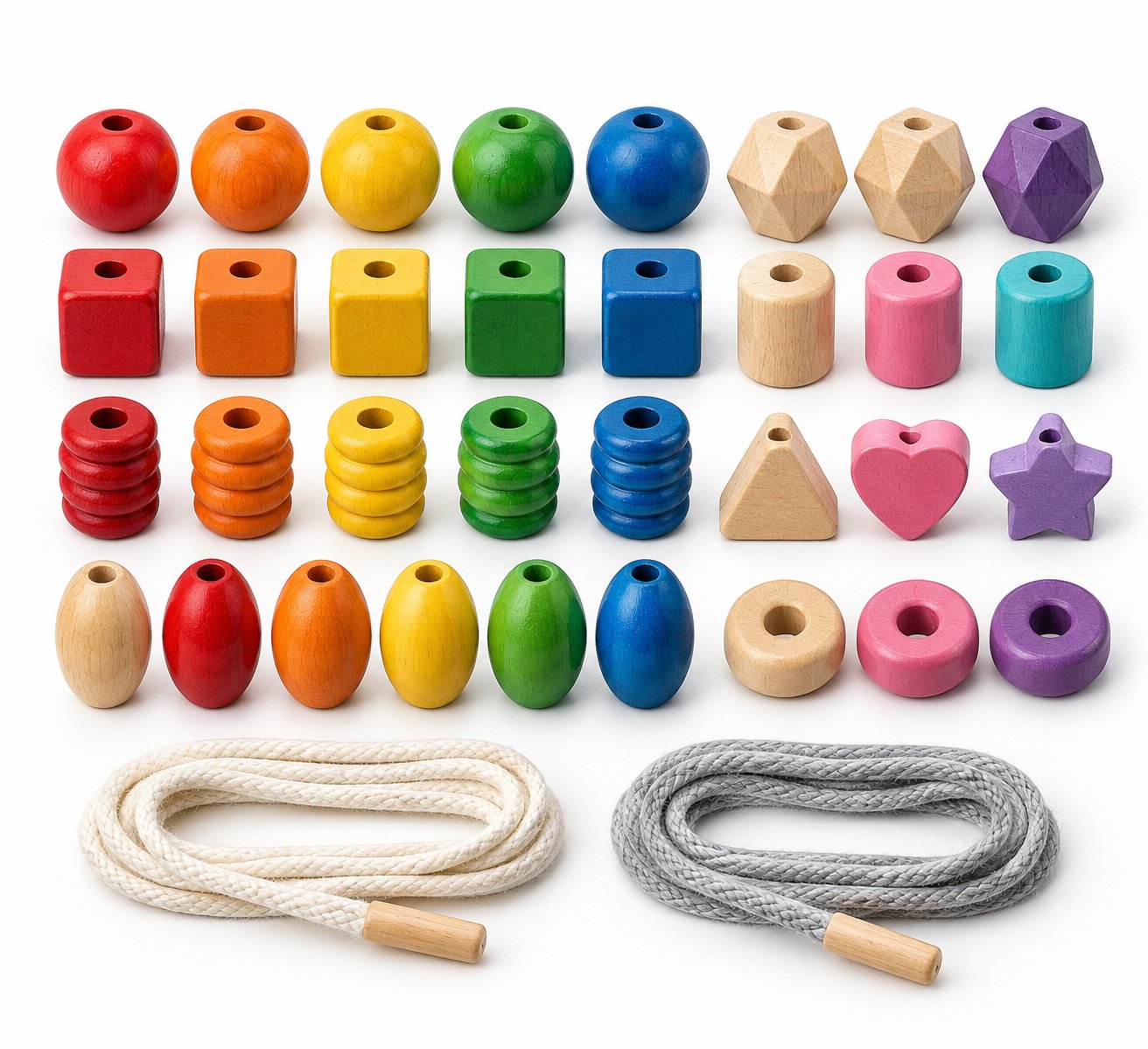
Lacing beads toys are generally rated for ages 3 and up, but the age label alone is not a buying decision. This guide answers the age question directly, then walks kindergarten and retail buyers through bead diameter, cord-end design, and certification checks — with the actual specs of a real 30-bead wooden set, EN71 / ASTM F963 compliance, and MOQ 500 sets.
Buyer's Selection & Safety Guide
"What age lacing beads?" is the question buyers, kindergarten directors, and early-education purchasers ask first — and it is usually the wrong first question. The age printed on a box tells you who the toy is intended for. It does not tell you whether the bead diameter suits the children in your classroom, whether the cord end lets a three-year-old thread independently, or whether the compliance paperwork will survive an import inspection. This guide answers the age question directly, then gives you the checks that actually decide a purchase order.
Short answer: The Wooden Bead Threading Set with 30 Beads is rated for ages 3 and up. That rating is typical for wooden lacing beads with beads around 2.5 cm in diameter. Under-3 use is not advised for this type of toy because small parts present a choking risk; always follow the age marking on the specific product you buy.
Key Takeaways
- Lacing beads are generally rated 3 years and up — verify the marking on the exact SKU, not the category.
- Bead diameter of 2.5 cm is large enough for small hands to grip and thread, and the set has 30 beads with 2 cotton cords.
- The wooden cord end (rather than a bare string tip) is what lets a child thread without adult re-threading every bead.
- Ask for EN71 / ASTM F963 compliance documents before you confirm a PO. The set complies with both.
- Minimum order is 500 sets, packed in a color box.
On this page
What Age Are Lacing Beads For?
The 3+ rating on this product category is not arbitrary. It reflects a combination of two things: a child's ability to grip and manipulate a bead on a cord, and the size of the smallest component relative to a young child's throat. Both change around the third year for most children.
In practical terms, lacing beads sit in the same band as most wooden threading toys, stringing sets, and early fine-motor play products. When you are spec-ing for a nursery class or a retail shelf, treat "3+" as the default floor and then check two things before you commit:
- Does the age mark match the class or shelf it is going to? A toddlers' room that mixes 2-year-olds and 4-year-olds is not the same buyer as a preschool room for 3–5s.
- Does the product documentation use the same age statement consistently? The box, the product listing, and the compliance file should agree. If they don't, ask the supplier which one is current.
If your program serves children under 3, this class of product is generally not the right fit, regardless of brand. The intended-use age is the control — not the child's individual dexterity.
Bead Size and the Small-Parts Question
For a buyer, bead diameter is the number that determines whether the product is practical in a classroom and whether it clears the small-parts consideration for the stated age group. In the 30-bead set, the bead diameter is 2.5 cm.
Why that matters for your order:
- Grip and threadability. At 2.5 cm, a bead is big enough for a three- or four-year-old to pick up with a pincer grip and hold steady while pushing a cord through the hole. Beads that are too small frustrate the child; beads that are too large make the activity clumsy.
- Small-parts handling. Toys for children under 3 are subject to small-parts requirements in most markets because of choking risk. The way to handle this in a purchase order is simple: buy the product with the age rating that matches your user group, and do not override it. General safety practice is to keep small components away from children below the marked age, and to use the product only within the manufacturer's stated age range.
- Cord length. The set ships with cords of 75 cm. That is long enough for multiple children to work on a table without the beads running out of cord, and it is a dimension worth confirming when you compare this set against alternatives on your shelf.
If a supplier cannot give you a bead diameter in centimeters or millimeters, that is a gap. Ask for it in writing before you compare quotes.
Cord-End Design and Independent Threading
The detail most buyers overlook is the end of the cord. A cotton cord with a frayed or bare tip is hard for a small child to push through a bead hole — the child hands it back to the adult, and the activity stops being independent play.
This set uses a wooden cord end — a rigid wooden tip that holds the cord stiff. That design choice supports the actual use case in a kindergarten or nursery: the child can pick up the cord and thread a bead without adult re-threading. For a buyer, that translates into a product that works in a group setting where one adult supervises several children.
Two cords are included with the 30 beads, which allows two children to work from the same set or one child to string a longer sequence. When you evaluate competing lacing bead products, this is a spec point worth writing into your comparison sheet alongside bead count and diameter:
- Is the cord end rigid, or is it a bare string tip?
- How many cords come in the set?
- What is the cord length, and is it stated in the product data?
- Is the cord material stated? (This set uses cotton cord.)
For a closer look at how threading tasks support skill development — and where lacing beads fit next to other threading formats — see what threading toys are for and the skills behind the beads. If your staff need a classroom-ready sequence, how to thread small beads: setup and steps for kids covers the activity side.
Certification Checks Before You Order
Compliance is where a lacing beads order either clears customs smoothly or stalls. The 30-bead threading set is EN71 / ASTM F963 compliant. Those two standards cover the major toy markets: EN71 for the European Union and ASTM F963 for the United States.
Here is how to use that in a purchasing process, rather than taking it at face value:
- Request the compliance documents for the SKU you are buying. Standards are applied to specific products and configurations. Confirm the document references the toy you are ordering, not a different model in the same catalog.
- Match the standard to your destination market. If you ship to the EU, EN71 is the relevant reference. If you ship to the US, ASTM F963 is. If you ship to both, ask the supplier to confirm both.
- Check the age statement on the compliance file aligns with the box. A mismatch between the retail age mark and the tested age rating is a red flag.
- Confirm packaging and labeling requirements for your market. The set ships in a color box; your market may require specific warning text or language coverage on that box.
- Confirm the order terms. MOQ is 500 sets. If you are a smaller retailer, that number determines whether you order direct or through a distributor.
Standards and age markings are product- and market-specific. Always verify the current documentation for the exact SKU and destination before you place a purchase order.
Reference Specs: 30-Bead Wooden Threading Set
| Specification | Detail | Why a buyer checks it |
|---|---|---|
| Age rating | 3 years and up | Matches your classroom or shelf user group; governs small-parts handling |
| Bead count | 30 wood beads | Determines activity duration and group sharing |
| Bead diameter | 2.5 cm | Grip size and threadability for small hands |
| Cord | 2 cotton cords, 75 cm length | Two children per set; length for longer sequences |
| Cord end | Wooden cord end | Supports independent threading |
| Compliance | EN71 / ASTM F963 compliant | EU and US toy market requirements |
| MOQ | 500 sets | Order feasibility for your volume |
| Packaging | Color box | Retail shelf readiness; labeling requirements |
Buyer FAQ
What does "what is lacing beads" mean in a buying context?
Lacing beads are a threading toy: wooden or plastic beads with a hole through the center, strung on a cord. In a purchasing context, the product should be evaluated on age rating, bead diameter, cord design, and compliance documentation — the four points that determine whether it works in your setting and clears your market's requirements.
Can this set be used with 2-year-olds?
The product is rated for ages 3 and up. For programs serving children under 3, this type of toy carries a small-parts consideration, and the age marking on the product should be followed. If you need a product specifically for under-3s, source a toy rated for that age group.
Is the 75 cm cord too long for a group setting?
Cord length is a listed specification, and 75 cm supports two children working from one set on a table. Whether it suits your room depends on your supervision ratio and activity setup — factor that into your trial order.
Do I need both EN71 and ASTM F963?
It depends on where you sell. EN71 is the reference for the EU market; ASTM F963 for the US. The set is compliant with both, but confirm the documentation covers your destination market and the exact SKU you order.
What is the minimum order?
MOQ is 500 sets, color box packaging. Confirm current terms with the supplier before you finalize your volume.
For the full product specification, see the Wooden Bead Threading Set with 30 Beads. If you are comparing this format against other threading activities on your shelf, the two guides linked above cover the purpose and the classroom setup so you can match the product to the use case before you place an order.


