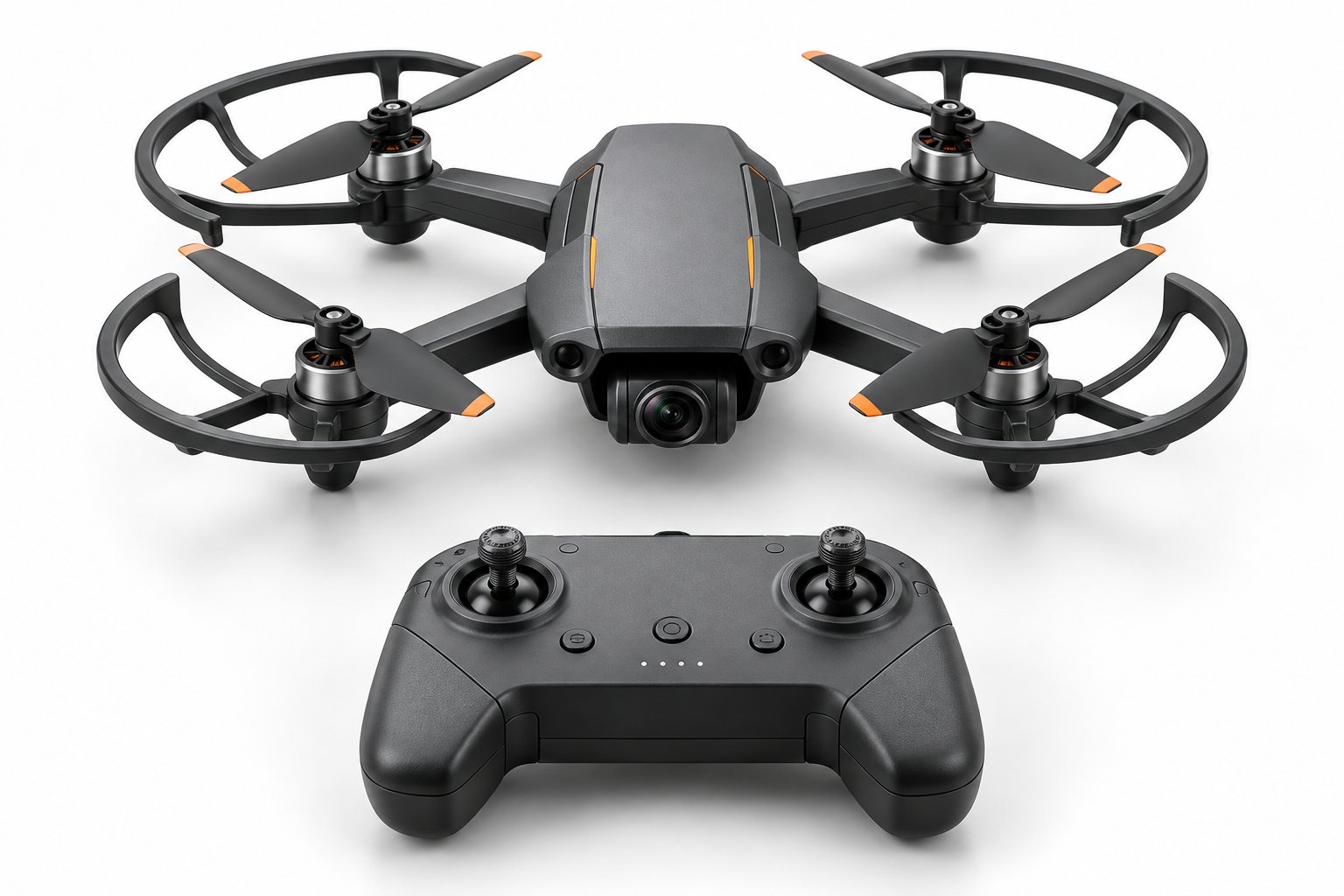
A clear explanation of what a drone is, the main categories of drone use — aerial photo and video, recreation and racing, and indoor play and learning — and a realistic definition of what a toy-grade drone can and cannot do, so retailers, distributors and parents can set honest expectations and position the category correctly.
A drone is an aircraft that flies without a pilot on board. The term covers almost everything from a handheld four-axis toy to a professional camera platform, which is exactly why the question "what is a drone and how are drones used" produces such different answers depending on who is asking. For retailers and distributors, the useful answer separates the whole category into use types — and then places toy-grade models honestly inside it.
Key takeaways
- A drone is a remotely or autonomously controlled aircraft with no pilot on board; most consumer and toy models use four rotors (a four-axis layout).
- Real use categories are distinct: aerial photo and video, recreation and racing, and indoor play and learning. Each has different hardware expectations.
- Toy-grade drones fly short ranges and short sessions, and record modest video. They are not substitutes for camera or commercial drones.
- Shelf positioning works best when the packaging states flight time, control range and camera resolution instead of implying professional capability.
What is a drone?
A drone, also called an unmanned aerial vehicle (UAV), is a flying craft controlled remotely, by onboard programming, or by a combination of both. The defining feature is not size or price — it is the absence of a pilot on board.
Most drones sold today, from entry-level toys upward, are multirotor designs. A four-axis (quadcopter) aircraft carries four rotors on four arms. Speed and direction come from varying the rotation speed of individual rotors rather than from moving control surfaces, which is why quadcopters can hover, rotate on the spot, and fly in any direction without a runway.
Four subsystems appear on almost every drone, whatever the price band:
- Airframe and motors — the body, arms, propellers and the motors that drive them.
- Flight controller and sensors — the electronics that keep the craft stable. On toy models this often includes an altitude hold function that maintains height so the pilot can concentrate on direction.
- Radio link — the connection between the controller and the aircraft, defined by a rated control range.
- Power source — usually a rechargeable lithium battery, which sets the practical flight time.
Camera and GPS modules are optional. Their presence or absence is the single biggest divider between a toy drone and a camera or commercial drone.
How are drones used? The main use categories
Drone use divides into a handful of categories that differ in hardware, regulation and buyer expectations. They are worth keeping separate, because a product built for one rarely performs well in another.
Aerial photo and video
This is the category most people picture first. Camera drones carry a stabilized gimbal, a higher-resolution sensor, and GPS-based position holding so the aircraft can hover in wind while the operator frames a shot. They are used for real estate, events, inspection, agriculture and general content production.
What matters for buyers is that image quality in this category depends on more than the advertised resolution. Sensor size, gimbal stabilization, transmission quality and flight time all shape the result. A 720p camera on a fixed mount is a recording feature, not a production tool — which is exactly the distinction the toy category depends on.
Recreation and racing
Recreational flying covers casual outdoor flights, hobby aerobatics and FPV (first-person-view) racing, where the pilot sees a live feed from the aircraft. Racing drones are built for speed and repairability: high thrust-to-weight ratio, durable frames, and user-serviceable motors and propellers. They trade camera quality and flight time for responsiveness.
This category overlaps with toy drones only at the very entry level. A beginner flying a toy quadcopter is learning the same stick control that racing pilots use, but the hardware serves a different purpose.
Indoor play and learning
Small drones flown indoors serve a different job: introducing flight control in a confined, low-risk space. Altitude hold, headless mode and propeller guards make this category practical for beginners and for younger pilots, because the aircraft is easier to keep stable and the rotating blades are shielded.
This is where most toy drones sit. The learning outcome — understanding throttle, yaw and directional control — is real, and it is the reason this segment stays on shelves alongside higher-priced models.
Commercial and specialist work
Beyond the consumer categories, drones are used for surveying, mapping, delivery trials, crop monitoring and industrial inspection. These platforms typically combine GPS, automated flight planning and payload options, and they are governed by aviation rules that differ by country. Toy drones do not enter this space, and packaging should never imply that they do.
Where toy drones fit — and what they cannot do
A toy-grade drone sits at the entry of the category. It teaches basic control, it is safe enough for indoor use with guards fitted, and it records simple video. It does not replace a camera drone, and stating that plainly protects both the retailer and the customer.
The Mini RC Drone with 720p Camera and Altitude Hold is a useful reference point for what the toy tier actually delivers. Its verified specification reads as follows:
| Feature | Specification |
|---|---|
| Aircraft type | Four-axis (quadcopter) |
| Flight aids | Altitude hold, one-key take-off/landing, headless mode |
| Camera | 720p, recording to microSD |
| Propeller protection | Guards on all four arms |
| Control range | Up to 50 m |
| Flight time | About 8 minutes |
| Battery | 3.7 V USB-rechargeable |
| Age grading | 8+ |
| Compliance | EN71 / ASTM F963 |
| Order terms | MOQ 500 pieces; OEM/ODM available |
Read that list as a boundary definition. A 50 m control range and about 8 minutes of flight time describe a craft flown in a garden, a hall or a living room — not a long-distance camera platform. The 720p camera captures clips for fun and for learning how to frame a shot; it is not built for commercial footage. Guards on all four arms and an 8+ age grading point to supervised indoor and near-range outdoor use.
Equally, those same numbers are the honest selling points. A buyer comparing a mini drone on a shelf wants to know how long it flies, how far it goes and what the camera records. Stating "up to 50 m" and "about 8 minutes" answers the question directly, and it prevents the returns that follow exaggerated expectations.
If you are comparing mini drone specifications in detail — motor layout, battery format, camera module — the companion article What Is a Mini Drone? Specs Buyers Should Compare Before Ordering covers those comparison points. This article stays at the category level: what a drone is and which use each type serves.
How to position the category on the shelf
Toy drones sell against two different expectations, and both need managing.
- Against camera drones. Make the difference visible with facts: recording resolution, control range, flight time. A shopper who understands that a toy drone flies about 8 minutes on a 3.7 V battery will not compare it to a gimbal platform.
- Against other toy drones. Here the useful differentiators are flight aids. Altitude hold and one-key take-off/landing reduce the crash rate for first-time pilots; headless mode removes the confusion of orientation. Propeller guards matter for indoor use and for younger pilots.
Age grading, compliance and order terms matter to you rather than to the end shopper, but they belong in your supplier evaluation. This model is graded 8+, carries EN71 and ASTM F963 compliance, ships at a 500-piece MOQ, and is available with OEM/ODM. Confirm current certification documents, packaging options and lead times directly with the supplier before committing to a program.
For a parent explaining drones at home, the same facts work. A drone is a remote-controlled aircraft; this one holds its height, takes off and lands at the press of a button, flies up to about 50 m away, records to a memory card, and stays airborne for roughly 8 minutes per charge. That is a complete and accurate description of what the toy does.
Frequently asked questions
Is a toy drone a real drone?
Yes. It is a UAV in the technical sense — an aircraft flown without a pilot on board. It is simply built to a different purpose and price point than a camera or commercial drone, with a shorter control range and flight time and a simpler camera.
Do toy drones need registration or a licence?
Rules vary by country and often depend on the aircraft's weight and how it is used. Because requirements differ by market, check the current local regulations for the destination country rather than relying on a general statement, and confirm with your supplier what documentation accompanies the model.
Can a toy drone carry a camera for commercial video?
No. A 720p camera recording to microSD is intended for casual clips. Commercial video work depends on stabilization, sensor size and transmission quality that toy-grade hardware does not provide.
What age is a mini RC drone suitable for?
This model is graded 8+. Propeller guards on all four arms and flight aids such as altitude hold and headless mode make it easier for beginners to control, but adult supervision remains appropriate for younger pilots.
What should a retailer quote to customers about flight time?
Use the stated figure: about 8 minutes per charge on a 3.7 V USB-rechargeable battery, with a control range up to 50 m. Quoting the actual numbers avoids the mismatch between expectation and experience that drives returns in this category.
If you are evaluating toy drones for a retail or distribution program, ask for the current specification sheet, compliance documents and the OEM/ODM options available for this four-axis model. The Mini RC Drone with 720p Camera and Altitude Hold page lists the verified product details to start from.