
A buyer-side explanation of the export letter of credit: how it works in a toy order, who does what among buyer, seller and banks, which documents usually travel with a drawing, and when LC terms make sense versus simpler payment arrangements.
A letter of credit is a bank instrument that pays a toy exporter when a defined set of shipping documents matches the terms the importer's bank has issued. For the buyer, it is a way to control payment against proof of shipment on a larger or newer supplier relationship. This article explains the mechanics from the buyer's side and where LC terms fit against simpler arrangements.
In this article
- What an export letter of credit actually is
- Who does what in an LC transaction
- The documents that usually travel with a presentation
- How LC terms map onto a toy order
- When a letter of credit is the right payment term
- When another payment term fits better
What an export letter of credit actually is
An export letter of credit (LC) is a written undertaking from a bank, issued at the request of the importer, to pay a stated amount to the exporter once the exporter presents documents that comply with the credit's terms. The exporter is not paid because the goods were good or bad in the buyer's judgment; it is paid because the documents match what the credit asked for. That distinction is the whole logic of the instrument, and it is also where most of the confusion sits.
Two things help buyers keep it straight. First, the bank deals in documents, not in toy trucks. Second, the credit is independent of the underlying sales contract: the bank checks the credit's list of terms, and a dispute about carton printing or colour approval is a contract question, not automatically a document question. In practice, well-written credits and well-written contracts are aligned so that this separation does not become a trap.
Who does what in an LC transaction
A simple LC involves four parties and a sequence. The buyer (applicant) instructs its bank. The issuing bank issues the credit. The exporter (beneficiary) prepares goods and documents. A bank in the exporter's country — either advising the credit to the beneficiary or confirming it — receives the documents and forwards them for payment or acceptance.
| Party | Role in the transaction |
|---|---|
| Buyer / applicant | Requests the credit, states the exact document list, and pays the issuing bank under its own facility arrangement. |
| Issuing bank | Issues the undertaking to pay a complying presentation and examines documents against the credit terms. |
| Exporter / beneficiary | Ships the goods and presents the documents within the credit's validity and presentation period. |
| Advising or confirming bank | Authenticates the credit to the exporter; a confirming bank adds its own undertaking on top of the issuing bank's. |
The buyer's leverage sits mostly in drafting the credit. A credit that names vague document wording, an approval step with no deadline, or a shipment window that conflicts with production creates discrepancy risk for the exporter and delay for the buyer. A credit that states clear document titles, a defined tolerance on quantity, and realistic dates closes most of that gap before the order begins.
The documents that usually travel with a presentation
LC documents are ordinary trade paperwork, described in the credit by name and content. Typical sets include the following:
- Commercial invoice — goods description, unit price, quantity, trade term, and the names of buyer and seller.
- Packing list — carton count, contents per carton, gross and net weight, and shipping marks.
- Bill of lading or transport document — issued by the carrier, showing port of loading and discharge, consignee, and whether freight is prepaid or collect.
- Certificate of origin — required by the destination country's customs or by a trade agreement.
- Inspection or test documentation — where the buyer's quality regime calls for a specific report to accompany the shipment.
- Insurance document — where the trade term places insurance on the seller.
Two practical warnings. First, every document must be consistent with the others and with the credit: a model number, a quantity, or a trade term that reads differently across the invoice, packing list and bill of lading is a discrepancy, and discrepancies can trigger a bank charge and a delay. Second, ask for only what the transaction genuinely needs. Each additional document requirement is another place where wording can fail to match.
How the trade term is named in the invoice matters here, because the term drives who arranges freight and insurance, and therefore which transport and insurance documents appear in the set. If you are still choosing between terms, our companion guides on trade terms explain the delivery side; this article stays on the payment side.
How LC terms map onto a toy order
Take a concrete example from our own catalogue: the RC Off-Road Truck 4WD, a hobby-grade radio-controlled truck with 4WD and independent suspension, an impact-resistant ABS shell, a control distance of up to 40 m, a 7.4 V USB rechargeable battery, and a recommended age of 6 and above. It carries EN71 and ASTM F963 testing, and the minimum order quantity is 500 pcs.
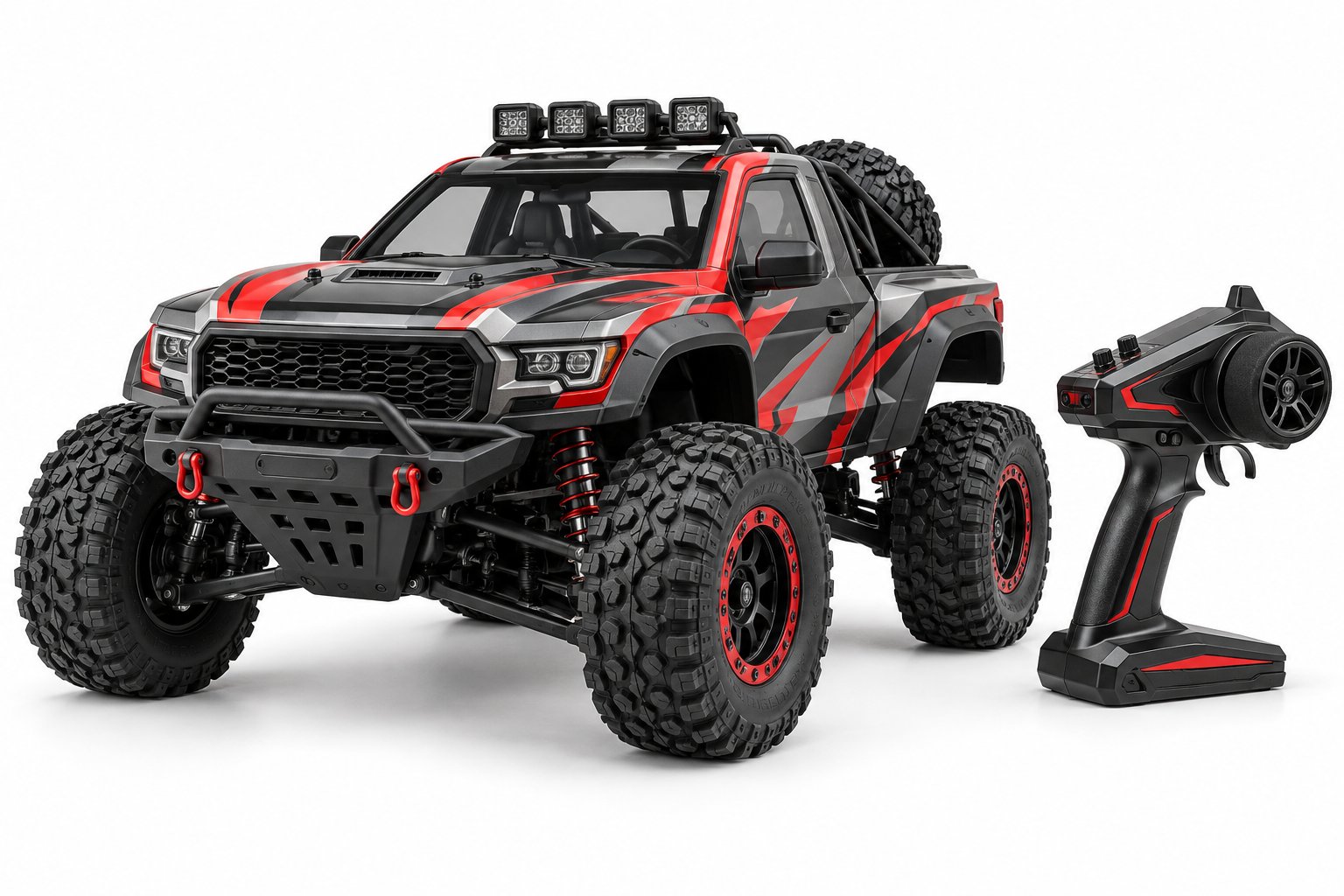
On an LC order for this model, the credit's goods description would typically read as the model name, the quantity in pieces and cartons, the unit price and the trade term. The packing list would mirror the carton count. The bill of lading would show the container or LCL shipment and the consignee. Test documentation would be listed only if the buyer requires it to travel with the documents rather than being shared earlier in the approval process.
The MOQ of 500 pcs is itself a useful reference point in the payment decision. It is a small enough lot that a first order can reasonably be run on a simpler term, and large enough that repeat programs can justify the administrative work of an LC. Buyers running multi-model programmes often split: LC for the main container, a simpler term for sample or reorder top-ups.
Where the order also involves artwork, packaging approval or age-grading decisions, those belong in the contract and in pre-production approval, not as conditions inside the credit. A credit condition that says "packaging approved by buyer" without defining who approves and by when invites a discrepancy that neither side wants.
When a letter of credit is the right payment term
LC terms earn their administrative cost in a predictable set of situations:
- A new supplier relationship at meaningful value. Both sides want a neutral mechanism: the buyer is not sending cash in advance, and the seller is not shipping on an open account promise.
- Regulatory or internal controls. Some buyers' finance or compliance functions require a documentary credit above a defined order value, or the destination country's rules make it the practical route.
- Cross-border risk that either party cannot absorb. Where currency, country risk or payment history makes a straight transfer unattractive, the bank undertaking carries the weight.
- Long or staged production runs. A credit can be structured around shipment windows that match a multi-container programme.
The cost side is real: bank charges on both ends, document preparation time, and the risk of discrepancy charges if the presentation is imperfect. Treat the LC as a tool with a price, and use it where that price buys risk reduction worth having.
When another payment term fits better
For many toy orders, a simpler arrangement is the better commercial choice. A telegraphic transfer with a deposit before production and the balance against a copy of the shipping document gives both sides a workable balance of risk at modest cost. Open account terms suit established repeat buyers with a payment history. Documentary collections — documents released against payment or acceptance — sit between the two, with less bank involvement than an LC.
| Payment term | Buyer's exposure | Seller's exposure | Administrative load |
|---|---|---|---|
| Deposit + balance by T/T | Deposit at risk if shipment fails | Balance at risk after shipment | Low |
| Documentary collection | Pays before release of documents | Goods shipped before payment | Moderate |
| Letter of credit | Pays only against complying documents | Paid on complying presentation | Higher |
| Open account | Receives goods before payment | Carries full payment risk until due date | Low, but risk-heavy for seller |
The right column is not a verdict — it is a trade-off. A buyer with a long relationship and a clean history may find open account or deposit terms cheaper and faster. A buyer opening a new category with a supplier they have not yet worked with may find the LC's structure worth the paperwork.
If you are weighing terms for an RC vehicle programme, the practical first step is to state the order shape — model, quantity, destination and required documents — and then agree the payment term that matches it. Our factory has operated since 2013 with 180 employees across a 12,000 m² facility, six production lines and a monthly capacity of 1.2 million pieces, and holds ISO 9001:2015 certification; those facts are relevant when your finance team asks how the production side is organised, but they do not by themselves decide the payment term.
Frequently asked questions
Does an LC guarantee the toys will be good quality?
No. The bank checks documents, not product. Quality is protected by your specification, pre-production approvals and inspection arrangements, which is why those belong in the contract and in the shipment inspection plan rather than in the credit's document list.
Can the credit cover more than one shipment?
Yes, a credit can be structured for partial shipments or a revolving arrangement, provided the credit states that explicitly. If the production plan is staged, say so when the credit is drafted.
What happens if the documents do not match?
The bank will typically raise the discrepancy and seek the buyer's acceptance or the exporter's correction. Either route costs time. Clear credit wording and a pre-shipment document check on both sides are the practical prevention.