EN71 is the European toy safety standard that sits behind the CE mark on toys sold in the EU. This article explains what the standard covers, how a manufacturer demonstrates compliance, and what importers, retailers and institutional buyers should verify in test reports and documentation before placing an order.
EN71 is the European standard that defines the safety requirements toys must meet before they can legally carry the CE mark and be placed on the EU market. If you import, distribute or buy toys for a nursery, kindergarten or retail shelf in Europe, EN71 is the document behind the claim you are relying on. This guide explains what the standard covers, how it connects to CE marking, how a manufacturer proves compliance, and what to check in the paperwork before you commit to an order.
Key takeaways
- EN71 applies to toys intended for children under 14 and is the standard most often cited when a toy is assessed against the EU Toy Safety Directive.
- The CE mark is the legal outcome; EN71 is the technical route a manufacturer typically uses to demonstrate that outcome.
- A compliance claim is only useful if you can trace it to a named standard, a specific product, a test date and an issuing laboratory.
- For wooden and outdoor toy lines, EN71 and ASTM F963 are the two compliance frameworks buyers most commonly request in a specification.
In this article
- What EN71 actually is
- How EN71 relates to CE marking
- What the standard covers
- How a manufacturer demonstrates compliance
- What buyers should check in a test report
- Documentation checklist before ordering
- FAQ for importers and institutional buyers
What EN71 actually is
EN71 is a European Standard for toy safety. It sets out the safety requirements and test methods used to assess whether a toy is safe for its intended age group. It is not a law in itself and it is not a certificate you buy once and keep forever. It is a technical standard that a testing laboratory applies to a specific product, and the result is recorded in a test report.
The distinction matters in procurement. When a supplier says a product is "EN71 compliant", the useful follow-up questions are: which parts of the standard were applied, to which product and batch, tested when, by which laboratory, and is the report still current for the version being shipped. Those answers are what turn a marketing phrase into a verifiable claim.
How EN71 relates to CE marking
The EU Toy Safety Directive is the legal framework. It requires toys placed on the EU market to meet essential safety requirements, and it requires the manufacturer to affix the CE mark once those requirements are met. EN71 is the harmonised standard that manufacturers typically follow to show they have met those requirements for the majority of toy categories.
So the relationship is a chain, not a synonym:
- The directive sets the legal obligation.
- EN71 provides a recognised technical route to satisfy that obligation.
- Testing against EN71 produces evidence.
- That evidence supports the CE declaration and the CE mark on the product.
The CE mark is therefore not a quality badge and not a certification issued by an authority. It is a declaration by the manufacturer that the product conforms. EN71 test reports are the supporting evidence a buyer can request to judge whether that declaration is credible. For a closer look at the marking side, including who is responsible for the declaration and what has to appear on the label and packaging, see our breakdown of CE marking on toys: what it covers and what buyers should verify.
What the standard covers
EN71 addresses several distinct safety areas rather than one single property. For purchasing purposes, it helps to think in three broad groups:
Mechanical and physical properties
This part looks at hazards a child can encounter through normal use and reasonably foreseeable misuse: sharp edges and points, small parts that could present a choking hazard, pinch and crush points, accessible cords, stability, and the structural integrity of the toy under expected loads. For wooden toys this is where joint strength, surface finish and the size of detachable components are assessed. For outdoor play equipment, stability and load-bearing behaviour fall into the same conversation.
Flammability
This part addresses how a toy behaves when exposed to a small ignition source. It matters most where the toy contains textile, plush or other soft materials, and it is one of the reasons a mixed-material toy can generate a longer test programme than a single-material one.
Chemical safety
This part deals with the migration and content of restricted substances, including heavy metals and other substances that children could be exposed to through mouthing, skin contact or wear. For painted, coated or printed toys it is directly relevant to the paint and finish specification. Where a toy is intended for very young children, chemical requirements tend to be examined more closely than for a toy aimed at older age groups.
The standard is published in parts, and each part addresses a different hazard area. A test report should name the specific parts applied to your product rather than referring to "EN71" as a single blank label. Confirm with your supplier or testing laboratory which parts are relevant to the specific toy you are buying, since the applicable set depends on material, age grading and intended use.
How a manufacturer demonstrates compliance
Compliance is demonstrated through evidence produced before and during production, not through a logo on a catalogue page. In practice, a manufacturer following this route typically does the following:
- Defines the product against an age grade and intended use, because the applicable requirements follow from those decisions.
- Sends representative samples to a third-party laboratory for testing against the relevant parts of EN71.
- Receives a test report describing the product tested, the test methods applied and the results.
- Draws up the technical documentation and the EU declaration of conformity that support the CE mark.
- Applies the CE mark and the required warnings and age labels to the product and packaging.
- Maintains consistency in production so that the tested configuration is the one actually shipped.
Step six is where many sourcing problems originate. A report is only meaningful if the toy that arrives matches the toy that was tested — same materials, same paint system, same components, same construction. A change of paint supplier, a substituted fitting or a modified joint can put the shipment outside the scope of the original report.
Where in-house quality control fits in
An in-house quality lab does not replace third-party testing, and it should not be presented as if it does. Its value is different: it catches variation between production runs so that the shipped goods stay within the configuration that was tested. For buyers, in-house QC capability is worth asking about because it indicates whether the supplier can hold a specification over repeat orders rather than only on the first shipment.
What buyers should check in a test report
When a supplier sends a test report, read it as a document about a specific object, not as a general statement about the company. The following points catch most of the problems buyers encounter.
| What to check | Why it matters |
|---|---|
| Product identification | The model, item number or description should match the product you are ordering, not a similar item from the same range. |
| Applicant and manufacturer | Confirms who requested the test and whether it relates to the actual production site. |
| Standard and parts applied | Should name the specific EN71 parts used, so you can judge whether the relevant hazards were covered. |
| Test date and report version | An older report may predate a design, material or supplier change. |
| Laboratory identity | A named, identifiable testing body is verifiable; an unattributed summary is not. |
| Age grading stated | The tested age range should match the age range you intend to sell the product for. |
| Materials and components listed | Paint, coatings, textiles and detachable parts should correspond to what is actually used. |
| Result and any remarks | Note any conditions, exclusions or limitations the laboratory attached to the conclusion. |
A test report is not a certificate of approval for a product family, and it does not cover variants that were not tested. If you are buying several colourways or sizes, ask which configurations are named in the report and which would require separate assessment.
Documentation checklist before ordering
For importers, retail buyers and procurement teams sourcing for kindergartens or preschools, the practical verification step is a short document request. It is reasonable to ask for:
- The EN71 test report covering the exact item and configuration you are ordering.
- The EU declaration of conformity associated with that product.
- Confirmation of the age grading and the corresponding warning labels.
- The name and location of the testing laboratory, so the report can be checked independently.
- A statement of any changes to materials or components since the test date.
- If you also sell in the United States, evidence for ASTM F963, since the two frameworks are commonly requested side by side.
Ask these questions before the purchase order, not after the container has shipped. A supplier who can produce the documents quickly and match them to the ordered item is telling you something about how they manage repeat production.
An example: wooden and outdoor toy lines
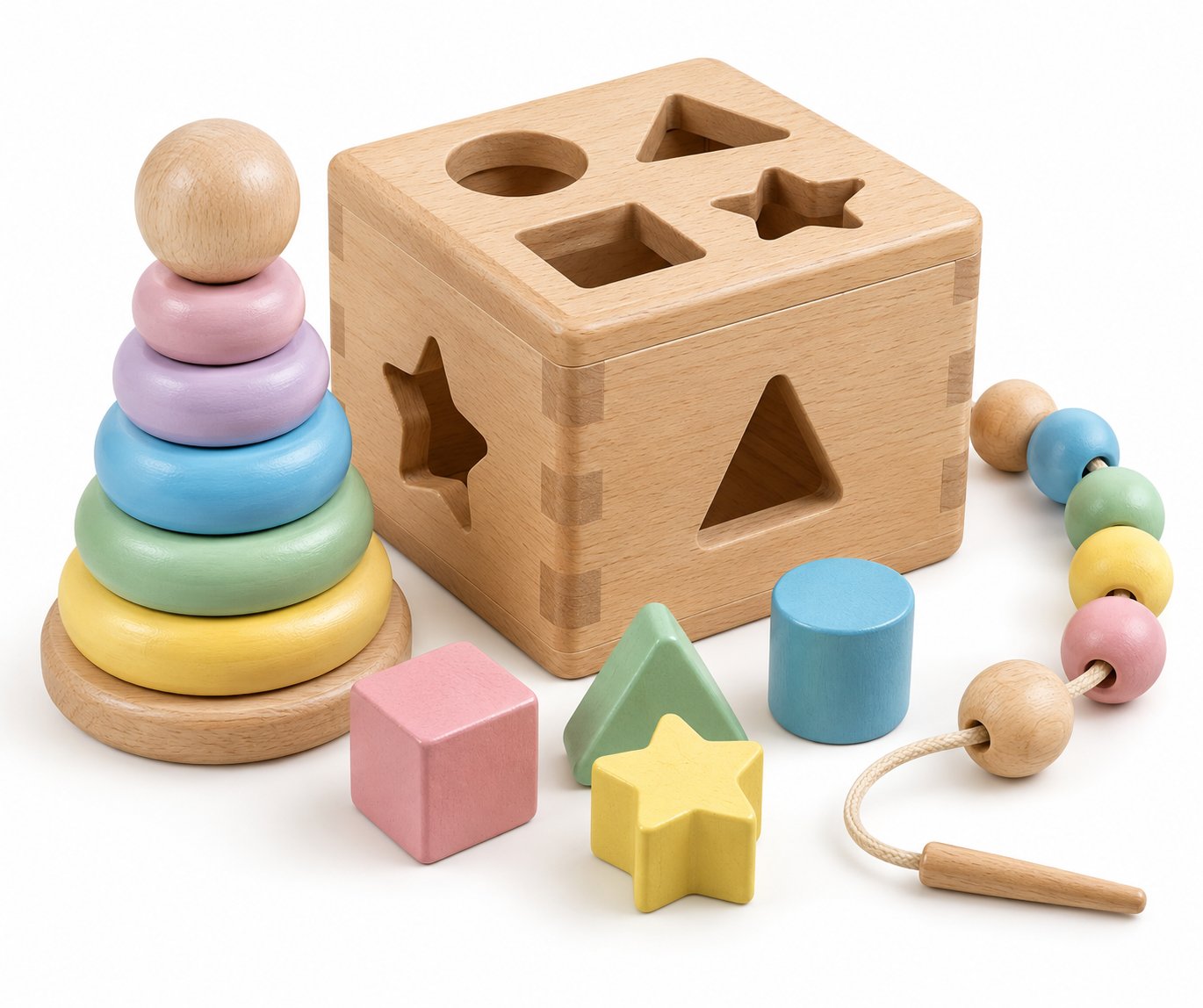
For wooden educational and outdoor ranges, compliance is normally specified at the line level. Our own wooden Montessori educational and outdoor toy lines are specified as EN71 and ASTM F963 compliant in their product specifications, and the company holds ISO 9001:2015 alongside EN71 and ASTM F963 certificates. OEM and ODM development is available, which means a new item can be taken through the same compliance route. An example of a line documented this way is the wooden Montessori educational toy set.
When you evaluate any supplier, including us, treat these as starting points for verification rather than conclusions. The documents above are the ones that let you confirm the claim for the specific item on your order.
FAQ for importers and institutional buyers
Is EN71 the same thing as CE marking?
No. CE marking is the legal marking required on toys placed on the EU market. EN71 is a harmonised standard used to demonstrate that the toy meets the safety requirements behind that marking. A CE mark without supporting test evidence is a claim without a basis you can check.
Does an EN71 report expire?
Reports are generally tied to a tested configuration rather than to a fixed expiry date, but they become unreliable if the product, materials, components or production site change. Review the test date against any design or supply changes you know about, and ask the supplier to confirm what has changed since testing.
Do I need EN71 if I also sell in the US?
EN71 addresses the EU market. The United States has its own framework, ASTM F963, which is why toy specifications often list both. If you distribute in both markets, request evidence for each separately.
Can a manufacturer self-declare EN71 compliance?
The manufacturer is responsible for the declaration. In practice, the credibility of that declaration depends on supporting test evidence from a laboratory. As a buyer, your verification step is to ask for the report and check that it matches the product you are ordering.
What if the supplier only sends a certificate image?
Ask for the underlying report and the declaration of conformity. A certificate image without product identification, test scope and laboratory details does not let you verify anything for the item on your purchase order.
Next step: if you are sourcing wooden educational or outdoor toys for the EU market, request the EN71 test report and declaration of conformity for the specific item you are considering, and compare them against the checklist above. New OEM and ODM items can be quoted through the same compliance process.