For retail and wholesale buyers, 'biggest' is a purchasing measurement with three different readings: scale ratio, body footprint, and packaged carton. Each one changes shelf space, display presence, pieces per carton, and freight weight. This article explains how to write the requirement on a purchase order so the quotation matches what you actually need.
The biggest RC truck in a catalogue is not the one with the largest box photo. For a buyer, “biggest” is a measurement decision with three separate readings: the scale ratio printed on the packaging, the physical footprint of the assembled truck, and the size of the colour box and export carton. Each reading drives a different cost and a different shelf plan. A truck that reads as large on a scale label can still be small on the shelf once its actual body dimensions are checked, and a truck that looks modest in a product photo can occupy more shelf depth than expected because of its height. The three readings do not always point to the same SKU, and the one you write on the purchase order decides everything downstream.
- Scale (for example 1:10 or 1:16) is a ratio notation, not a centimetre length. Ask for overall dimensions in centimetres.
- Body footprint (length × width × height) determines shelf depth, display presence, and planogram fit.
- Carton size and gross weight determine pieces per carton and volumetric freight cost; request both plus one filled sample carton.
- The purchase order should list length, width, height, carton quantity, carton dimensions and gross weight, packaging type, and MOQ.
Scale is a ratio, not a length
RC trucks are often labelled with a scale notation such as 1:10 or 1:16. That notation describes the relationship between the model and a reference vehicle, not a measurement of the model itself. Two trucks both marked 1:16 can have different overall lengths because the reference vehicle assumed by each brand may differ, and because body styling, bumpers, and roof accessories change the finished envelope. A 1:16 label does not tell a buyer how much shelf space the truck will take, how deep the shelf must be, or how many units fit on a planogram. It only says the model is a reduced representation of a full-size vehicle.
For purchasing, the scale notation is useful mainly as a category marker: it tells you roughly where a model sits relative to others in the range. It should not be used as the primary size spec. Instead, ask the supplier for the overall assembled dimensions in centimetres, measured from the longest points of the body, bumpers, and any fitted roof furniture. That measurement is what your shelf, your shipping carton, and your display plan actually react to.
Overall dimensions and shelf footprint
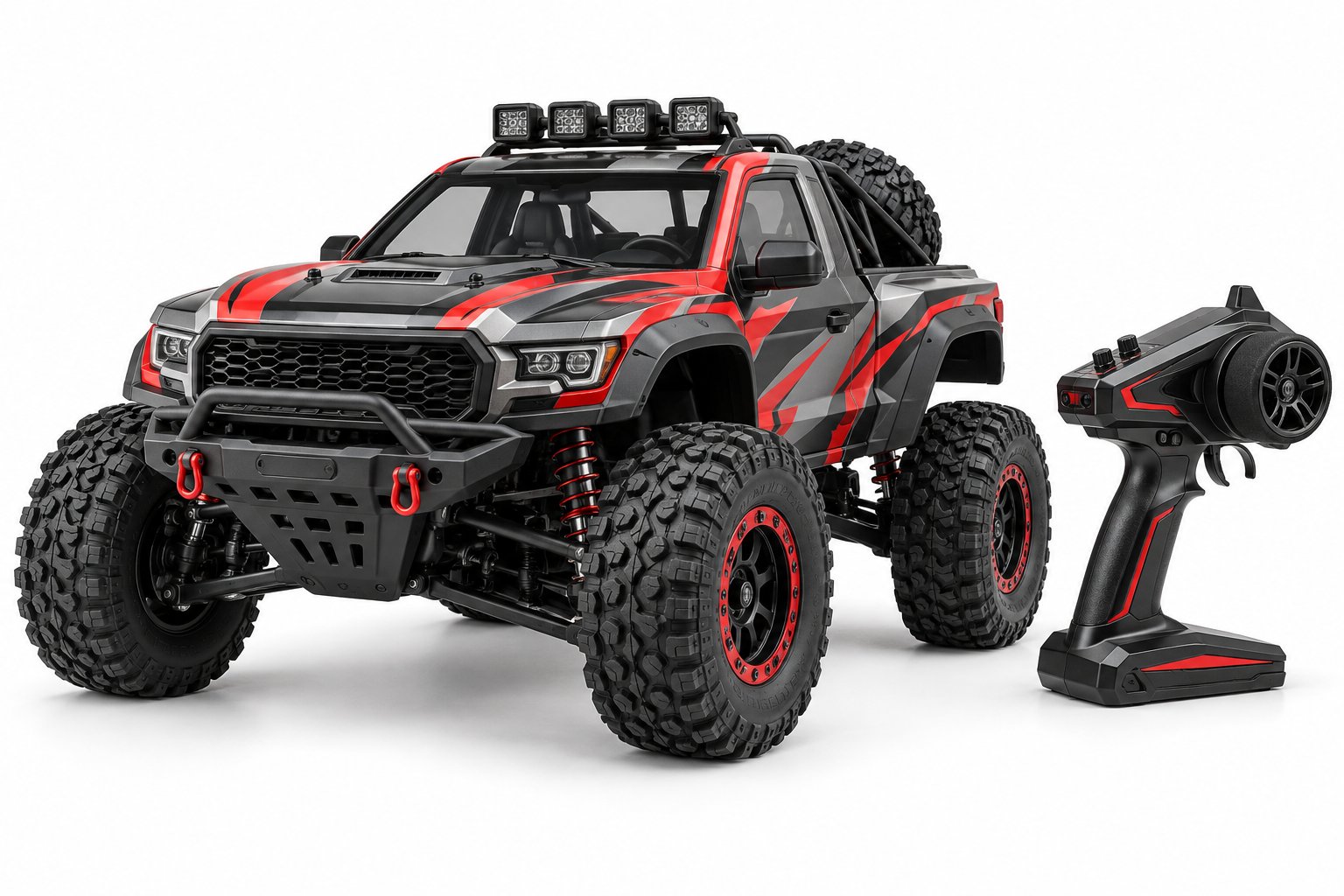
Body dimensions turn “biggest” into a number a retail buyer can act on. A usable spec line reads like this: 32 × 20 × 14 cm. That is the assembled length, width, and height of the 4WD RC Off-Road Truck with Independent Suspension for Gravel. For a shelf plan, the length and width set the footprint, while the height sets the vertical clearance needed on the shelf or in the display fixture.
Height deserves separate attention. In RC trucks, the height figure usually includes roof furniture such as a light bar, a roll bar, or a roof-mounted accessory. A buyer comparing two trucks with similar footprints but different heights may find that one fits under a shelf lip and the other does not. Ask the supplier whether the stated height is measured to the highest point of the body including roof items, and whether any of those items are removable for packaging.
Footprint also affects display presence. A longer, wider truck occupies more shelf depth and takes a more prominent position in a planogram, but it also reduces the number of facing positions available in the same shelf run. That trade-off is a merchandising decision, not a product defect; the point is to know the footprint before you commit to a display programme.
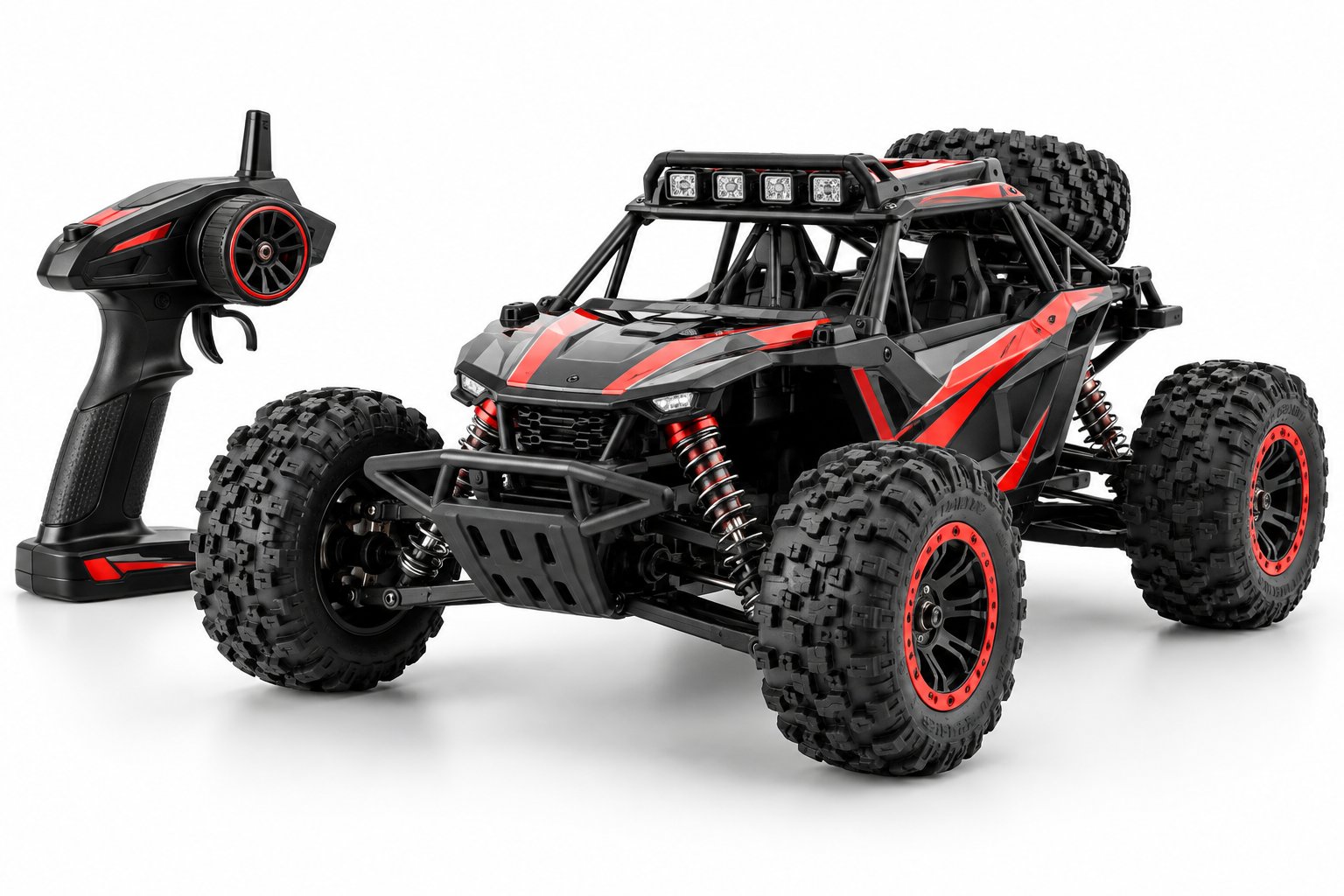
For a second reference point, the 2.4GHz Remote Control Off-Road Car for Gravel and Grass is supplied in a colour box with an export carton like the 4WD truck; its exact body dimensions should be requested in centimetres if they are not on the spec sheet. Treat any scale notation as a category label and always compare the centimetre figures.
The packaged layer: colour box, carton, and freight
Product dimensions are only half the story. The packaged layer is where “biggest” starts to affect cost. Both products above are supplied in a colour box, packed into an export carton at 16 pieces per carton. The colour box is the retail-facing unit; the export carton is the freight-facing unit. A larger colour box can improve shelf presence but may reduce the number of units that fit in a standard carton, or increase the carton size and gross weight. That change flows directly into freight cost.
Freight for cartoned goods is often charged on volumetric weight, which is a calculated weight based on the carton's length × width × height, not on the actual scale weight. The divisor used to convert volume into volumetric weight, and the rate applied to it, come from your own freight quote and your carrier's rules; they vary by mode, lane, and contract. What a buyer can control at the specification stage is the carton's outer dimensions and gross weight. Ask the supplier for both, and request one filled sample carton so you can measure the dimensions and weigh it yourself before the order is finalised. A filled sample carton also shows how the colour boxes are arranged inside, which affects how the carton will behave in a retail-ready or palletised programme.
If the carton is larger than your freight assumption, the effect appears as a higher chargeable weight on the quote, even if the product itself is light. That is why carton dimensions and gross weight belong on the purchase order alongside the body dimensions, not in a separate email after pricing.
Decision table: scale vs. footprint vs. carton
The three readings lead to different buying choices. The table below shows what each choice gives you and what it costs.
| Buying by | What it controls | What it costs the buyer |
|---|---|---|
| Scale ratio | Category position within the range; rough size impression for catalogue copy | Does not give a usable shelf measurement; two 1:16 trucks can differ in length; risk of over- or under-buying shelf depth |
| Body footprint (length × width × height in cm) | Shelf depth, height clearance, facing count, display presence | Larger footprint reduces the number of facings per shelf run and may require a deeper fixture; height may limit shelf lip clearance |
| Carton volume and gross weight | Pieces per carton (16 pcs), outer carton size, volumetric freight weight | Larger carton increases chargeable weight and may reduce units per pallet; smaller carton may reduce display presence per unit |
What to put on the purchase order or specification sheet
A specification-based order removes ambiguity. Use this checklist as the basis for the size and packaging section of the purchase order or spec sheet:
- Length, width, and height of the assembled truck in centimetres, with a note on whether height includes roof furniture.
- Carton quantity — for example 16 pieces per carton.
- Carton dimensions and gross weight of the export carton, plus one filled sample carton for verification.
- Packaging type: colour box for retail, or plain carton for programme or school supply, stated explicitly.
- MOQ — 500 pieces for the products referenced here; confirm the MOQ against the chosen packaging and any OEM or ODM request.
- Age range — 6+ years for both products, if your channel requires it on the label.
OEM and ODM are available on both products, so packaging and body variation can be discussed, but the requested dimensions should still be written in centimetres on the order so the quotation and the sample carton can be checked against the same figures.
Buyer FAQ
Is a bigger truck better for retail?
Not automatically. A larger body can improve display presence, but it also takes more shelf depth and reduces the number of facings in a fixed shelf run. The right choice depends on your planogram and on whether the truck is sold as a feature item or as a volume SKU. Compare footprint and carton quantity, not scale labels alone.
Does a bigger scale always ship dearer?
Not necessarily. Scale is a ratio notation, so it does not directly predict carton size or gross weight. Freight cost follows the carton's dimensions and gross weight and the volumetric rules in your own freight quote. A larger-scale model packed efficiently in a smaller carton can cost less to ship than a smaller-scale model in a bulky colour box. Ask for carton dimensions and gross weight for each SKU you are comparing.
Can a larger body be offered on the same platform?
That is an OEM/ODM question for the supplier. Both products referenced here are available for OEM and ODM, so body variation can be discussed, but the answer depends on the specific platform and the requested dimensions. State the target length, width, and height in centimetres, along with the carton quantity you need, so the supplier can confirm what is feasible before you commit to a shelf plan.
What is the minimum order for a custom packaging programme?
The MOQ is 500 pieces for the products referenced in this article. Packaging changes, such as a shelf-ready colour box versus a plain carton, should be confirmed against that MOQ when you request a quotation.
How should I compare two suppliers who both say “biggest”?
Ask both for the same three figures: assembled length × width × height in centimetres, carton quantity, and carton dimensions and gross weight. Then request one filled sample carton from each. Those are comparable facts; scale labels are not.
Next step: quote against your shelf and freight assumptions
Pricing is quoted against the specification, so the scale, body size, carton quantity, and packaging type you choose change the quotation. A buyer who needs a large-footprint display truck and a buyer who needs a compact carton for volumetric freight are not quoting the same item, even if both started by asking for “the biggest RC truck.”
Send your shelf dimensions, required carton quantity, packaging preference, and any freight assumptions you already have, and request a specification-based quotation against those figures. That gives you a price you can check against a sample carton and a planogram, rather than a price built on a scale label.