A buyer-side comparison of the four channels retailers and wholesalers use to source RC trucks and remote control cars — wholesale distributors, trade fairs, B2B marketplaces, and factory-direct OEM — with the trade-offs of each, a supplier-vetting checklist, and a look at what a factory-direct RC line actually contains.
Retailers and wholesalers searching for where to buy RC trucks usually are not choosing a toy — they are choosing a procurement route. This article compares the four channels that supply remote control cars to trade buyers, lays out what to verify before placing a first order, and shows what a factory-direct RC line looks like as one of those options.
Key takeaways
- Each channel — distributor, trade fair, marketplace, factory direct — trades a different mix of price, order flexibility, and control over the product.
- MOQ is the first filter for most importers, because it determines how much capital sits in stock before a single unit sells.
- Product compliance (EN71 / ASTM F963) and OEM/ODM availability decide whether a channel can support your own packaging and SKU strategy.
- A comparison table makes channel weights visible before you contact suppliers; the vetting checklist tells you what to confirm once conversations start.
On this page
Where to buy RC trucks: the four channels at a glance
Most importers test one channel first and then add a second. Before weighing channel features, recognize that the same sourcing channel can also supply remote control cars, and not every channel explains what it actually carries. Use the table below as a starting filter, then read the channel notes that follow.
| Channel | Typical buyer | MOQ flexibility | Control over packaging / logo | Compliance documents to expect | Main trade-off |
|---|---|---|---|---|---|
| Wholesale distributor | Retailer starting with mixed SKUs | Low, mixed cartons | None | Product safety files on request | Lowest MOQ, highest unit cost, no brand control |
| Trade fair | Wholesaler scouting ranges | Negotiable on site | Negotiable with manufacturers | Depends on each exhibitor | Fastest product comparison, seasonal cadence |
| B2B marketplace | Online-first seller | Wide range, from very low | Depends on supplier, often limited | Supplier-declared, must be verified | Widest supplier choice, hardest to verify |
| Factory direct / OEM | Importer building an own-brand range | Set by the factory (e.g. 500 units) | Full packaging and logo input | Compliance for the supplied model | Higher MOQ, better unit economics and brand fit |
The table describes channel behavior, not a specific supplier's terms. Confirm MOQ, packaging scope, and document versions for the exact model you plan to order.
Channel 1: Wholesale distributors
Wholesale distributors buy in bulk and resell mixed cartons, which is why they remain the first stop for retailers testing a toy category. If your goal is a few hundred units across several RC styles rather than one container of a single model, a distributor lets you start without committing to a factory.
- Pros: low entry quantity, quick availability, you can mix RC trucks with other toy categories in one order.
- Cons: unit price includes the distributor's margin; packaging and branding are fixed; product specs are often summarized, so you rarely see the full compliance file before ordering.
Ask for the model's parameter sheet and any safety documentation the distributor can share. If a question about MOQ, lead time, or compliance cannot be answered from the distributor's own file, plan to verify it at the source before repeating the order.
Channel 2: Trade fairs
A toy or consumer-goods fair compresses weeks of supplier research into a few days. You can pick up a physical sample, compare shell material and wheel construction side by side, and ask an engineer rather than a salesperson about the electronics.
- Pros: hands-on product assessment, direct contact with the manufacturer, and immediate clarity on whether a supplier actually makes the goods or only trades them.
- Cons: fairs run on a fixed calendar, so your sourcing window may not align; show-floor promises still need written confirmation; travel cost per qualified supplier is high.
Use a fair to shortlist, not to close. Collect the model sheet, the compliance statement, and the MOQ in writing, then compare the shortlist against factory-direct and marketplace options before deciding.
Channel 3: B2B marketplaces
Marketplaces give the widest supplier list and let you compare quotations without travel. They are also where supplier quality varies most, because listings are self-published.
- Pros: huge candidate pool, easy price comparison, MOQ is often listed up front, and many suppliers accept sample orders.
- Cons: a listing does not prove a manufacturer makes the product; certification claims need independent verification; you may be dealing with a trading company quoting a factory you cannot see.
Treat marketplace listings as leads, not as verified suppliers. The vetting checklist below works the same way whether the contact came from a marketplace, a fair, or a distributor.
Channel 4: Factory-direct and OEM/ODM sourcing
Going factory direct means ordering from the manufacturer that makes the RC trucks, usually with OEM/ODM options for packaging, logo, and — in the ODM case — adapted product features. This channel suits importers who have a stable retail or wholesale channel and want their own SKU rather than a generic carton.
- Pros: better unit economics at volume, control over packaging and branding, and a direct line for compliance questions and repeat production.
- Cons: MOQ is set by the factory (commonly 500 units for a model), you carry more inventory risk than with a distributor, and you are responsible for checking that the supplier's compliance documentation matches the model you order.
Factory-direct sourcing is not automatically the right answer for a first order. It becomes the better option when you already know which RC model sells, when branding matters, and when the MOQ fits your working capital.
Supplier-vetting checklist
Whichever channel produced the contact, verify the same set of items before paying a deposit.
Product and specifications
- Request the full parameter sheet for the exact model: scale, drive type, suspension, shell material, tire material, recommended age, control range, battery or battery type, and product dimensions.
- Order a sample and check it against the sheet — carton dimensions, actual product size, and control range are the items buyers most often find differ by model.
- For an RC truck with a rechargeable battery, confirm the charger type and battery specification in writing.
Compliance
- Ask which safety standard the model is supplied against — for toys sold into the EU, EN71; for the US market, ASTM F963 — and request the corresponding document for that model.
- Check that the document identifies the product and model you are ordering, not only the supplier's wider range.
- Confirm that age grading on the packaging matches the recommended age on the product data.
Commercial terms
- MOQ per model and per colorway.
- Whether OEM/ODM is available, and what exactly it covers (packaging, logo, manual, color, or product modification).
- Sample cost and sample lead time, quoted separately from production.
- Production lead time and the last order date before your peak selling season.
Packaging and carton data
- Unit carton dimensions and gross weight for freight calculation.
- Master carton quantity and dimensions.
- Retail-ready packaging options if your channel requires shelf display.
Supplier verification
- Ask whether the supplier manufactures the product or trades it, and ask for the production site if a factory audit matters to your business.
- Ask for two or three reference markets where the supplier already ships — even without names, the answer tells you whether your target market is routine for them.
- Compare the same model quoted through two or three channels before committing. The gap between distributor and factory-direct pricing explains what each channel charges for.
A factory-direct RC line, as one example
LequToys manufactures an RC toy line with OEM/ODM available and EN71 / ASTM F963 compliance for the models supplied. The range covers four product types, each with the specification that buyers most often ask about first.
| Model | Key specifications | MOQ |
|---|---|---|
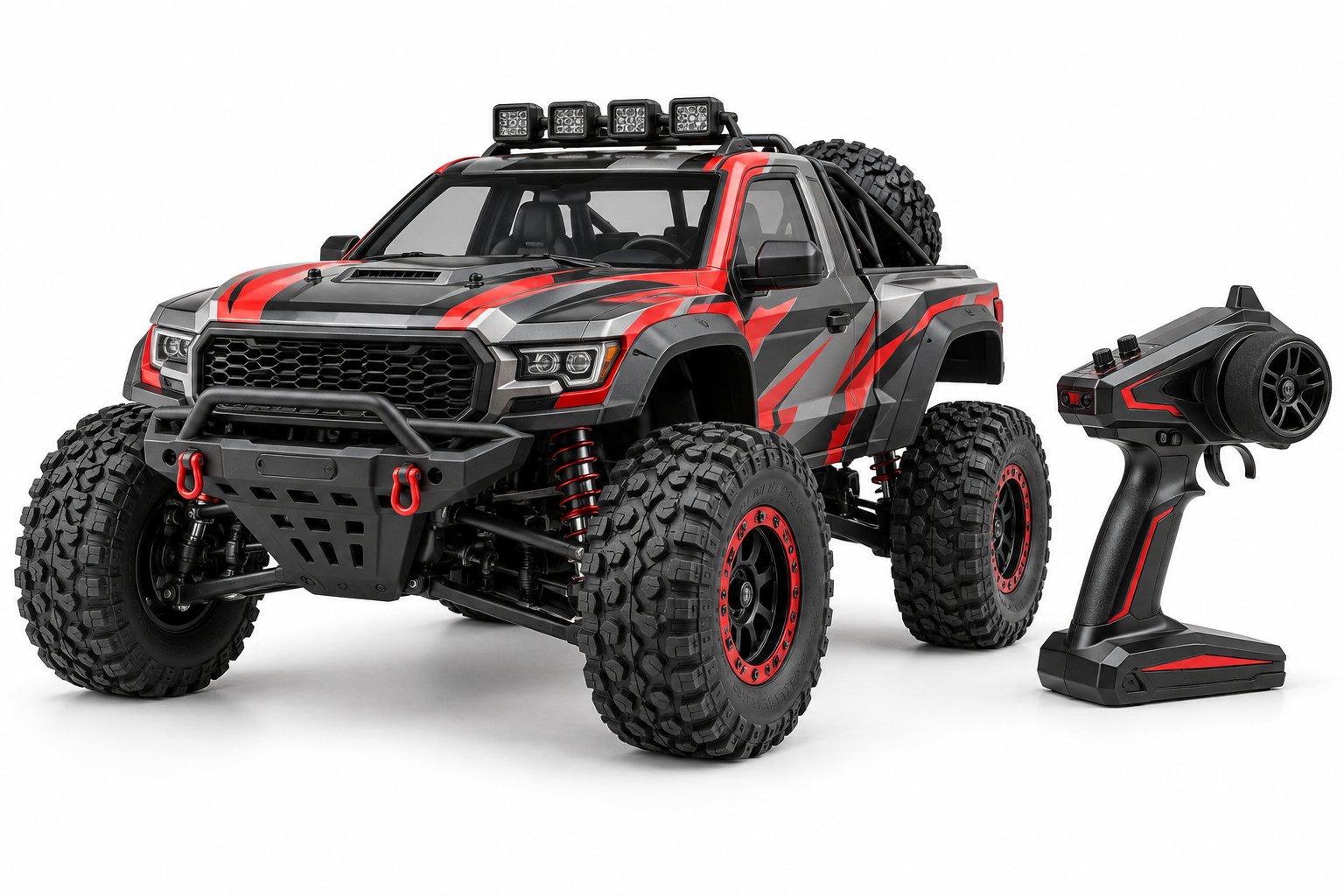
| 4WD RC Off-Road Truck | 4WD, independent suspension, ABS shell, rubber tires, ages 6+, control range up to 40 m, body 32×20×14 cm, 7.4V USB-rechargeable | 500 units |
| 4-Channel RC Stunt Car | 360° spin, control range up to 30 m, 24×16×9 cm, 3.7V USB-rechargeable | 500 units |
| RC Walking Robot | 2-channel, control range up to 15 m, 28 cm tall, ABS, 3×AA batteries | 500 units |
| Mini RC Drone | 720p camera, altitude hold, propeller guards | 500 units |
For a retailer assembling an RC planogram, these four models cover four different shelf positions: a durable outdoor truck, an indoor stunt car, a low-price walking robot, and an entry-level camera drone. The common MOQ of 500 units per model is the number to weigh against your first order budget; sample orders are the usual way to assess build quality before committing to a production run.
If you are comparing channels for an RC truck order, the product pages are the fastest way to check whether the specification and MOQ fit your program:
- 4WD RC Off-Road Truck
- 4-Channel RC Stunt Car with 360° Spin
- RC Walking Robot Toy
- Mini RC Drone with Camera
FAQ
Which channel has the lowest MOQ for RC trucks?
Wholesale distributors and B2B marketplaces usually quote the lowest entry quantity, often allowing mixed cartons. Factory-direct orders are set by the manufacturer; for the LequToys RC line the MOQ is 500 units per model. Lower MOQ usually means a higher unit price, so compare total landed cost rather than unit price alone.
Where can I buy remote control cars with my own packaging?
OEM/ODM sourcing is the channel that covers custom packaging and logo. Availability depends on the supplier and model — confirm with each supplier whether OEM applies to packaging only or also to product changes, and what the associated MOQ is.
Is EN71 or ASTM F963 required for RC toy imports?
Which standard applies depends on your destination market: EN71 for toys sold into the EU, ASTM F963 for the US. Ask the supplier for the compliance document covering the exact model you order, and confirm the age grading on the packaging matches the product data.
How do I compare a distributor quote with a factory-direct quote?
Get both quotes for the same model and compare MOQ, unit price, packaging ownership, compliance documents, and lead time side by side. The channel with the lower unit price may not be cheaper once branding, documentation, and inventory risk are included.
Channel choice is a working-capital decision as much as a price decision. Start with the channel that matches your order size, verify the specification and compliance files for the exact model, and scale the channel once the SKU proves itself. For the LequToys RC line, the four product pages above list the specifications and MOQ needed for that first comparison.