Beach ball unit prices are not published rates — they move with size, material, printing, valve quality, order quantity, and packaging. This guide breaks down what actually decides your bulk cost and how to get an accurate quote.
Bulk Buying Guide
If you are searching for a straight dollar figure for a beach ball, the honest answer is that there is no single price. A beach ball is built to a specification, and that specification — size, material, printing, valve, quantity, packaging — is what sets your unit cost. This guide explains exactly which decisions move the number, so you can brief a supplier and get an accurate quote instead of a guess.
Key takeaways: Beach ball pricing is driven by six specification levers plus order quantity. Two balls that look identical in a photo can quote very differently once panel count, material thickness, and valve type change. Confirm every figure directly with your supplier against a written specification.
What this article covers
Why There Is No Fixed Beach Ball Price
Unlike a commodity screw, a beach ball is a printed, assembled, inflatable product. Every element can be specified differently, and each choice adds or removes cost. A supplier cannot quote responsibly without knowing the answers, which is why serious manufacturers ask a set of specification questions before they send a price rather than publishing a number.
This matters for retailers, distributors, schools, and event organizers because the same visible product can be quoted at meaningfully different levels depending on build quality. A lower quote often reflects a thinner material, fewer printed panels, or a cheaper valve — not simply a better deal. Understanding the drivers helps you compare quotes on equal footing instead of comparing a budget build against a premium one.
The Factors That Actually Move Unit Cost
When you request a bulk beach ball quote, these are the variables your supplier will price against. Each one is a decision you control.
Size and Diameter
Beach balls range from small hand-held sizes to large promotional formats. A larger ball needs more material per unit and produces fewer units per meter of sheet or film, so material cost rises with diameter. Larger balls also take more space in a shipping carton, which affects freight and per-unit logistics cost. Size is usually the first thing to fix in your specification because it changes almost everything downstream.
Material: PVC Gauge vs. Fabric
The two main construction routes are PVC and fabric-based builds. Within PVC, thickness (often expressed as a gauge) is a direct cost lever: thicker panels resist punctures and hold air longer but use more material. Fabric constructions behave differently again, with different durability and hand-feel characteristics. If your buyers expect a ball to survive an entire outdoor season rather than a single event, that expectation should be written into the specification, because it changes the material grade your supplier quotes.
Number of Printed Panels
A beach ball is assembled from panels, and the number of printed panels determines how much printing area and assembly work the product needs. More printed panels generally means more print setup, more color coverage, and more seams. A design that wraps around more panels will cost more than a simple one- or two-color print on fewer panels. If your artwork can be adapted to a lower panel count, that is a legitimate way to reduce unit cost without sacrificing the look.
Printing Method
Screen printing, transfer printing, and full-color digital or heat-transfer methods differ in setup cost and per-piece cost. Methods with higher setup charges tend to be economical at large quantities but expensive on small runs, while simpler methods suit short promotional orders. The right method depends on your artwork complexity, your colors, and your order quantity. Ask your supplier how each method affects both the sample and the bulk price, because the trade-off is not linear.
Valve Quality
The valve is a small component with an outsized effect on buyer satisfaction. A quality valve inflates quickly, seals reliably, and resists leaking after repeated use. Cheaper valves can be a hidden cost: returns, complaints, and lost repeat orders. When comparing quotes, ask what valve type is included — a premium valve may carry a modest cost difference that pays for itself in fewer defects and better end-user experience.
Assembly, Sealing, and Quality Control
Panel alignment, seam sealing, and inspection are labor-dependent steps. Tighter tolerances and stricter inspection standards raise the labor content per unit but reduce the rate of defective balls in your shipment. For B2B buyers, the relevant question is not whether defects exist, but what acceptance standard the supplier applies and how that standard is reflected in the quote.
| Cost driver | What raises the cost | What lowers the cost |
|---|---|---|
| Size / diameter | Larger format, more material, more carton space | Smaller format within your use case |
| Material | Thicker PVC gauge, fabric builds, UV-resistant grades | Thinner gauge for short-life promotional use |
| Printed panels | More panels, more colors, wrap-around artwork | Fewer panels, simplified artwork |
| Printing method | High setup methods on small runs | Method matched to artwork and volume |
| Valve | Premium sealing and durability | Basic valve for one-off events |
| Inspection standard | Stricter AQL, more labor per unit | Relaxed standard (check with your market) |
| Order quantity | Short runs, frequent changeovers | Volume orders that amortize setup |
| Packaging | Retail color boxes, custom cartons, inserts | Bulk export cartons only |
How Order Quantity Changes Your Unit Cost
Every beach ball quote includes fixed costs — artwork setup, print setup, tooling or plate charges, and production changeover time. These costs are spread across the units you order. A small order carries the same setup burden over fewer pieces, so the per-unit cost is higher. As quantity grows, that fixed overhead is diluted and the unit price falls.
This is why a supplier cannot give you the best price for a small trial order and a full production run at the same time. The practical approach is to tell your supplier the real quantity you intend to buy, plus your potential annual volume if you expect repeat orders. Volume commitments often unlock better pricing and smoother scheduling.
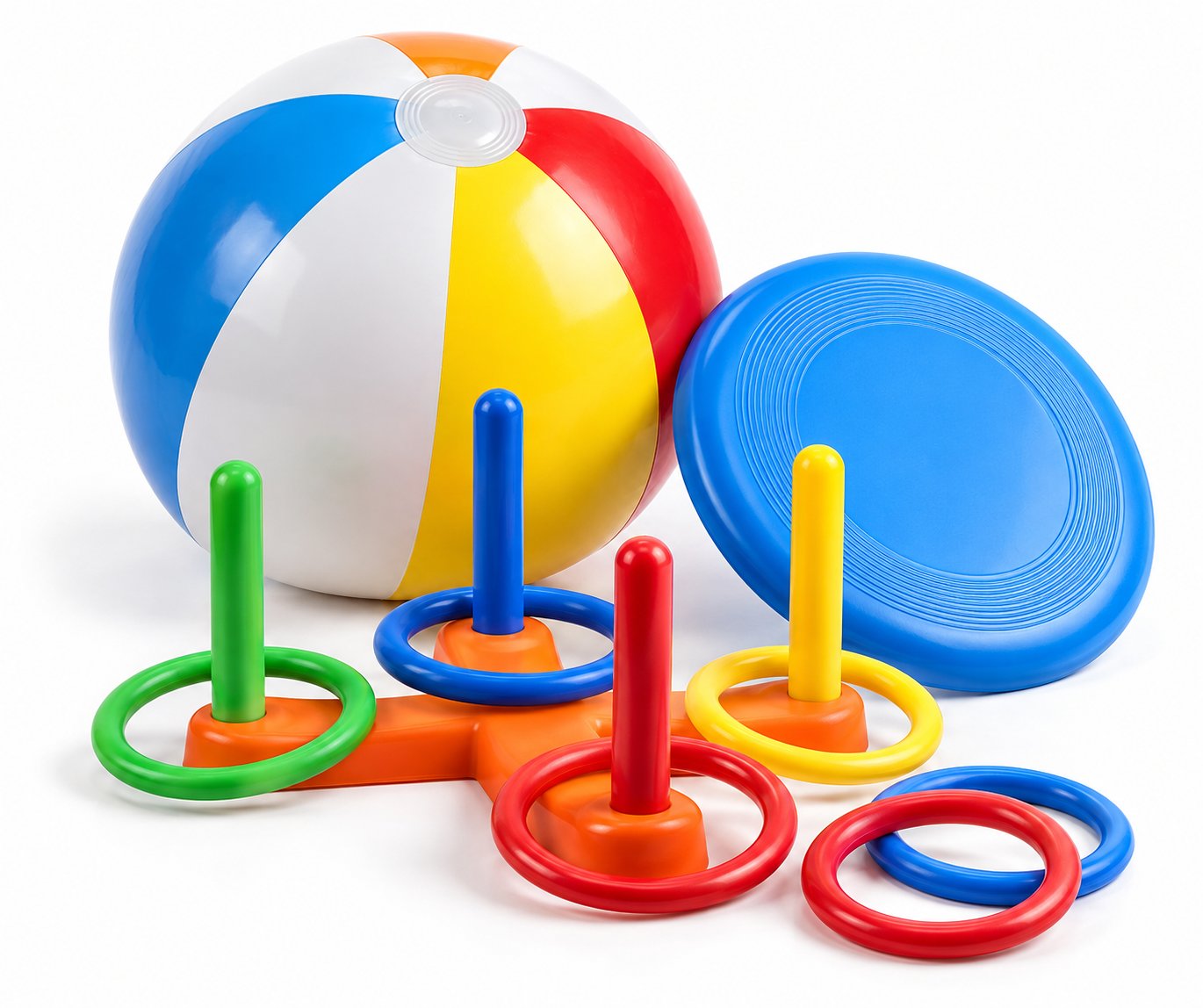
Beach balls are frequently bundled with other outdoor items rather than ordered alone. One example is the Outdoor Sports Set with Beach Ball and Ring Toss for Group Play, which combines a beach ball, flying disc, and ring toss in a single set. That set is made from weather-resistant plastic and fabric, is suitable for ages 3 and up, has a minimum order quantity of 500 sets, ships in a color box plus export carton, and is compliant with EN71 and ASTM F963, with OEM/ODM available. If you are sourcing a multi-item outdoor program, a set-based order is worth comparing against separate single-item orders, since the set is packed and shipped as one unit.
Note on timing: Unit price is only part of your landed cost. Carton dimensions, units per carton, and packing method determine how much you pay for freight, so always ask for packing details alongside the unit price.
Packaging and Compliance Costs
Packaging is a specification decision with a direct cost. Bulk export cartons cost less per unit than retail-ready color boxes with printed artwork and inserts. If your channel requires retail packaging, that cost should be quoted explicitly rather than assumed.
Compliance is another factor. If your market requires toy safety testing — for example EN71 in Europe or ASTM F963 in the United States — the product must be built and documented to meet those standards. Testing, documentation, and compliance-ready materials all carry cost, and they should be built into the quote from the start. Retrofitting compliance after production is far more expensive than specifying it upfront. Always confirm with your supplier which standards the specific product and configuration have been tested against.
How to Get an Accurate Quote
The fastest way to receive a usable price is to send a complete specification. Suppliers who receive vague briefs either guess or come back with a list of questions, which costs you time. Prepare the following before you ask for pricing:
- Size and diameter: the finished inflated diameter you need.
- Material preference: PVC gauge or fabric construction, and expected lifespan.
- Artwork details: panel count, number of colors, and whether your design can be adapted.
- Quantity: the exact order quantity plus expected annual volume.
- Packaging: bulk export carton or retail packaging, and any labeling requirements.
- Compliance: the standards your destination market requires.
- Delivery terms: EXW, FOB, or another Incoterm, and your destination port.
With those details, a supplier can quote accurately and you can compare offers that describe the same product. If you receive a quote without a specification attached, ask for one — two prices for "a beach ball" are not comparable.
Understanding the production process helps you specify better
Buyers who understand how panels are cut, printed, and sealed tend to write tighter specifications and get more accurate quotes. For a detailed walkthrough, see how a beach ball is made inside the factory. If you are still deciding where to buy rather than what to buy, the guide to how retailers source beach balls covers sourcing channels and what to check at each stage.
Buyer FAQ
Why can't I find a published price list for beach balls?
Because the product is customizable on multiple dimensions at once. Size, material, printing, valve, packaging, and quantity all change the cost, so a single published figure would be misleading. Suppliers provide quotes against a confirmed specification instead.
What is the minimum order quantity?
MOQs vary by product and supplier. For reference, the Outdoor Sports Set with Beach Ball and Ring Toss has a minimum order quantity of 500 sets. For individual beach balls, confirm the MOQ with your supplier, as it depends on the chosen specification and printing method.
Does a lower quote always mean a better deal?
No. A lower quote may reflect thinner material, fewer printed panels, a basic valve, or a relaxed inspection standard. Compare quotes against an identical written specification so you are comparing build quality, not just numbers.
Can I order a sample before committing to bulk?
Sampling terms depend on the supplier and the customization involved. Ask about sample cost, lead time, and whether sample charges are credited against your bulk order.
Are custom designs and private labeling possible?
OEM and ODM options are commonly available for outdoor toy products, including custom printing and branding. Confirm the scope of customization — artwork, packaging, labeling — with your supplier before production.
Ready to price your beach ball order?
Send your specification — size, material, panel count, quantity, packaging, and target market — and we will respond with a quote based on your actual requirements. The more detail you provide, the more accurate the price.
Include your destination port and required Incoterm so we can quote delivered terms as well as unit cost.