A straightforward category definition for retailers, importers, and preschool buyers: what makes a toy educational, the four main types, how they differ from ordinary toys, and the compliance and sourcing facts that matter before you shortlist suppliers.
Educational toys are toys designed so that a specific kind of learning happens while the child plays. The learning target can be a physical skill, a thinking skill, or a practical life skill, but it is chosen deliberately rather than left to chance. "Learning toys" is the same category under a different name, and buyers searching either term are looking for the same products.
For retailers, importers, and preschool or kindergarten purchasers, the definition matters commercially. It separates products that carry age, material, and compliance requirements from general novelty toys, and it determines how you brief a supplier, what documentation you ask for, and how the product is merchandised on shelf.
Key takeaways
- An educational toy has a defined learning purpose, not merely a licensed character or a flashing light.
- Four main types dominate B2B assortments: construction/STEM, Montessori-style practical skills, puzzles and sorting, and threading/fine-motor toys.
- Age grading, material choice, and compliance (for example EN71 and ASTM F963) are part of the product definition, not separate paperwork.
- The same wooden shape sorter and the same plastic building set can be bought as category fill or as a curriculum-linked SKU; the specification changes accordingly.
What makes a toy educational
Three characteristics do most of the separating work.
A stated learning objective
The toy is built around a skill the child is expected to practise. A stacking toy with graduated rings targets size comparison and hand control. A 120-piece interlocking building set targets spatial reasoning and cooperative planning. Both come with a purpose the buyer can name on a shelf label or in a catalogue line.
Open-ended or progressive play
Educational toys usually allow more than one correct outcome, or they increase in difficulty as the child develops. A shape-sorting box has a fixed goal, but a construction set with beams, plates, wheels, and connectors lets the same pieces become a bridge, a cart, or a tower. Progressive play extends the useful life of the SKU, which matters directly to your stock turn.
The purchase decision is made by an adult
Parents, teachers, and institutional buyers select these products against a learning goal, an age band, and a safety standard. That is why the category behaves more like a considered purchase than an impulse toy buy, and why specification sheets, age marking, and test reports carry weight at the point of sale.
The four main types of educational toys
Most serious educational ranges are assembled from four families. They overlap at the edges, but each answers a different buying question.
Construction and STEM sets
These are building systems: beams, plates, wheels, and connectors that press together without tools. They are the most common way retailers address STEM merchandising because one SKU supports individual and group play. A representative example on our own line is the STEM Building Blocks Set, a 120-piece ABS set for age 4+ with press-fit assembly, BPA-free plastic, EN71 and ASTM F963 compliance, MOQ 500 sets, and OEM/ODM options.
Montessori-style practical-skill toys
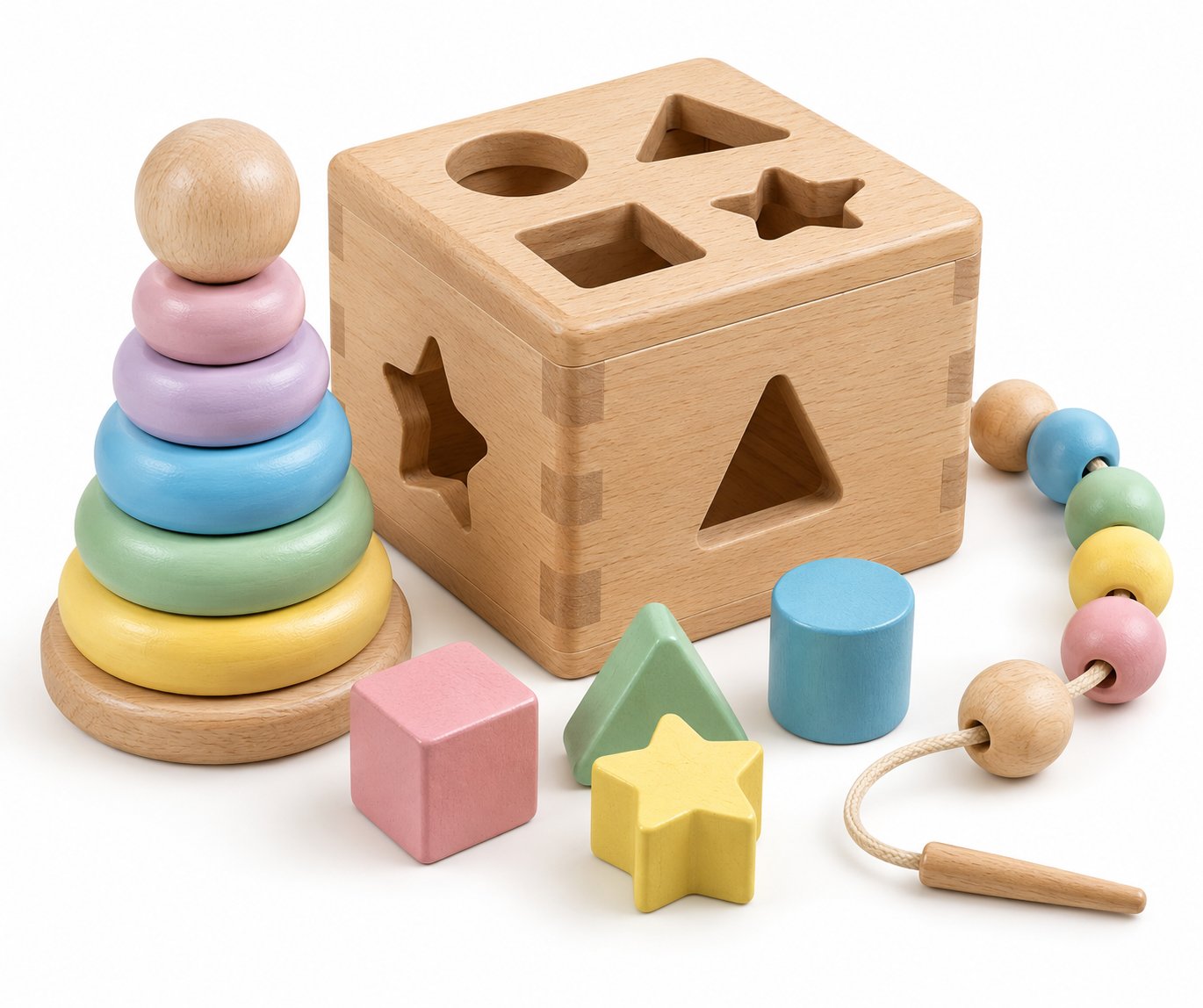
This group concentrates on real-world actions: sorting, stacking, transferring, and manipulating everyday shapes. Wood is the traditional material because it gives weight, grip, and a muted finish that keeps attention on the task. Our Wooden Montessori Learning Set combines a shape-sorting box, stacking toys, and a threading toy in smooth child-safe wood with a non-toxic finish, age 3+, EN71 and ASTM F963 compliance, MOQ 500 sets, and OEM/ODM options.
Puzzles and sorting activities
Puzzles, peg boards, and sorting trays work on classification, matching, and problem sequencing. They are the easiest category to explain to a non-specialist shopper, which makes them strong entry-level assortment items. At the sourcing level, the questions are piece count, piece size relative to the age band, and how the puzzle stores after use.
Threading and fine-motor toys
Lacing beads, threading boards, and similar items develop the finger control that precedes writing. They are frequently bundled with Montessori-style sets because the same buyer group purchases both, and because a threading element adds perceived value without changing the target age band.
| Type | Typical material | What it develops | Buyer consideration |
|---|---|---|---|
| Construction / STEM | ABS plastic | Spatial reasoning, group planning | Piece count, press-fit strength, age band |
| Montessori-style practical skills | Smooth wood, non-toxic finish | Independence, size and shape discrimination | Surface finish, edge safety, age marking |
| Puzzles and sorting | Wood, board, or plastic | Matching, classification, sequencing | Piece count, storage format, shelf footprint |
| Threading / fine motor | Wood beads, cords, boards | Finger control, hand-eye coordination | Cord safety, bead size versus age band |
What distinguishes educational toys from ordinary toys
The difference is not always visible on the shelf, so it is worth stating plainly for buying teams.
- Purpose over novelty. An ordinary toy is built to entertain; an educational toy is built to a learning outcome. Novelty features such as sound or light are optional, and are often omitted in Montessori-style products.
- Age grading is functional. Age 3+ on a wooden set and age 4+ on a building system reflect small-part and assembly considerations. When you consolidate an assortment, keep the age band consistent across the range you present to one retail channel.
- Material is part of the specification. Child-safe wood, non-toxic finishes, and BPA-free ABS are selling points for teachers and parents. They also drive tooling, unit cost, and test scope.
- Compliance is assumed, not negotiated. Buyers in Europe and North America expect EN71 and ASTM F963 compliance as a baseline. Ask prospective suppliers for test documentation covering the specific SKU, not a generic certificate.
- Adult guidance is implied. These products are often bought with a lesson or activity in mind, which creates room for instruction sheets, curriculum cards, and classroom-pack formats.
How this definition changes your sourcing brief
Once you accept the definition, three items move to the front of the supplier conversation.
- Learning objective and age band first. Tell the supplier which of the four types you want and at what age. This determines whether the answer is a wooden shape sorter or a 120-piece plastic construction set, and whether group play is in scope.
- Material and compliance second. Specify the finish and the standard, then request documentation for the exact SKU you will buy. Our own sets are EN71 and ASTM F963 compliant at the product level, which is the level you need to verify.
- Commercial terms third. MOQ 500 sets applies across both products described above, with OEM/ODM available. Confirm whether your requirement is private label, custom colourway, or a standard catalogue SKU before pricing is discussed.
If you are building a range rather than a single line, two further articles on this site go deeper: How to Choose Educational Toys: An Age-by-Age Checklist covers band-by-band selection, and What Are Montessori Toys? A Complete Guide for Retailers and Preschool Buyers explains the Montessori sub-category in detail.
FAQ
Is "learning toys" the same as "educational toys"?
Yes. The two terms describe the same category and are used interchangeably by buyers. The only practical difference is search wording, so there is no need to maintain separate product definitions for each.
Are all wooden toys educational?
No. Wood is a common material in Montessori-style and sorting products, but material alone does not make a toy educational. The learning objective and the way the toy is played with determine the category.
Which certifications should I ask for?
For Europe and North America, EN71 and ASTM F963 are the usual references. Request the test report that covers the exact product and age band you are purchasing. If a supplier cannot tie documentation to the specific SKU, treat that as an open item to confirm before ordering.
What MOQ should I expect?
It depends on the supplier and the product. For the two sets described above, MOQ is 500 sets, and OEM/ODM is available. For other products, confirm the figure in writing rather than assuming it carries across the range.